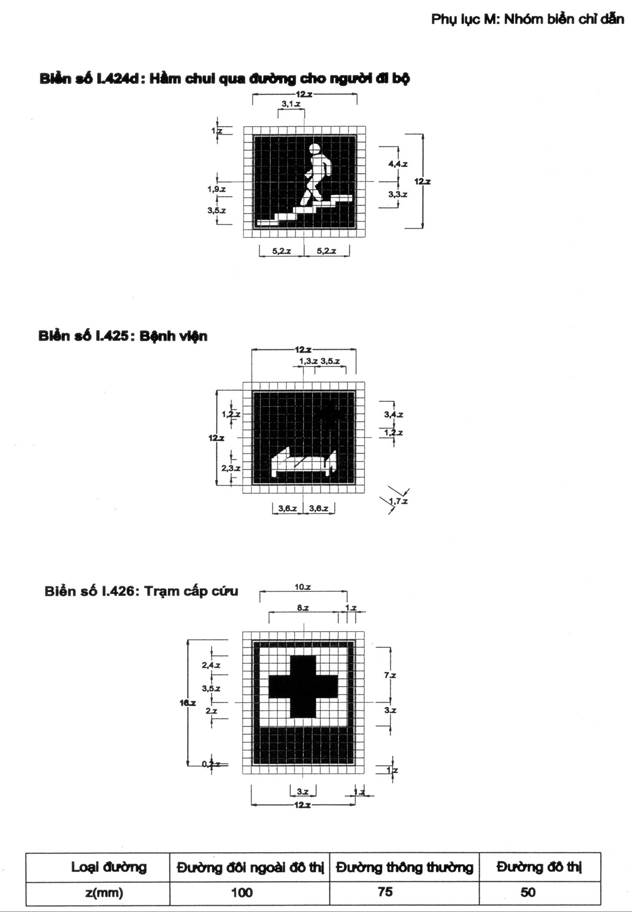
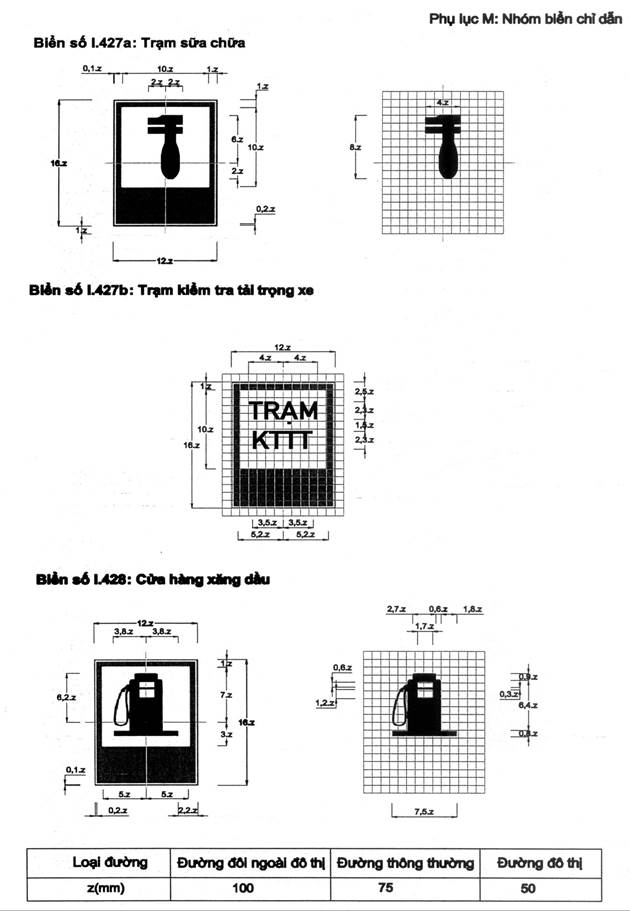
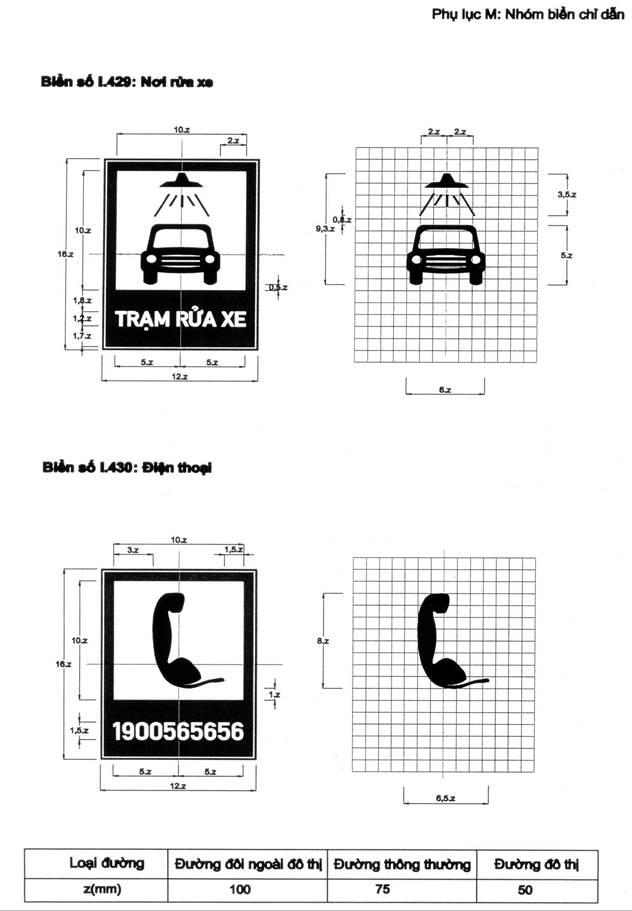
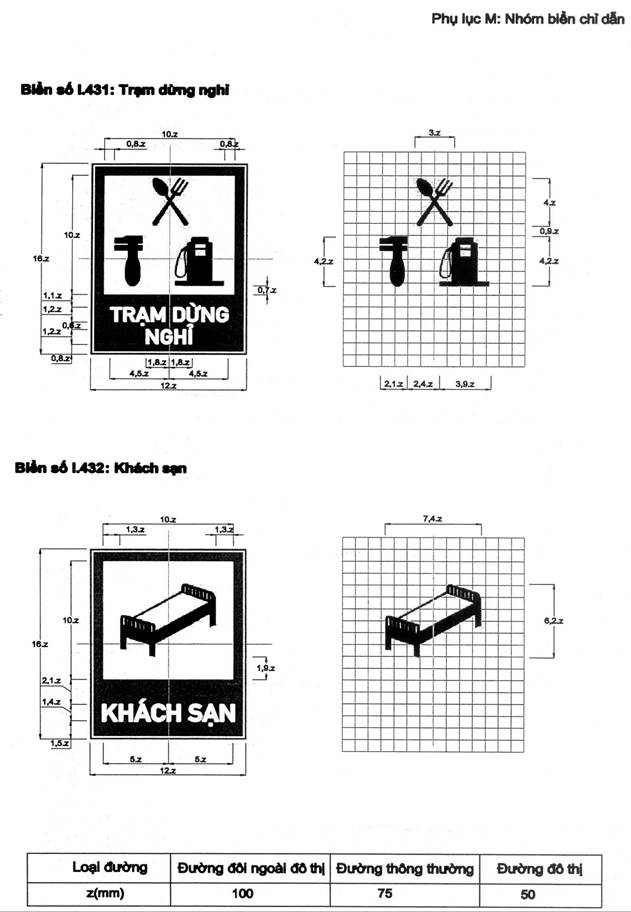
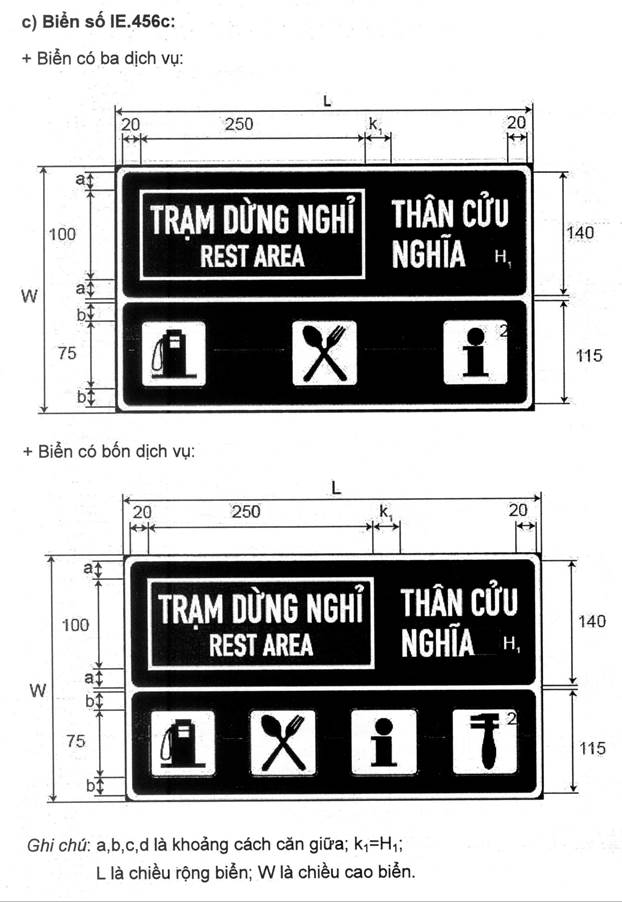
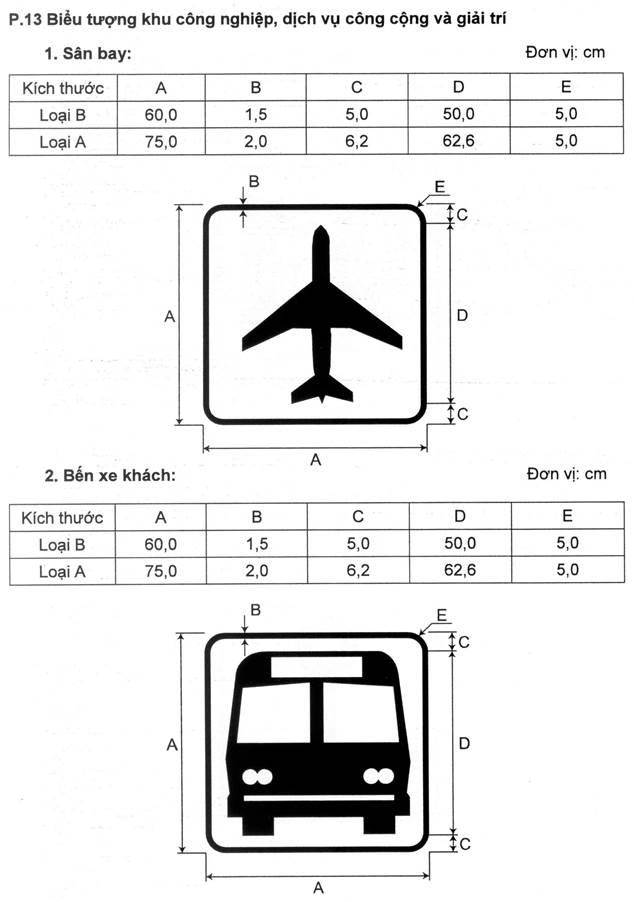
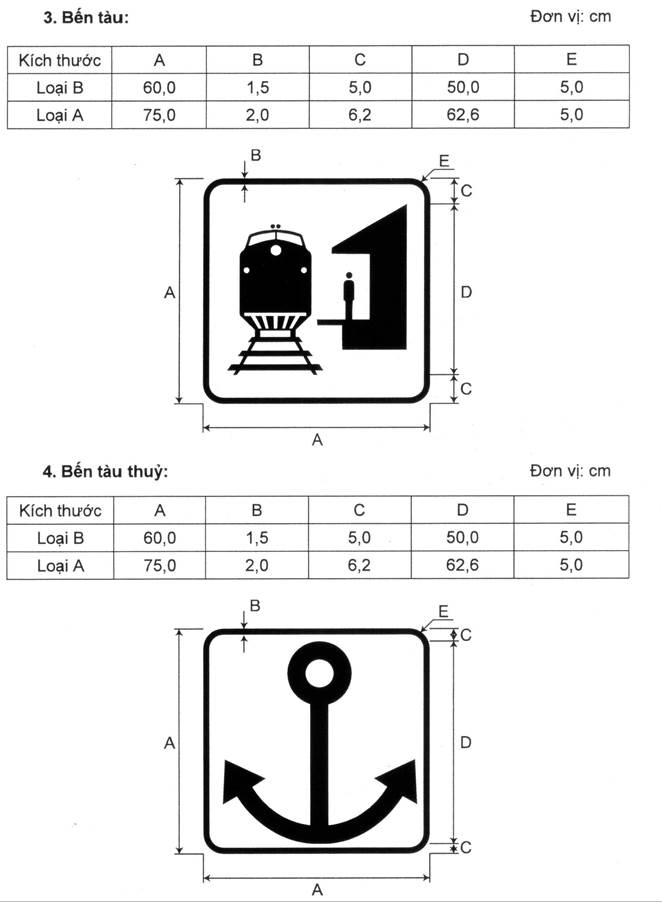
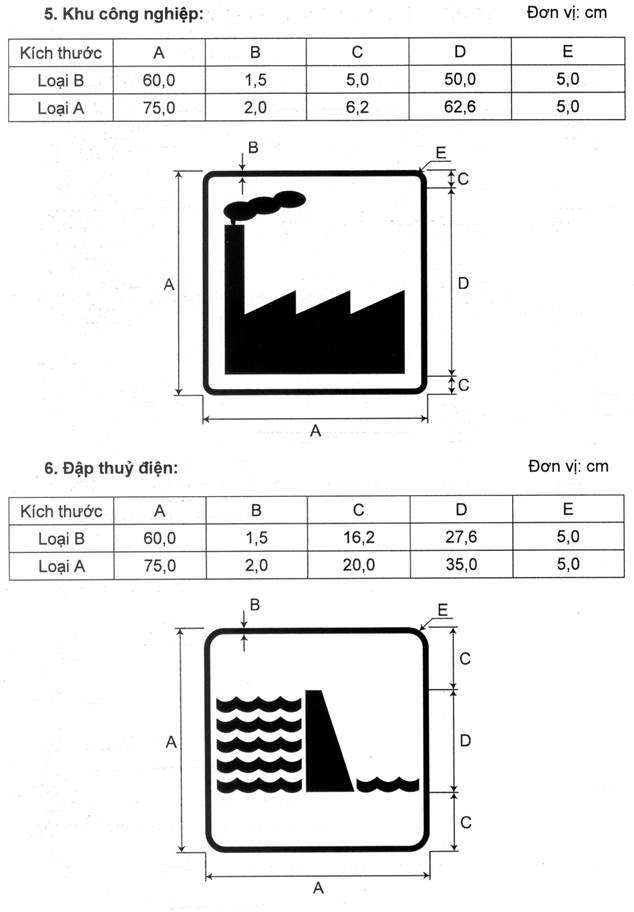
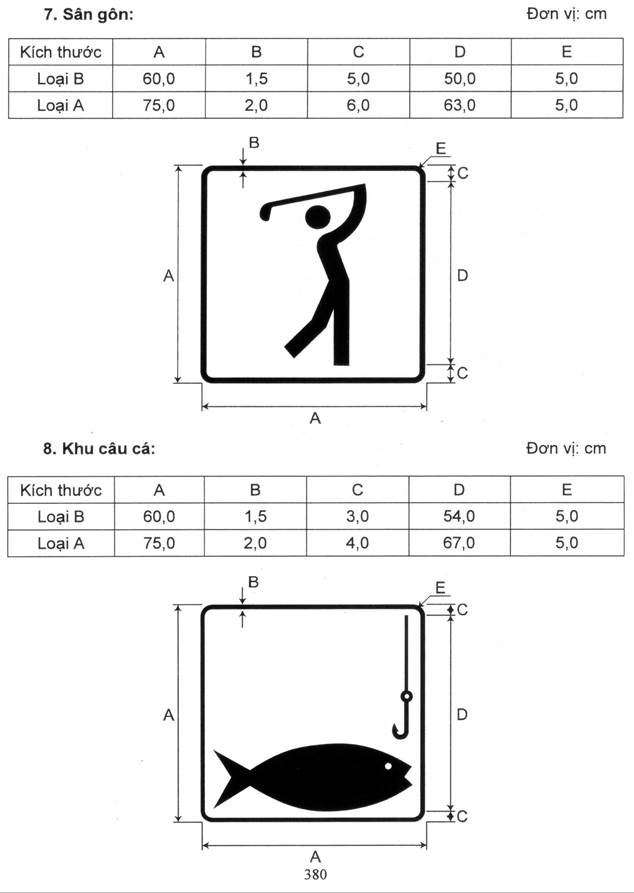
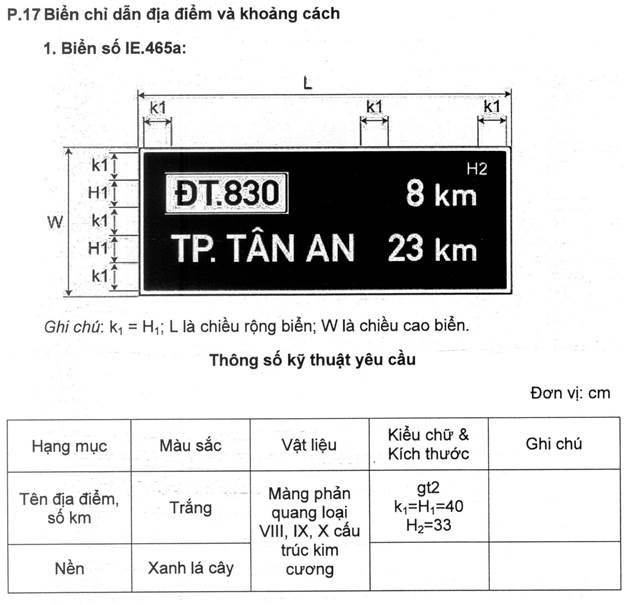
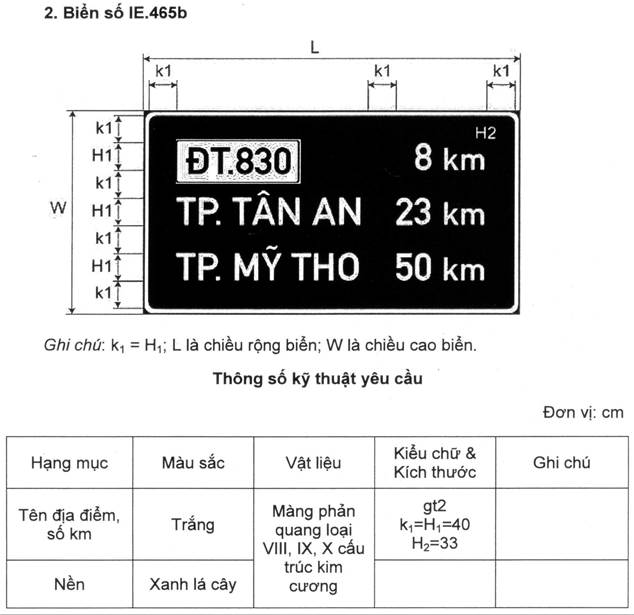
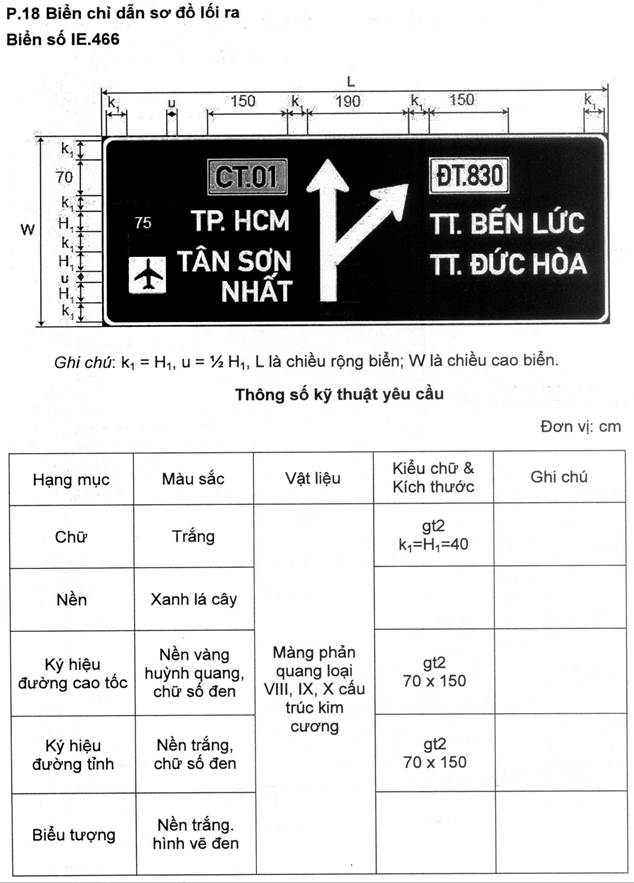
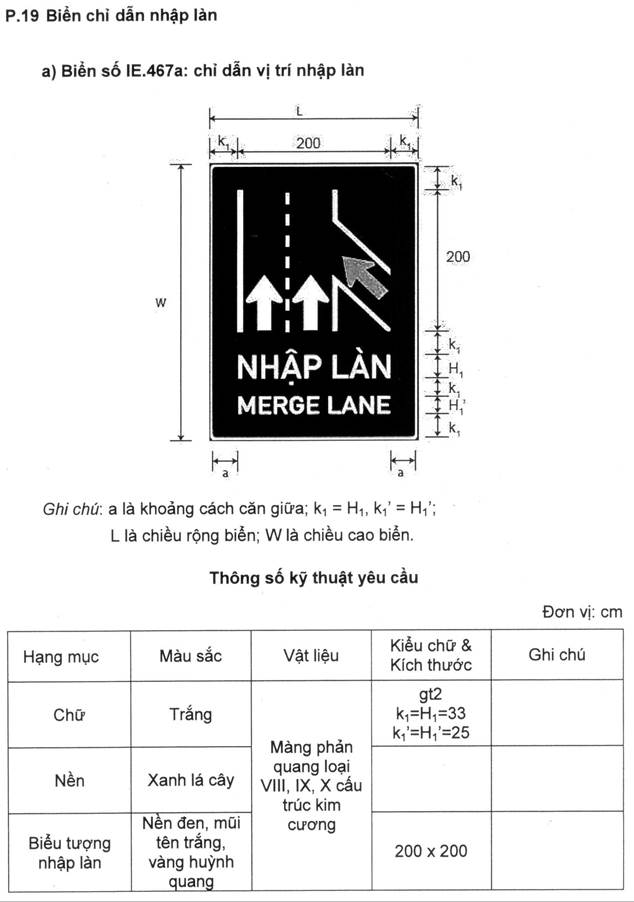
NATIONAL TECHNICAL REGULATION ON TRAFFIC SIGNS AND SIGNALS
Foreword
The National Technical Regulation QCVN 41:2019/BGTVT is compiled by Directorate for Roads of Vietnam, appraised by Ministry of Science and Technology, and promulgated by Minister of Transport under Circular No. 54/2019/TT-BGTVT dated December 31 of 2019. The National Technical Regulation QCVN 41:2019/BGTVT replaces the QCVN 41:2016/BGTVT.
TABLE OF CONTENTS
|
Part 1: General provisions |
|
|
Part 2: Technical regulations |
|
|
|
Chapter 1 - Order of application of traffic signals and order of road priority |
|
|
Chapter 2 - Traffic signals |
|
|
Chapter 3 - Traffic signs |
|
|
Chapter 4 - Prohibitory signs |
|
|
Chapter 5 - Warning signs |
|
|
Chapter 6 - Signs giving orders |
|
|
Chapter 7 - Information signs on non-expressway road |
|
|
Chapter 8 - Supplementary signs and text-only signs |
|
|
Chapter 9 - Information signs on expressway |
|
|
Chapter 10 - Road markings |
|
|
Chapter 11 - Traffic cones, reflective markers, protective walls, and barriers |
|
|
Chapter 12 - Milestone kilometer markers, H markers |
|
|
Chapter 13 - Right-of-way markers |
|
|
Chapter 14 - Traffic prohibitory signs |
|
|
Chapter 15 - Convex mirrors, dividers, and crash barriers |
|
Part 3: Management regulations |
|
|
Part 4. Organizing implementation |
|
|
Appendix A - Light signals |
|
|
Appendix B - Interpretation - Use of prohibitory signs |
|
|
Appendix C - Interpretation - Use of warning signs |
|
|
Appendix D - Interpretation - Use of signs giving orders |
|
|
Appendix E - Interpretation - Use of information signs |
|
|
Appendix F - Interpretation - Use of supplementary signs |
|
|
Appendix G - Interpretation - Use of road markings |
|
|
Appendix I - Milestone kilometer markers - H markers - Right-of-way markers |
|
|
Appendix K - Size of text and numerals on signs |
|
|
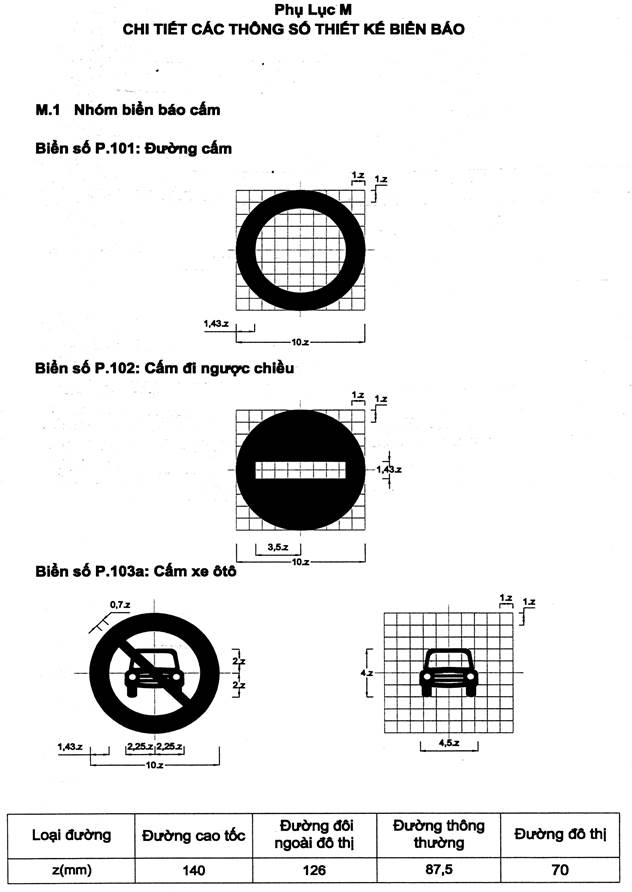
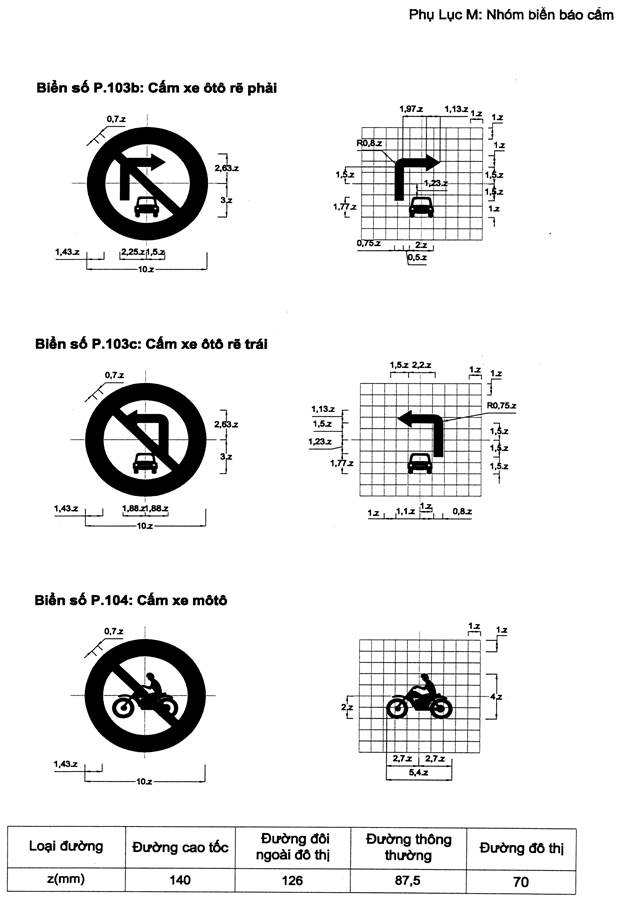
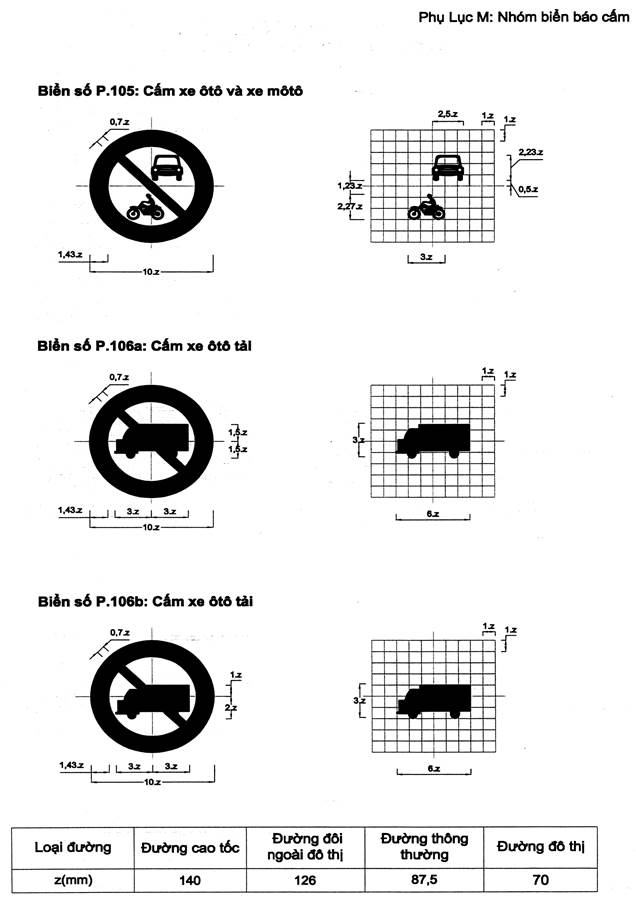
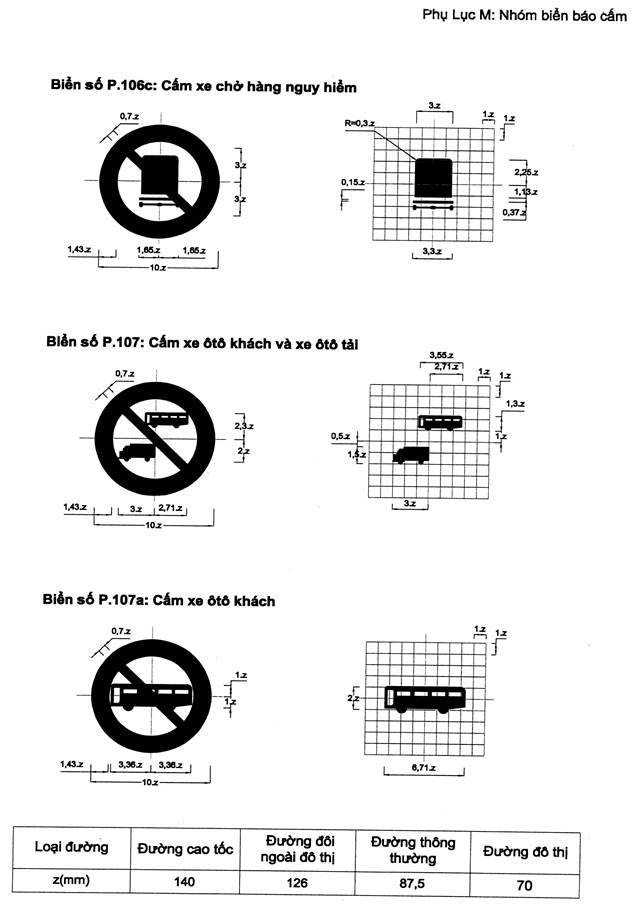
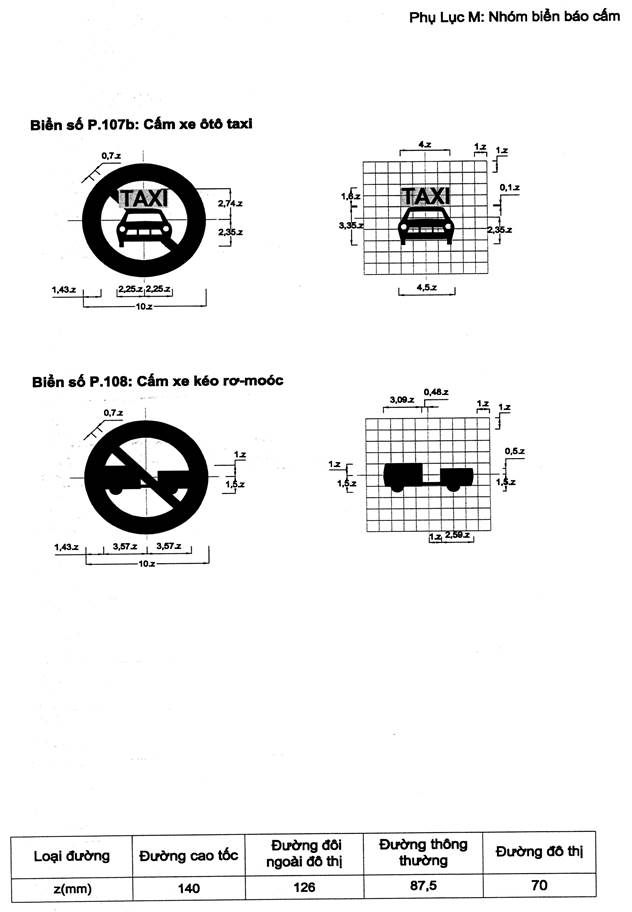
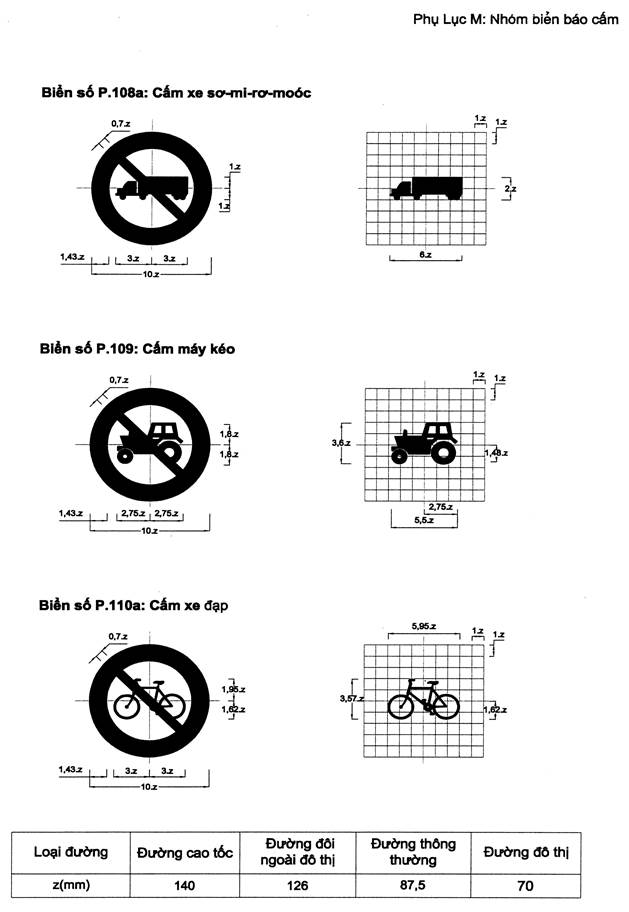
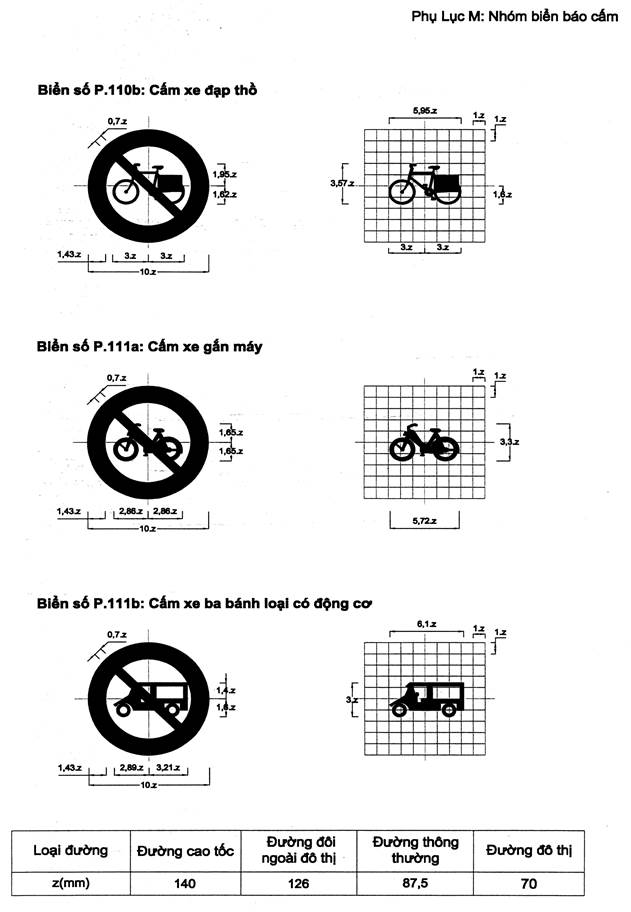
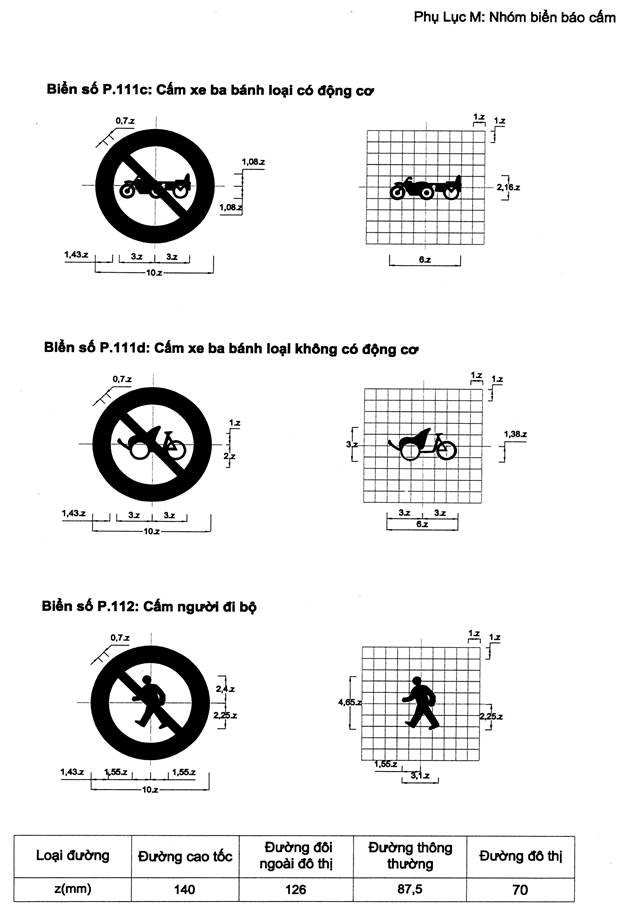
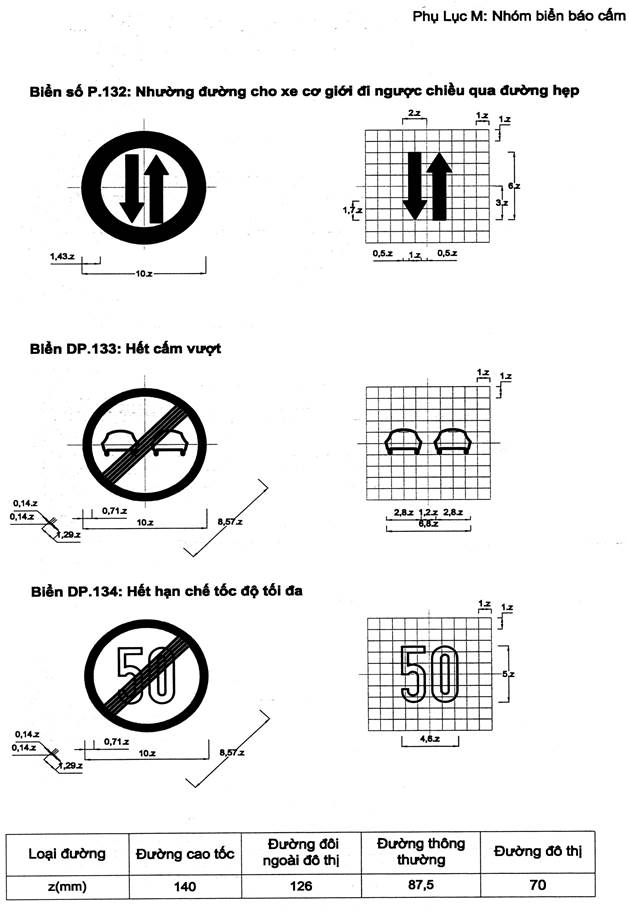
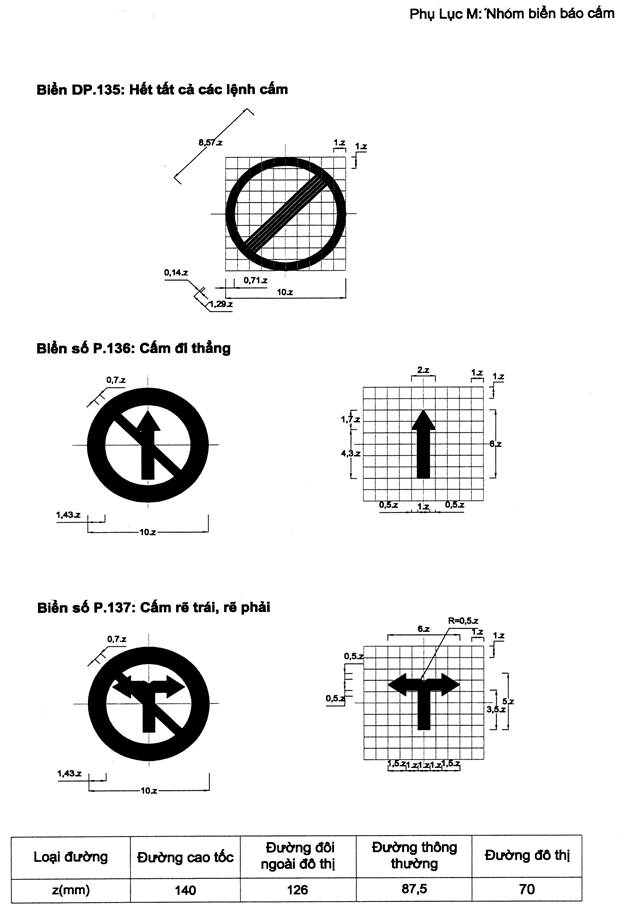
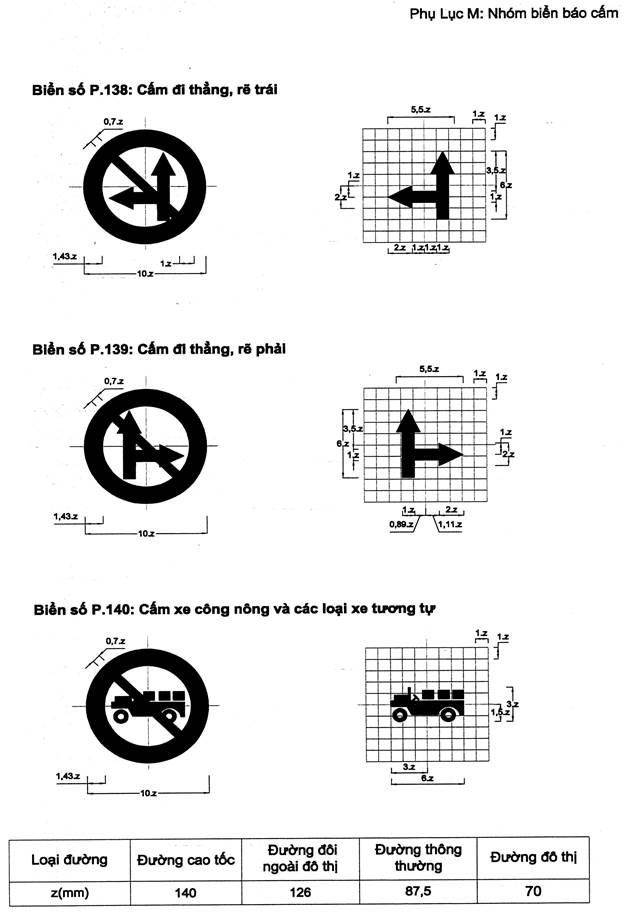
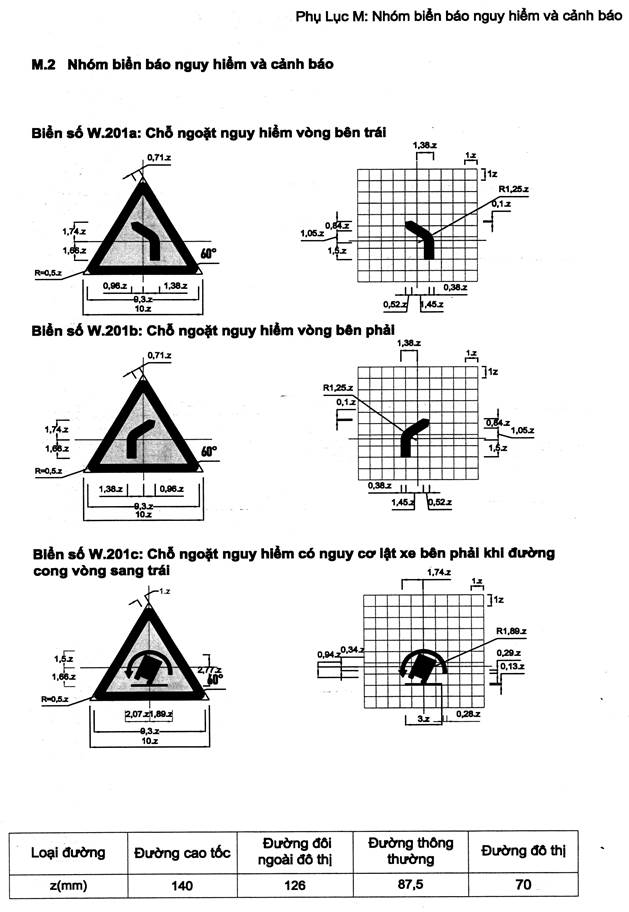
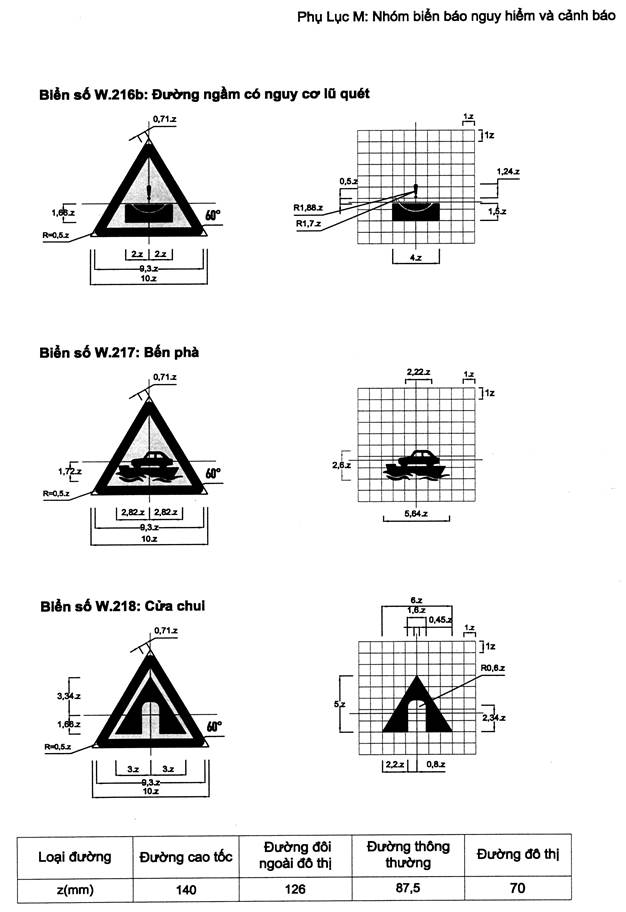
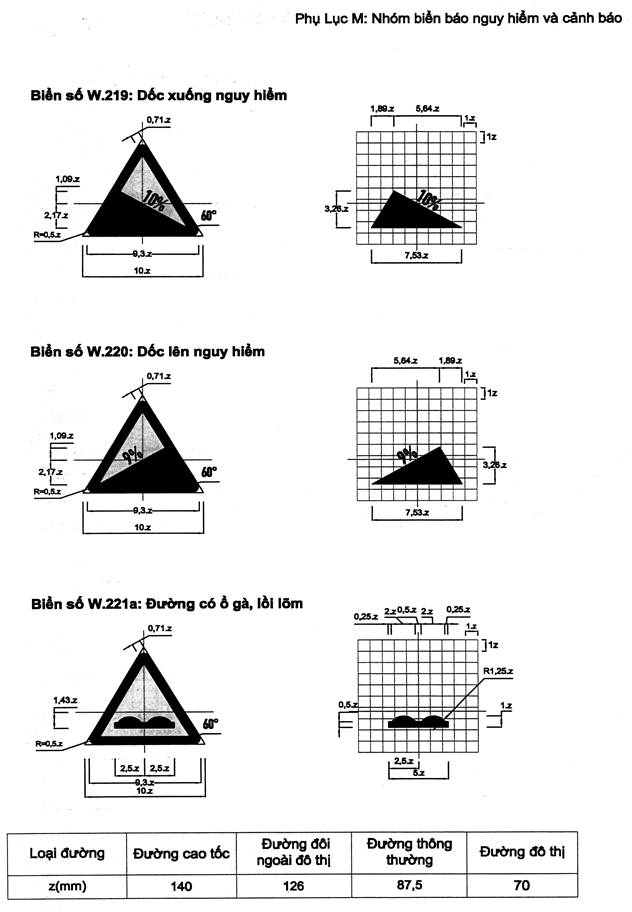
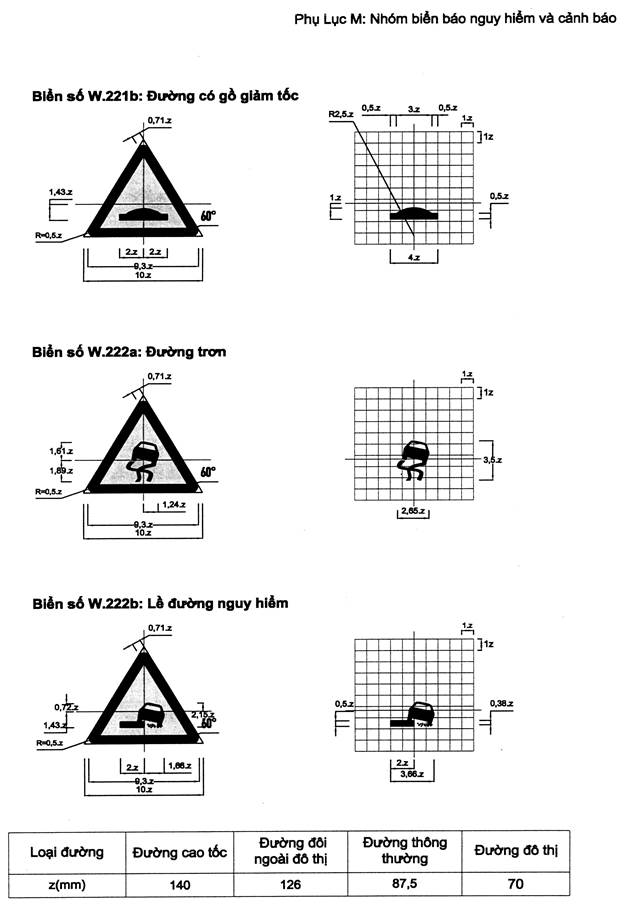
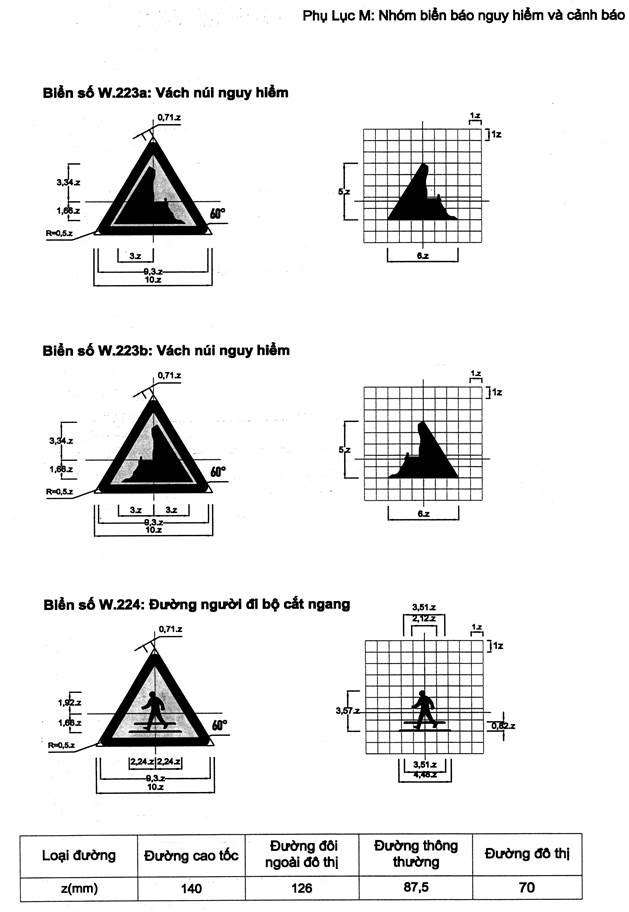
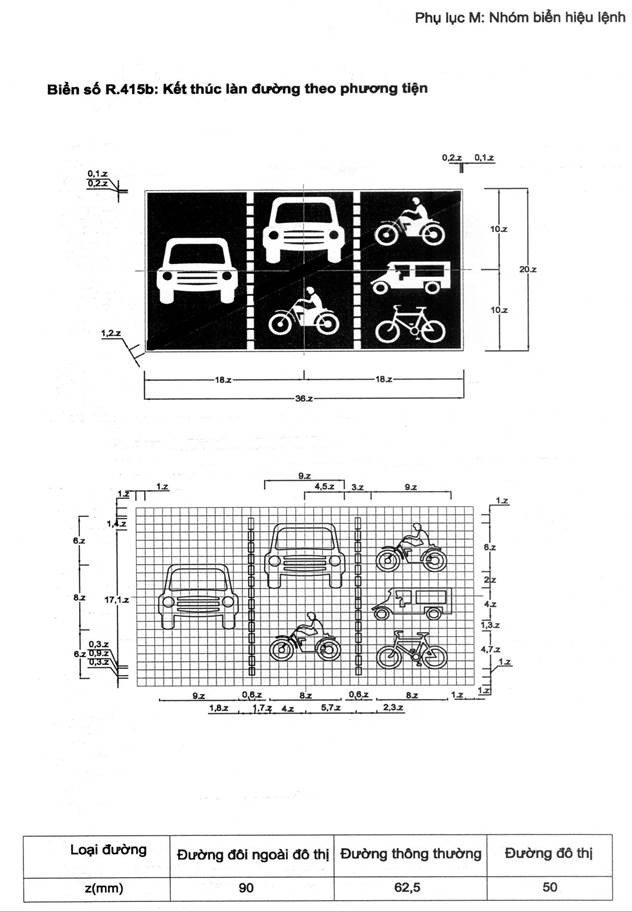
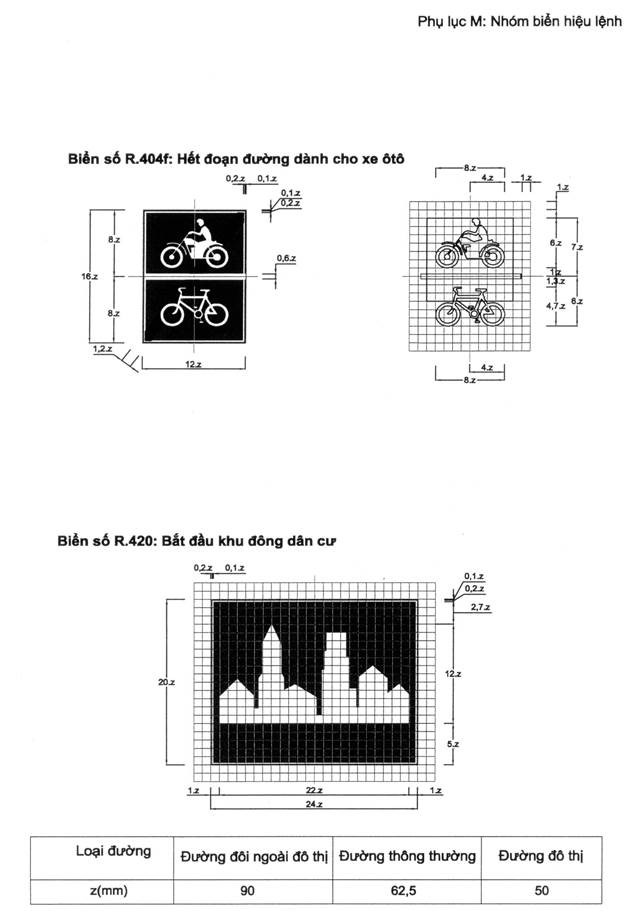
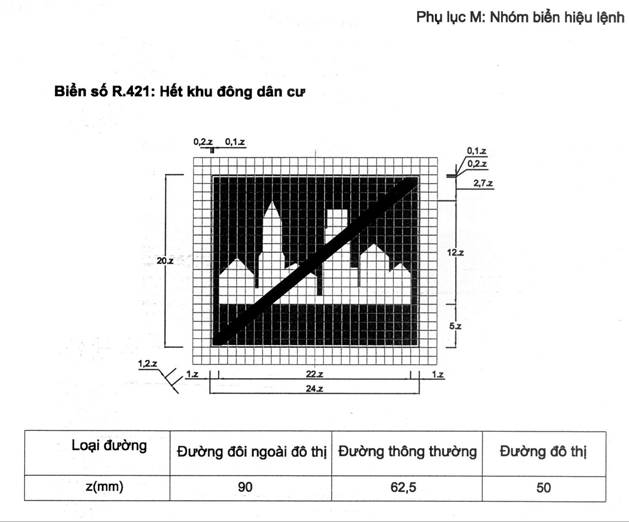
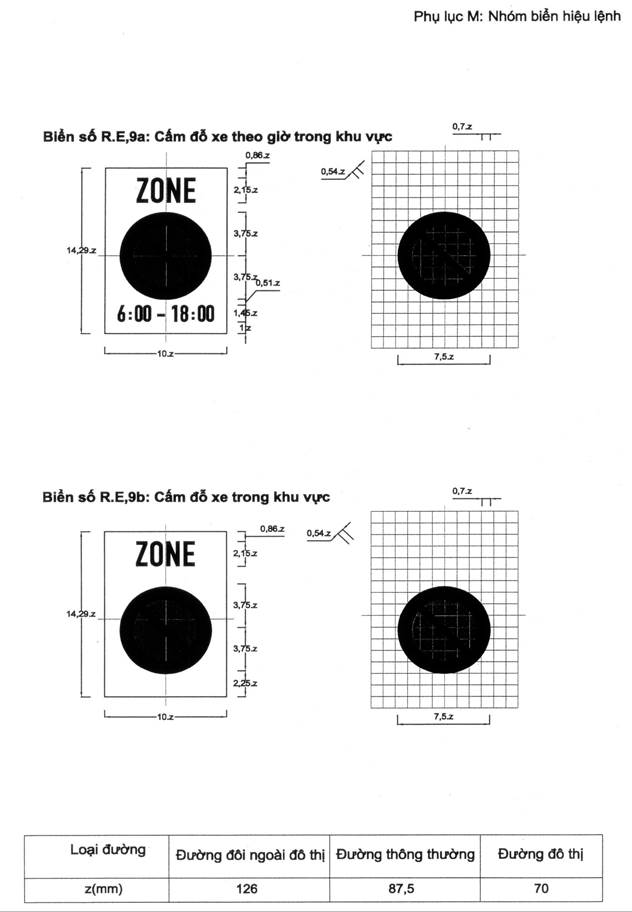
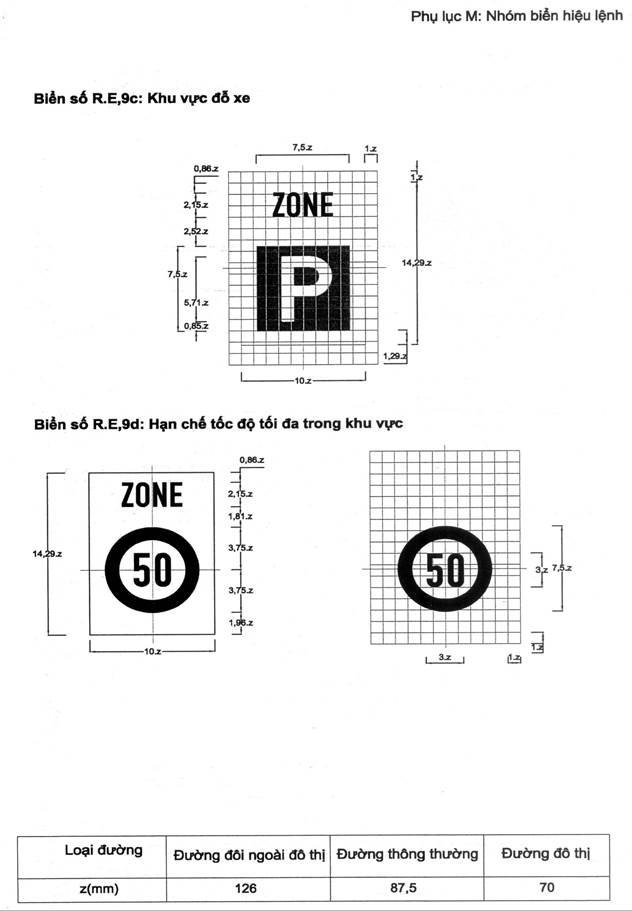
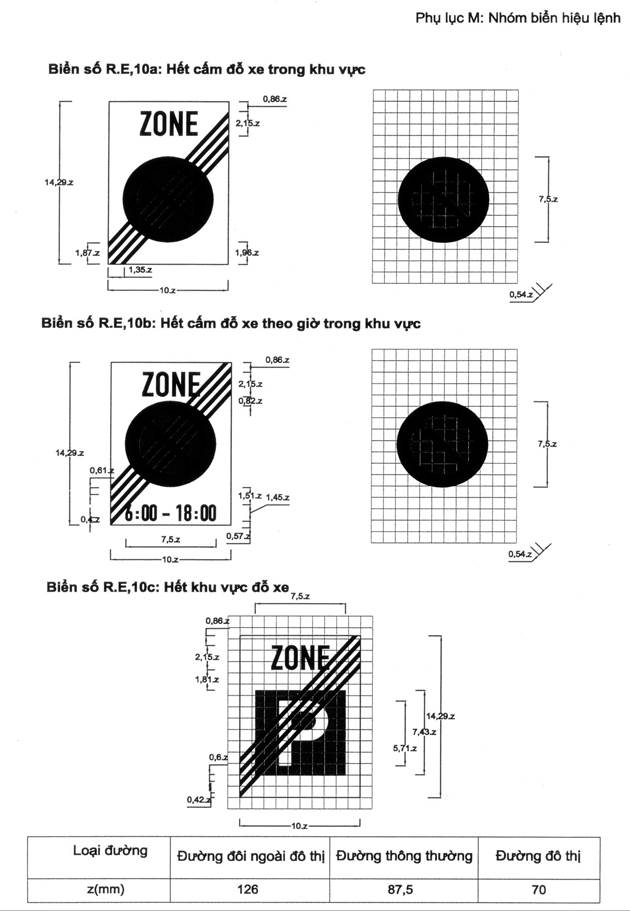
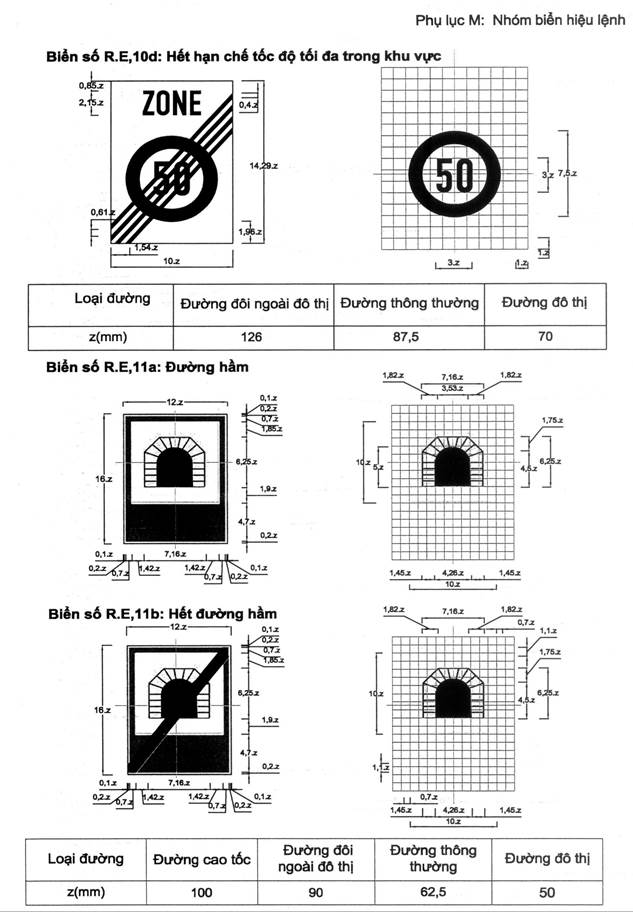
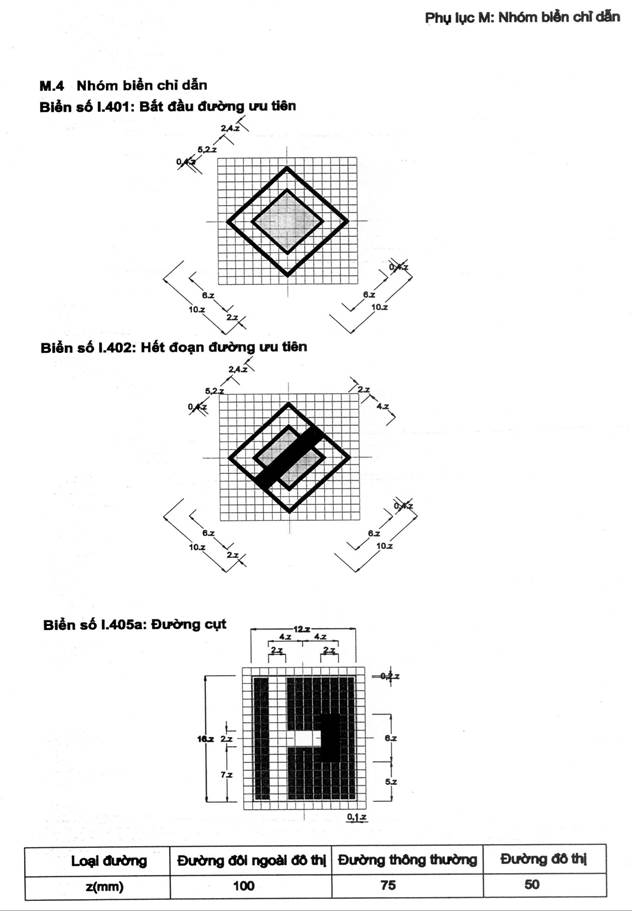
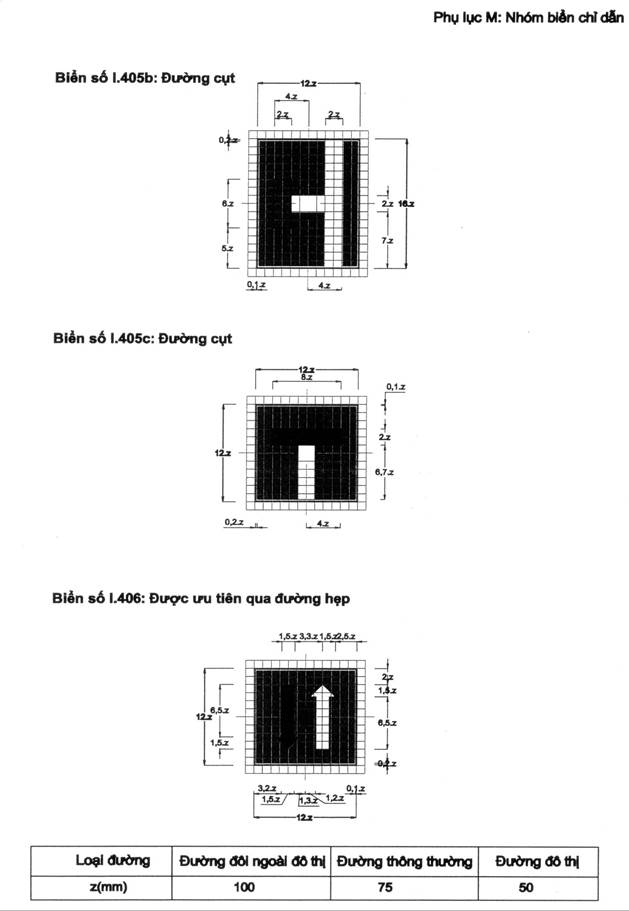
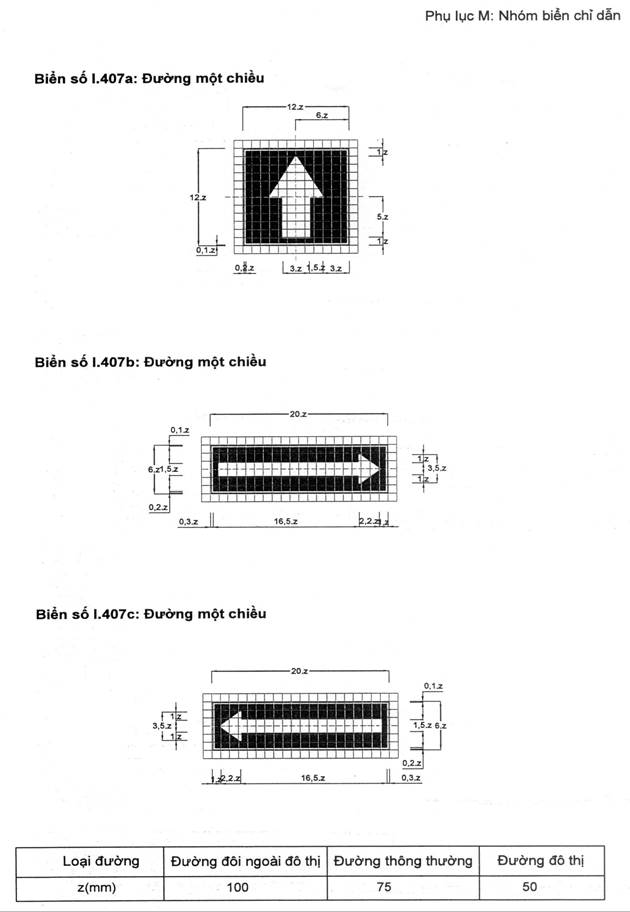
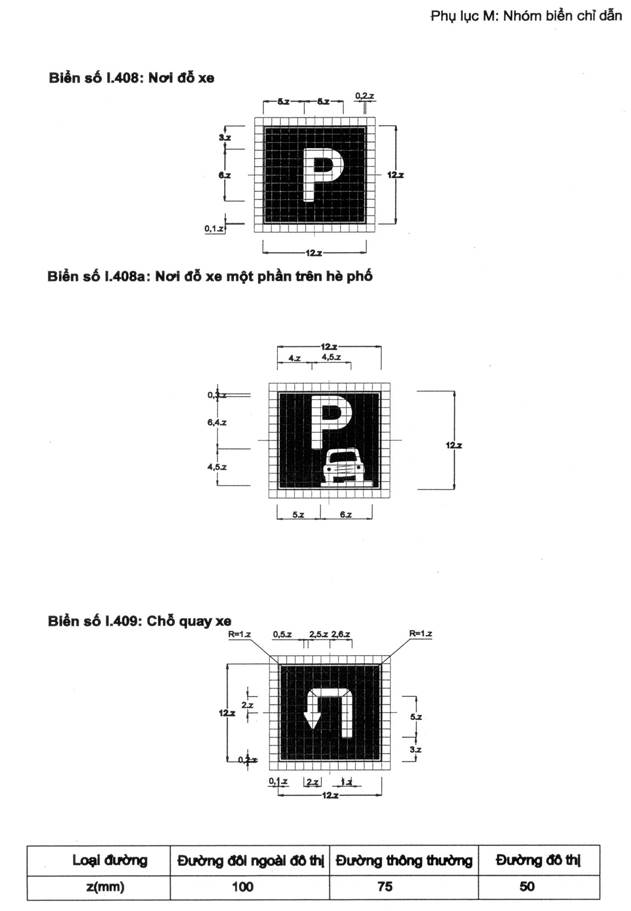
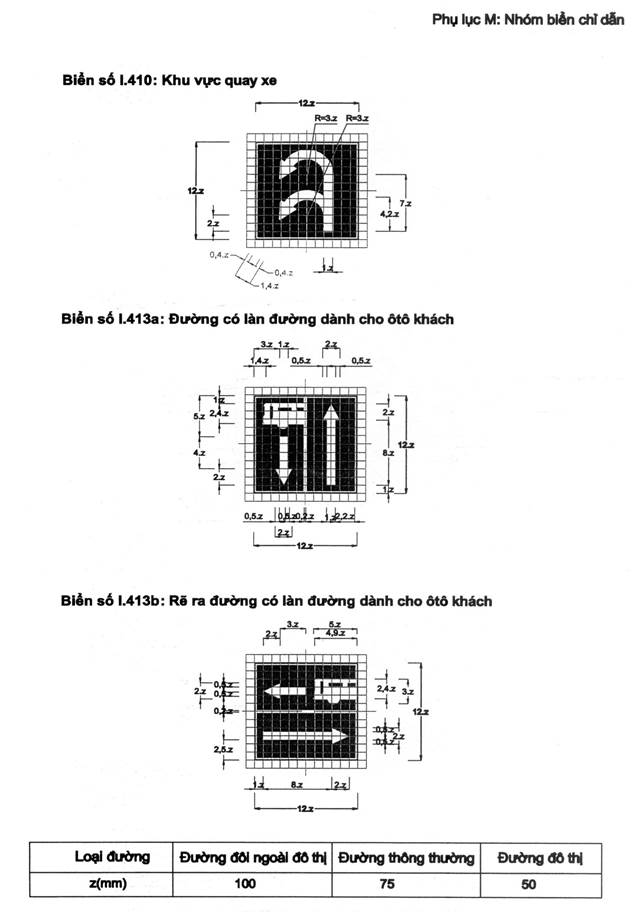
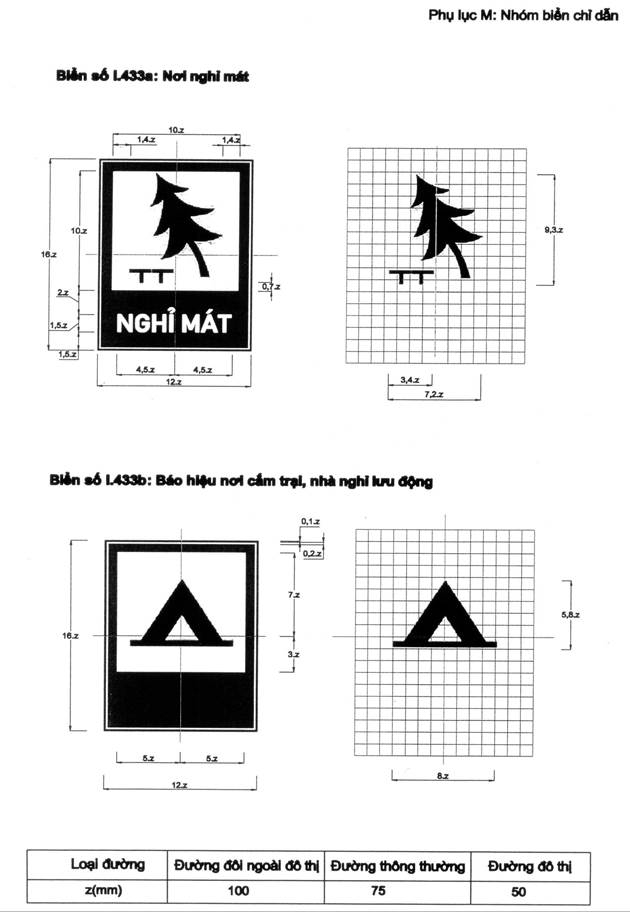
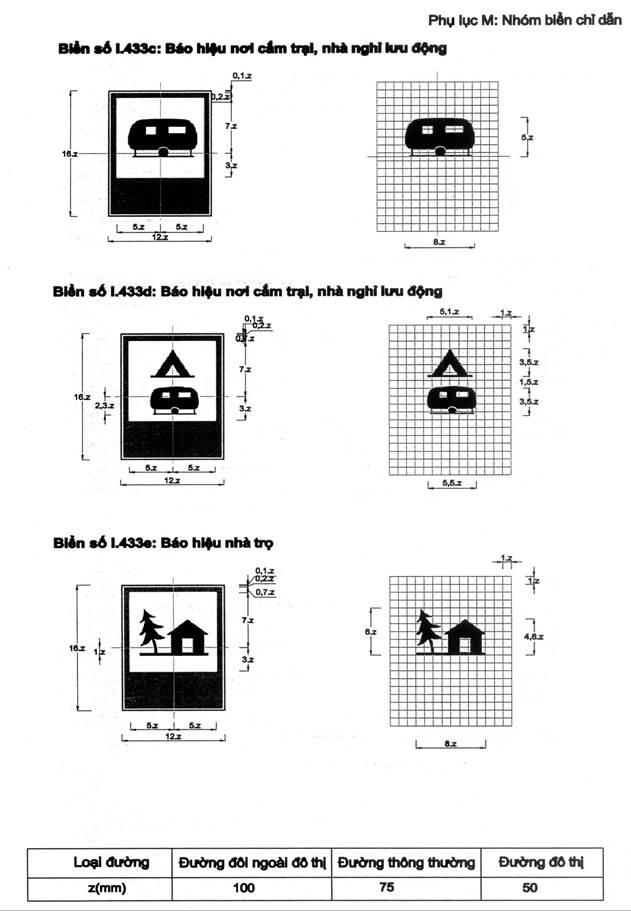
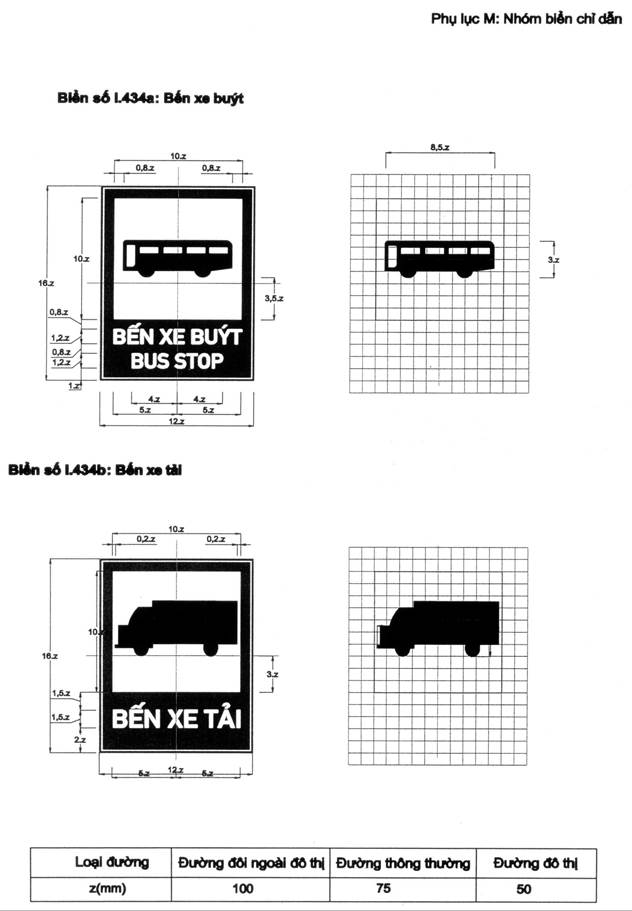
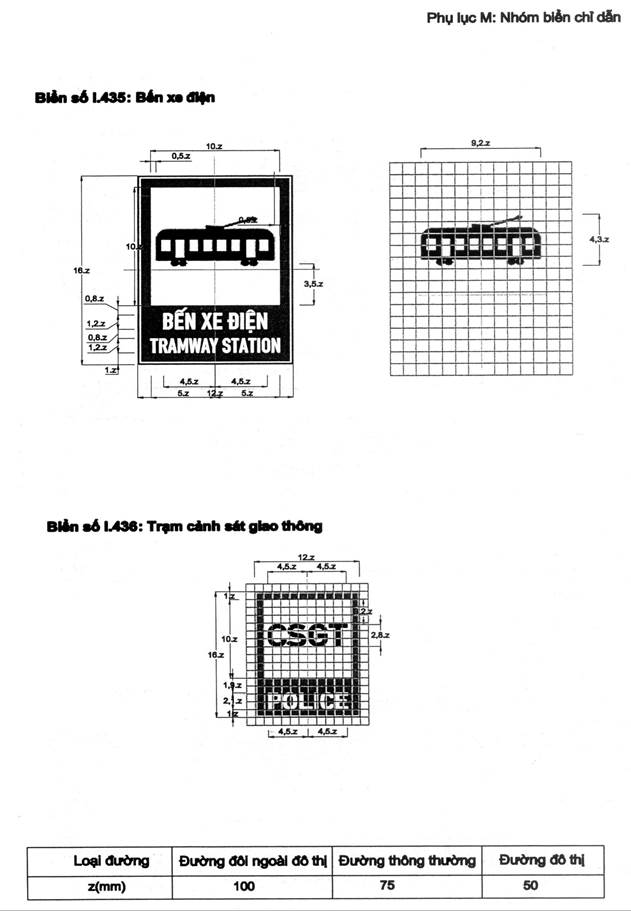
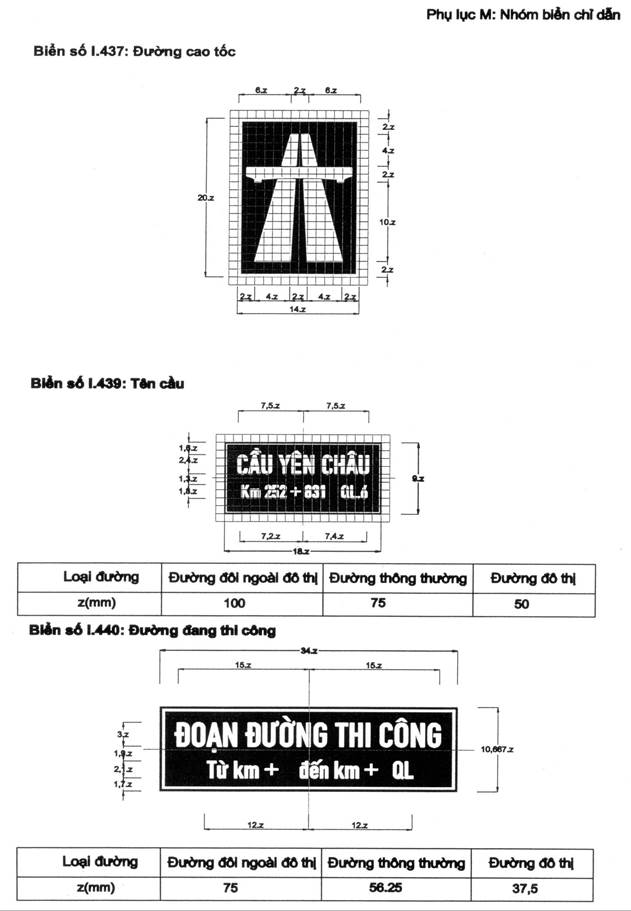
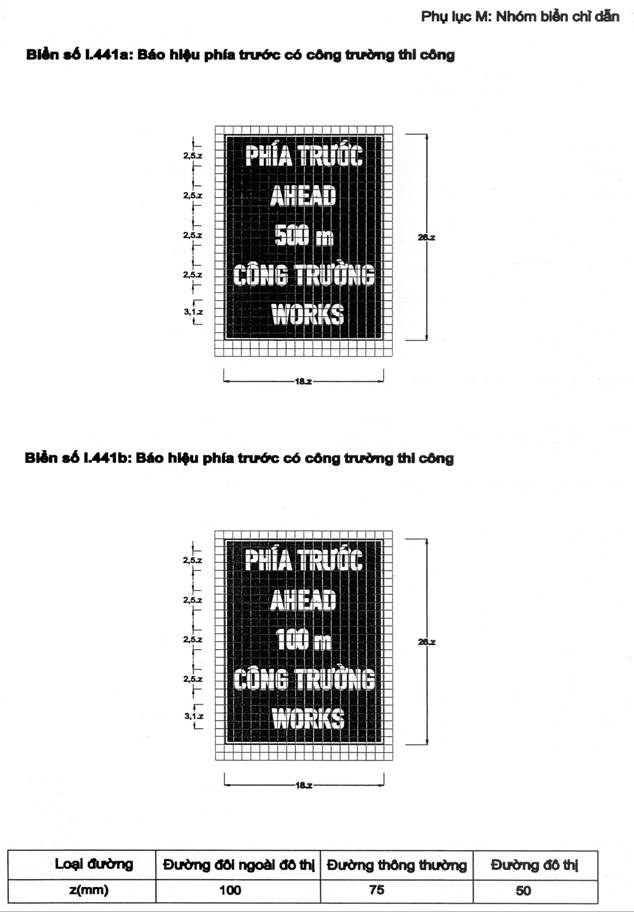
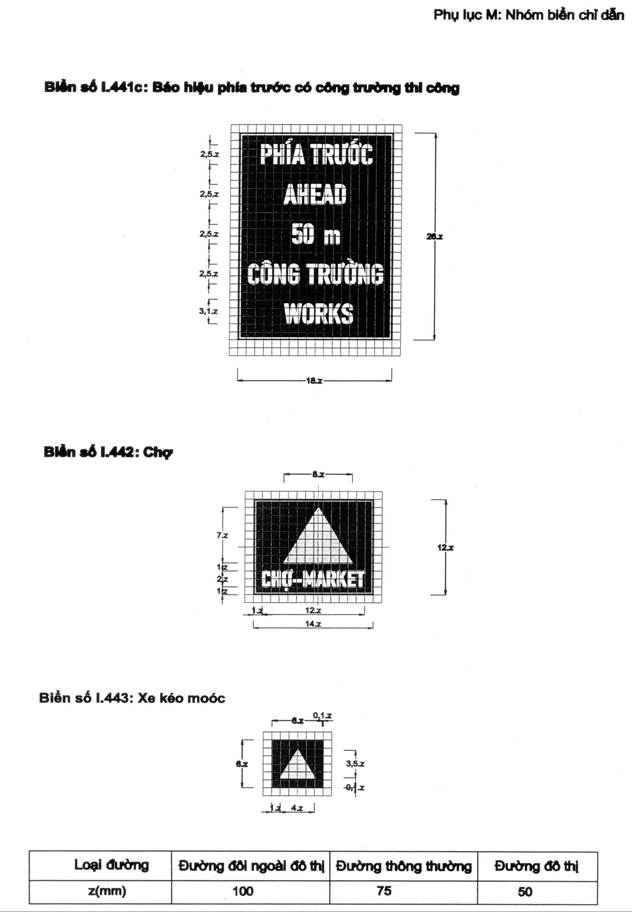
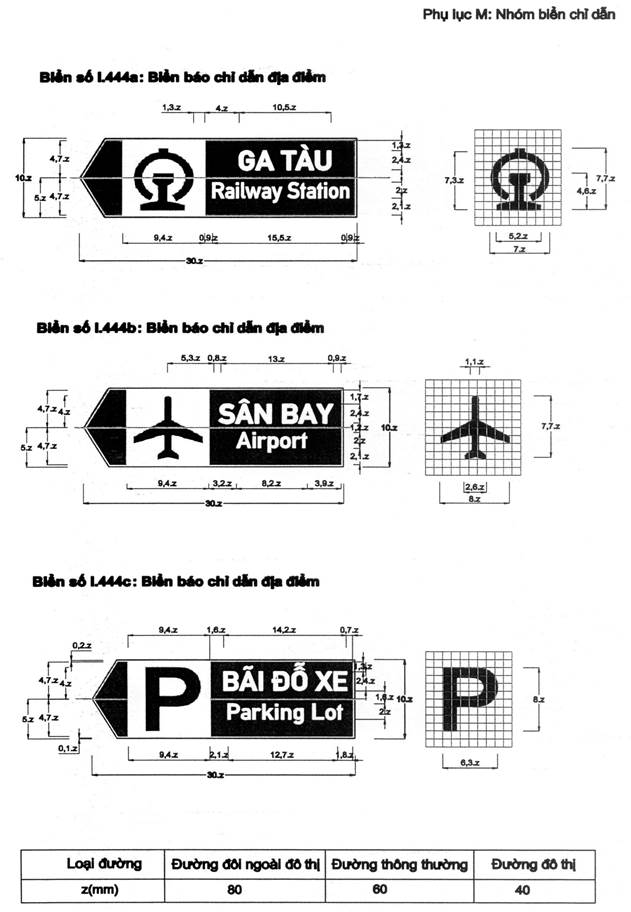
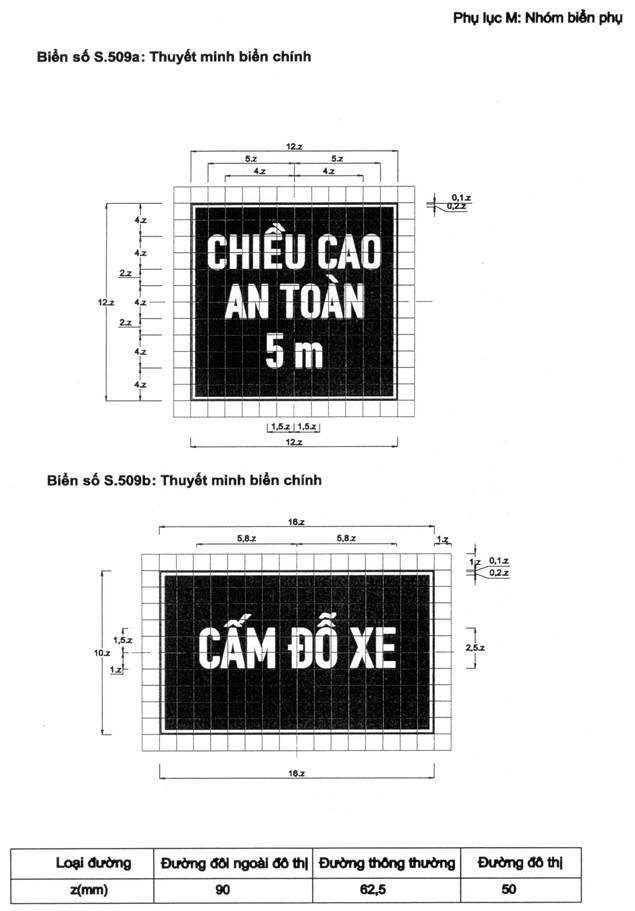
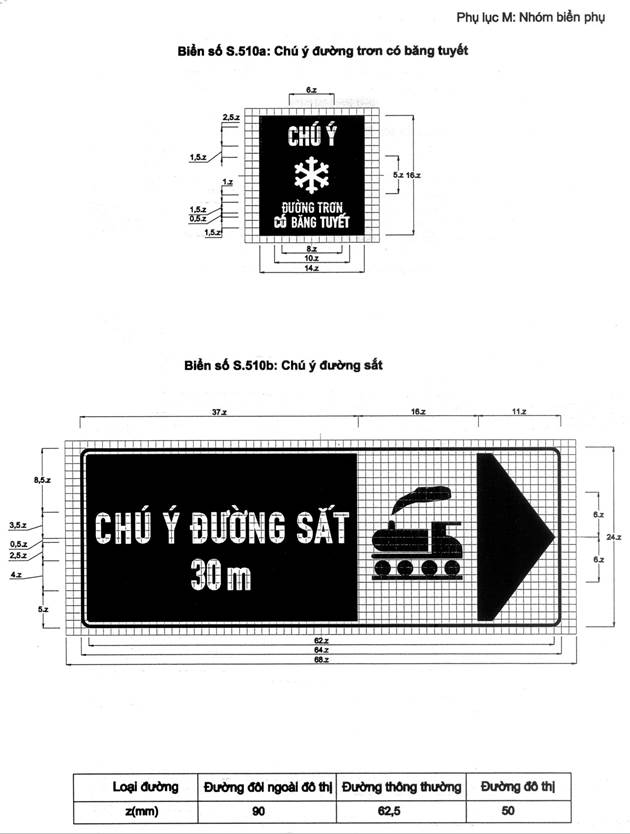
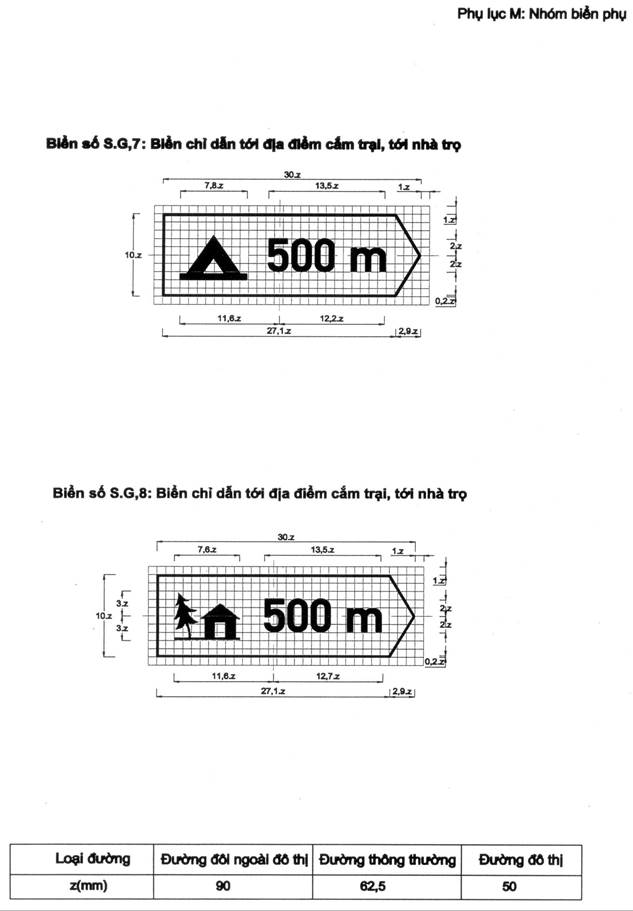
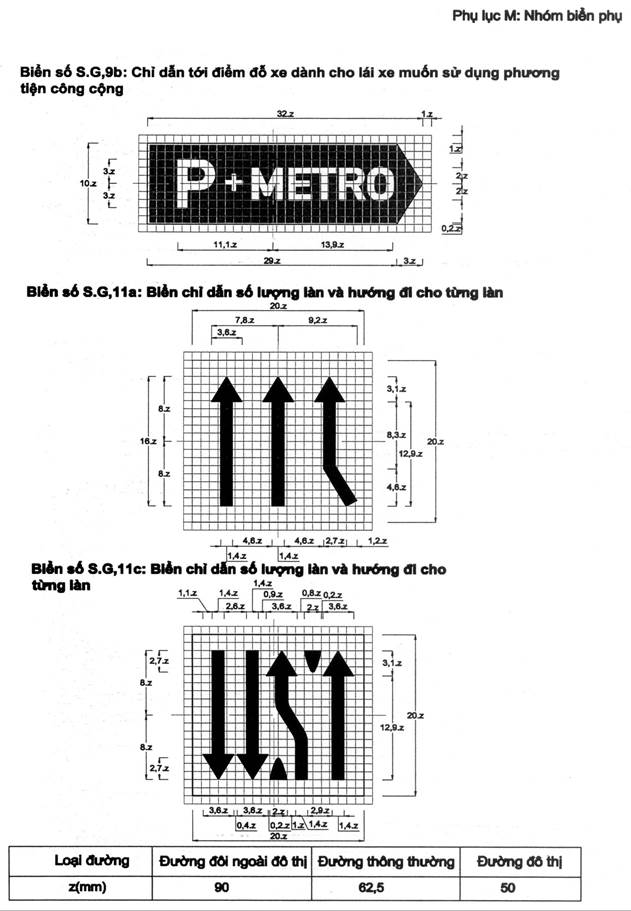
Appendix M - Detail design specifications of signs |
|
|
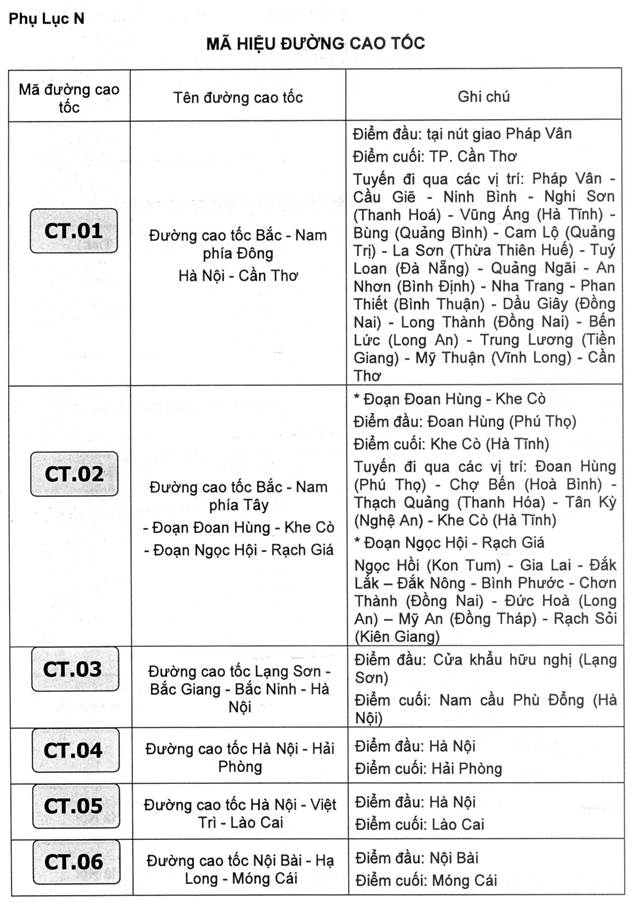
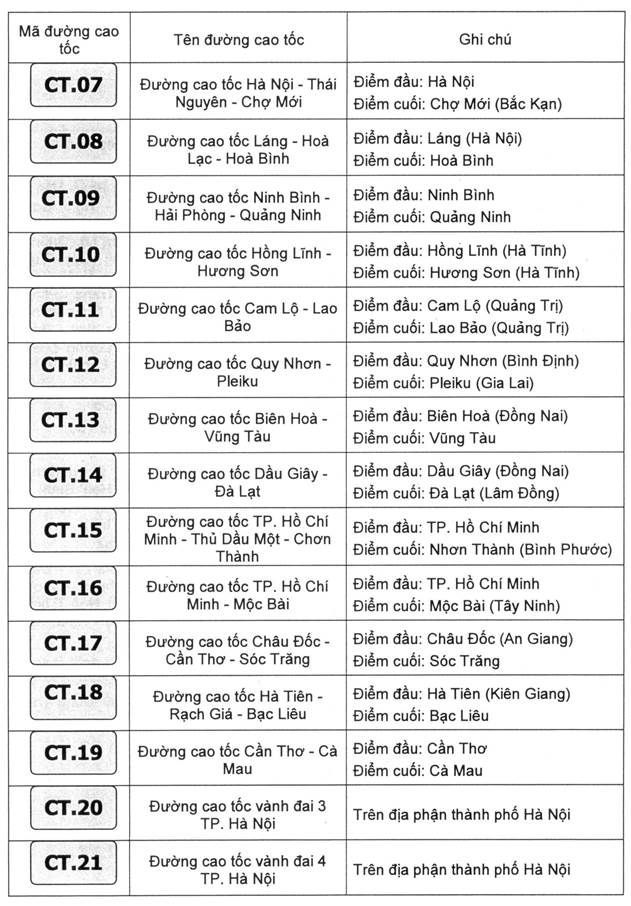
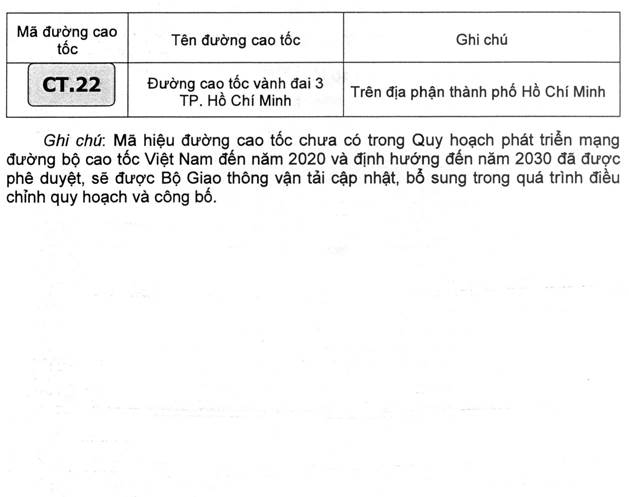
Appendix N - Expressway code |
|
|
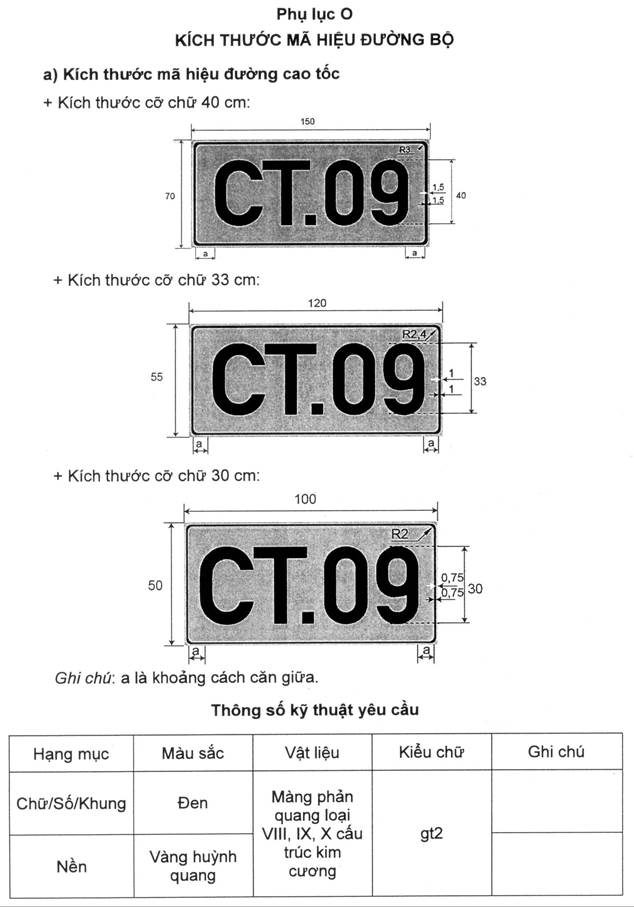
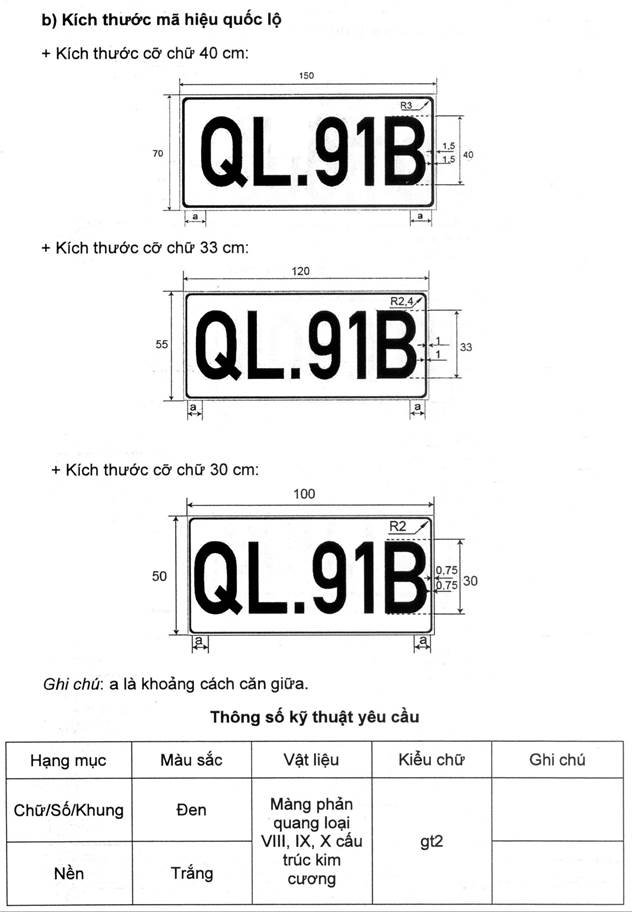
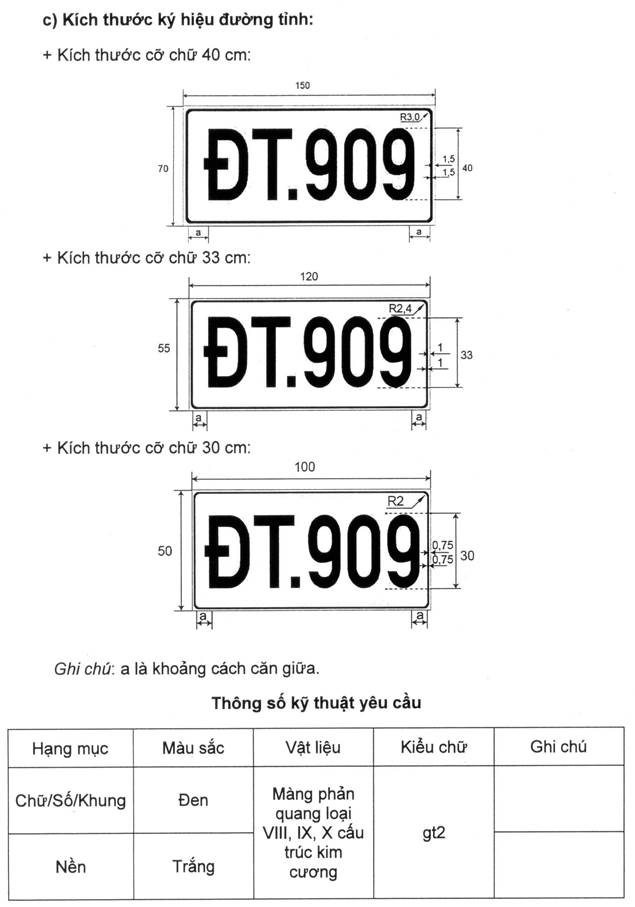
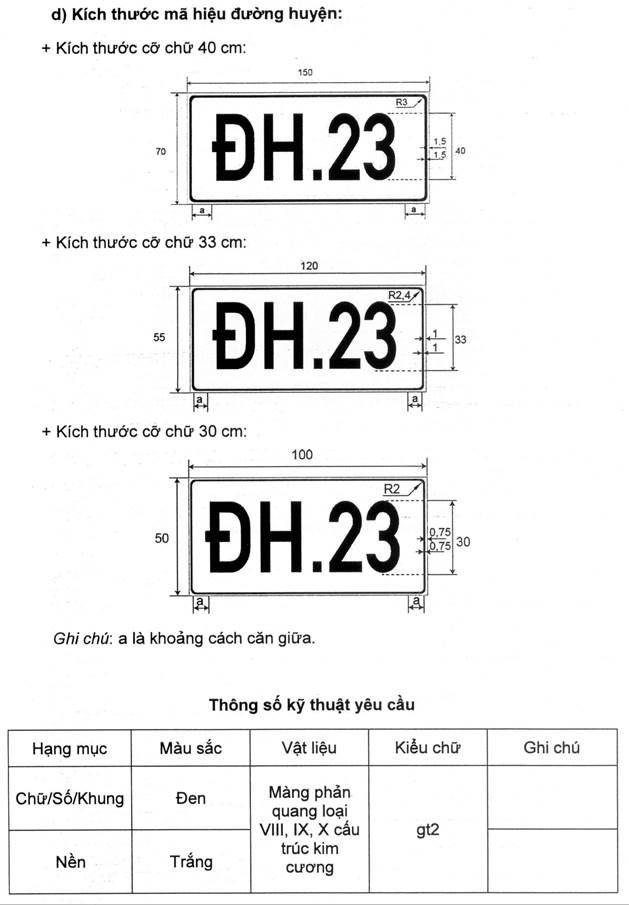
Appendix O - Dimensions of road code |
|
|
Appendix P - Detail design specifications of expressway information signs |
|
PART 1: GENERAL PROVISIONS
This Regulation prescribes road signaling system, including: command of traffic enforcers, traffic lights, light signals, road signs, road markings, traffic cones, protective walls, barriers, milestone kilometer markers, H markers, right-of-way markers, convex mirrors, dividers, and other traffic safety devices.
This Regulation prescribes signaling system applicable to all road types within Vietnamese road network, including: expressway, national highway, provincial road, district road, commune road, urban road, specialized road, and road under road system participating in international treaties to which Vietnam is a signatory (GMS-CBTA Agreement, treaties under ASEAN, and other international treaties) - hereinafter referred to as “international roads”.
This Regulation applies to road users operating on Vietnamese road network and other organizations, individuals related to management, investment, construction, protection, maintenance, operation, and use of road traffic infrastructures.
In the Regulation, the terms below are construed as follows:
3.1. Urban road (ĐĐT) means a road contained within administrative border of a city or a town.
3.2. Crowded residential road means a road in city center or road along which residences are located and activities that may affect road traffic safety take place and is identified by residential road sign (which may be erected for each direction of travel).
3.3. Road reserved for motorized vehicle means a road, road section, or lane reserved for motorized vehicles and separated from road section reserved for non-motorized vehicles and pedestrians by dividers or solid road markings and is signified by signs or road markings.
3.4. Road reserved for specific vehicle types means a road, road section, or lane for specific type or types of vehicles and separated from road section reserved for other vehicle types and is signified by signs or road markings.
3.5. Road reserved for non-motorized vehicles and pedestrians means a road, road section, or lane separated from road sections reserved for motorized vehicles by dividers or solid road markings.
3.6. Priority road means a road on which vehicles have right of way over vehicles from other directions at junction and on which priority sign is erected.
3.7. Priority lane means a lane on which vehicles are have priority and right of way over other vehicles in traffic situations.
3.8. Non-priority road means a road that meets a priority road at an at-grade junction.
3.9. One-way road means a road that only facilitates one direction of travel.
3.10. Two-way road means a road that facilitates both directions of travel in the same roadway without dividers.
3.11. Dual-carriageway means a road whose directions of travel area separated by dividers (if separation is implemented by road markings, such road is not considered a dual-carriageway).
3.12. Roadway means a part of road used by vehicles for travel purposes.
3.13. Roadway reserved for motorized vehicles means a part of road used by motorized road vehicles and specialized vehicles.
3.14. Roadway reserved for non-motorized vehicles means a part of road used by non-motorized vehicles.
3.15. Lane means a section of roadway established longitudinally of the road and wide enough for safe vehicle operation. Each roadway shall consist of a lane or lanes.
3.16. Divider means a part of the road on which vehicle operation is prohibited which divides roadway by directions of travel or divides roadway reserved for motorized vehicles and non-motorized vehicles or other vehicle types on the same direction of travel.
3.17. At-grade junction (intersection) means where 2 or more roads meet on the same level and also includes the area created by the meeting of these roads.
3.18. Motorized vehicle means motor vehicles; tractors; trailers or semi-trailers towed by motor vehicles; two-wheeled motorbikes; side cars; mopeds (including electric mopeds) and similar vehicle types designed to transport passengers and goods on roads. Motorized vehicles include rubber-tyred trams (means a type of tram that does not operate on tracks).
3.19. Kerb weight means weight of vehicles, in kilogram (kg) or tonne (t) at stopping position specified under Certificate of technical safety and environmental protection inspection for motorized road vehicles less passenger and cargo weight.
3.20. Gross weight means kerb weight of vehicles plus passenger, luggage, and cargo weight (if any).
3.21. Permissible gross weight means kerb weight plus permissible passenger, luggage, cargo weight according to Certificate of technical safety and environmental protection inspection for motorized road vehicles.
3.22. Axle load means the part of gross weight distributed on each axle (single axle, tandem axle, triaxle)
3.23. Car means a type of motor vehicle determined according to Certificate of technical safety and environmental protection inspection for motorized road vehicles for passenger transportation of up to 9 seats (including the driver’s seat).
3.24. Pickup trucks and vans with permissible cargo weight of less than 950 kg and three-wheeled vehicles whose kerb weight is greater than 400 kg, for the purpose of traffic arrangement, are considered cars.
3.25. Truck means a type of motor vehicle that is designed and equipped for goods transport (including hauling units, trailer hauling units, vehicle types such as pickup trucks and vans with permissible cargo load of at least 950 kg).
3.26. Passenger bus (passenger coach) means a type of motor vehicle determined in accordance with Certificate of technical safety and environmental safety inspection for motorized road vehicles carrying more than 9 passengers.
3.27. Semi-trailer hauling unit means a type of motorized vehicle for cargo transport where semi-trailer is the cargo space, is connected to the hauling unit, and distributes a significant load onto the hauling unit and is not designed to carry passengers and cargo by itself (hauling units are motor vehicles designed to tow semi-trailers).
3.28. Trailer truck means a type of motor vehicle designed specifically to tow trailers or a motor vehicle additionally equipped to tow trailers where towing weight is determined in accordance with Certificate of technical safety and environmental protection inspection for motorized road vehicles.
3.29. Trailer means a combination of axles and tyres of rigid design and connected to motor vehicle in a way that trailer load is not rested entirely on the hauling units.
3.30. Tractor means a tracked or tyred vehicle for digging, moving, lifting, bulldozing, sweeping, towing, propelling.
3.31. Motorbike (scooter) means a two-wheeled or three-wheeled motorized vehicle or similar vehicle types having engine displacement of at least 50 cm3 and kerb weight of at most 400 kg.
3.32. Moped means a two-wheeled or three-wheeled motorized vehicle having maximum design speed of 50 km/h. In case of combustion engine, engine displacement or equivalent volume shall be less than 50 cm3.
3.33. Non-motorized vehicle includes bicycle (including motorized bicycle, electric bicycle), cycle rickshaw, cattle wagon, wheelchair used by people with disabilities, and similar vehicle types that are not motorized.
3.34. Bicycle means a two-wheeled or three-wheeled vehicle propelled manually by pedals or handles and includes vehicles of equivalent functionalities used by people with disabilities.
3.35. Cargo bicycle means a bicycle for transporting cargo contained in brackets or fastened on both sides of the bicycle.
3.36. Human-powered vehicle is a type of non-motorized vehicle with one or more wheels that are moved by human propulsion or towing except for stroller and specialized mobility aids of people with disabilities.
3.37. Animal-powered vehicle is a type of non-motorized vehicle towed by livestock.
3.38. Road user means vehicle operator; individual using vehicles for traffic purpose; livestock herder, controller; pedestrian.
3.39. Priority vehicle means a vehicle to which priority is given in accordance with the Law on Road Traffic.
3.40. Right-of-way marker means a marker located longitudinally on the outermost boundary to define the plot used as road.
3.41. Gantry means a type of overhead structure above roadway.
3.42. Cantilever post means a post structure with an overhang section above roadway.
3.43. Hazardous goods mean goods containing hazardous substances which when transported on road may cause harm to lives, health of people, traffic infrastructures, national safety and security.
3.44. Operating speed means the speed at which operators operate their vehicles.
3.45. Design speed means the speed that is selected to design basic road elements in difficult conditions.
3.46. 85th percentile speed (V85) means operating speed at or below which 85% of drivers operate.
3.47. Maximum speed limit means the maximum speed of a road, road section, or lane imposed by the authority. Vehicle operators shall not operate vehicles at a higher speed.
3.48. Minimum speed limit means the minimum speed of a road, road section, or lane imposed by the authority. Vehicle operators shall not operate vehicles at a lower speed if traffic conditions allow them to operate at a higher speed.
3.49. Sight distance means the distance measured along the road from the front of a vehicle to an obstacle ahead.
3.50. Safe stopping distance means the distance measured from the front of a vehicle for the vehicle to stop completely before colliding with a static object that suddenly appears on the same lane as the vehicle.
3.51. Safe overtaking distance means the distance measured from the front of a vehicle necessary for a moving vehicle on a two-way road to overtake a slower moving vehicle in the same direction of travel by briefly occupying the other lane then return to their designated lane safely.
3.52. Overtaking means a traffic situation in which a vehicle moving behind overtakes a vehicle moving ahead; all vehicles shall overtake to the left (unless otherwise specified under the Law on Road Traffic). Vehicles moving at a lower speed shall stay to the right; where a vehicle signals for overtaking and where sufficient safety conditions are met, operator of vehicle ahead shall decelerate, stay to the right side of the roadway until the vehicle behind finishes overtaking, and do not obstruct the overtaking process.
3.53. Vehicles on lanes with different speed: In respect of road where each direction of travel has at least two lanes (defined by lane markings) reserved for motorized vehicles, vehicle operators shall operate within an individual lane. During traffic, vehicles on different lanes may move at different velocity as long as they comply with regulations on speed limit and types of vehicles and, upon changing lane, adhere to road traffic laws.
3.54. Yielding means a traffic situation in which a vehicle stops and gives way to another vehicle which then is not required to change direction or brake rapidly.
3.55. Complete grade-separated junction means a road junction implemented by a combination of underpass and overpass structures where vehicles can move onto roads at different elevations.
3.56. Side road means a road connecting to and from a junction.
3.57. Exit means where vehicle separate from traffic flow on main road.
3.58. Entry point means where vehicles merge into traffic flow on main road.
PART 2: TECHNICAL REGULATIONS
CHAPTER 1
ORDER OF APPLICATION OF TRAFFIC SIGNALS AND ORDER OF ROAD PRIORITY
Article 4. Order of application of traffic signals
4.1. Where different traffic signals of different interpretations are installed in the same area, road users shall comply with traffic signals in the following order:
4.1.1. Command of traffic enforcers;
4.1.2. Command of traffic lights;
4.1.3. Command of traffic signs;
4.1.4. Command of road markings and other signs on road surface.
4.2. Where an area has a fixed traffic sign and a temporary traffic sign and the interpretations of both of which are different, road users shall adhere to the temporary sign. Temporary signs are signs used for short-term traffic arrangement such as for events, traffic incidents, or road construction or repair.
Article 5. Order of road priority
5.1. Order of road priority:
- Expressway;
- National highway;
- Urban road;
- Provincial road;
- District road;
- Commune road;
- Specialized road.
5.2. Where two roads of equal priority meet at at-grade junction, whether a road is priority road shall be considered in the following order:
5.2.1. The road is deemed priority road by competent authority;
5.2.2. The road that has higher technical grade is given priority;
5.2.3. The road that has higher average daily traffic is given priority;
5.2.4. The road that has higher load of public transport is given priority;
5.2.5. The road that has pavement of a higher class is given authority.
5.3. Two roads that meet at at-grade junction shall not be both priority roads.
CHAPTER 2
TRAFFIC SIGNALS
Article 6. Traffic control methods
6.1. Means of traffic control:
6.1.1. Hand gestures;
6.1.2. Flags;
6.1.3. Batons of alternating black and white (with or without internal lights);
6.1.4. Light signals.
6.2. Traffic control methods:
6.2.1. Enforcers;
6.2.2. Automatic lighting system.
Article 7. Command of traffic enforcers
7.1. Command of traffic enforcers is given in form of hand gestures, flags, batons, or traffic lights. For the purpose of attracting attention of road users, traffic enforcers shall also use whistles in addition to aforementioned means.
7.2. Command of traffic enforcers:
7.2.1. Raising arms upwards shall require road users in all directions to stop;
7.2.2. Raising one or both arms to the side shall mean that road users to the front and the rear of traffic enforcers must stop at which point road users to left and the right of traffic enforcers can move in any direction. Repeatedly waving left arm from the back of the head to the side shall mean that road users to the left of traffic enforcers should accelerate or repeatedly waving right arm horizontally at chest height shall mean that road users to the right of traffic enforcers should accelerate. Repeatedly waving left or right palm vertically at waist height shall mean that road users to the left or the right of traffic enforcers respectively must decelerate. Raising left or right palm perpendicular to the ground shall mean that road users to the left or the right of traffic enforcers respectively to stop;
7.2.3. Raising right arm forward shall mean that road users to the rear and the right of traffic enforcers must stop; road users to the front of traffic enforcers may turn right; road users to the left of traffic enforcers may move in any direction; pedestrians to the rear of traffic enforcers may cross the street; while repeatedly raising left arm forward parallel to the right arm shall mean that road users to the left of traffic enforcers may turn left in front of the traffic enforcers.
7.3. Regulations on whistles used by traffic enforcers for the purpose of traffic coordination:
7.3.1. One long loud whistle means the stop command;
7.3.2. One short whistle means go;
7.3.3. One long whistle followed by one short whistle means that left turn is permissible;
7.3.4. Two short loud whistles mean danger ahead and that deceleration is required;
7.3.5. Three short quick whistles mean acceleration;
7.3.6. One or several consecutive loud whistles mean to pull over vehicles for inspection or indicate violating vehicles.
7.4. Regulations on light signals in stop command issued by traffic enforcers: traffic enforcers shall raise batons emitting red light towards oncoming vehicles.
7.5. Where stop signal or command is issued, if road users have crossed stop line at junctions and cannot stop past the stop line due to safety reasons, road users may continue; if pedestrians are walking on roadway, the pedestrians shall quickly cross to the other side or stop at traffic island or at road dividers.
7.6. Traffic from a direction to which traffic enforcers point their batons shall stop.
Article 8. Priority of traffic enforcers
Road users shall strictly adhere to command of traffic enforcers even if such command contradicts traffic lights, traffic signs, or road markings.
Traffic enforcers are traffic police in designated uniform or individuals authorized to perform traffic coordination task.
Article 10. Traffic coordination by traffic lights
10.1. Primary traffic lights use 3 colored lights: green, yellow, and red; are mostly round, and stacked vertically or horizontally.
10.1.1. Descending order of lights in vertical arrangement: red, yellow, and green.
10.1.2. Order of lights in horizontal arrangement from the left: red, yellow, and green.
10.2. In addition to the primary method using 3 colored lights, additional colored lights shall also be used depending on the scale and traffic arrangement at junctions.
10.2.1. Lights in the shape of directional arrows or other shapes conforming to this Regulation shall be installed on the same horizontal plane as traffic lights. These shapes can be a type of vehicle or a pedestrian figure.
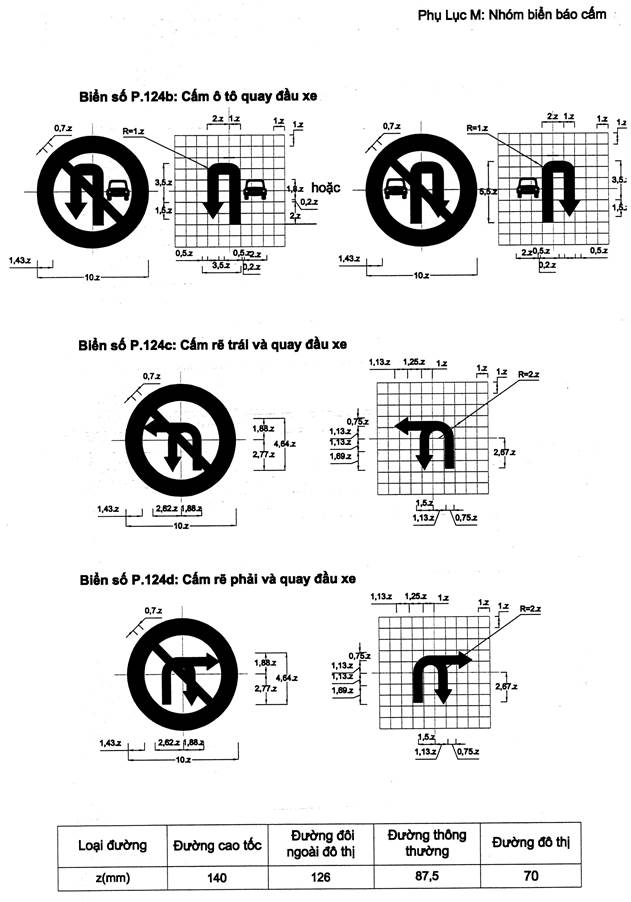
10.2.2. Primary colored lights of traffic lights may be shaped into directional arrows. If arrows allowing left-turn are present, u-turn is also allowed by default unless P.124 (a,b) “Cấm quay đầu xe” (No u-turn) signs are installed.
10.2.3. Countdown timer (during normal operation) indicates remaining duration of the lights.
10.2.4. Red cross lights mean that vehicles must stop. If vehicles have already entered junctions by the time red cross lights turn on, the vehicles must rapidly exit the junctions.
10.3. Interpretation of traffic lights:
10.3.1. Green light: allows road users to move.
10.3.2. Yellow light indicates the transition from green light to red light. When yellow light is lit, road users must stop before stop line; road users past the stop line or too close to the stop line to brake may continue moving.
Blinking yellow light means that road users may continue moving while decelerating, paying attention, yielding to crossing pedestrians or other vehicles in accordance with the Law on Road Traffic.
10.3.3. Red light: requests road users to stop before stop line. If stop line is not present, road users must stop before traffic lights in the direction of travel.
10.3.4. If stop line is not present, the nearest traffic lights in direction of travel shall be considered stop line.
10.3.5. Only one of the colored lights of green, yellow, or red shall be illuminated at any time.
10.4. Interpretation of arrow-shaped lights:
10.4.1. In case of green arrow lights, road users shall only move when the lights are illuminated. Arrow lights allowing left turn shall also allow u-turn if signs prohibiting u-turn are not installed.
10.4.2. If a light bearing illustration of a type of vehicle is a green light, only that type of vehicle is allowed to move.
10.4.3. Where green arrow lights are illuminated at the time as red or yellow lights, road users shall move in the direction indicated by the arrow while yielding to vehicles approaching from other directions.
10.4.4. Where red arrow lights are illuminated at the same time as primary green lights, road users are not allowed to move in the direction indicated by the red arrow. In respect of junctions where red arrow lights are installed, waiting lanes shall be required to accommodate road users traveling in the direction indicated by the red arrow.
10.4.5. If red lights bearing illustration of a vehicle type are illuminated at the same time as primary green lights, road users operating the illustrated vehicle type are not allowed to move. Where red lights bearing illustration of a vehicle type are installed, waiting lanes shall be required to accommodate the illustrated vehicle type.
10.5. Traffic coordination using two color traffic lights:
10.5.1. Traffic coordination for pedestrians shall use traffic lights consisting of two colors: red lights illustrating a person at a standing still position or the text “Dừng lại” (Stop); green lights illustrating a person at a walking position or the text “Đi” (Walk).
Pedestrians may shall only cross the road when green lights are illuminated and walk within the path created by road studs or zebra crossings. Blinking green lights indicate a transition to red lights at which point pedestrians must not cross the road.
10.5.2. Non-blinking green and red lights shall be used for traffic coordination at level crossing, ferry stations, road bridges, area allowing planes to descend and ascend at low altitude, etc. Green lights: road users may go. Red lights: road users must not move. Green lights and red lights shall not be illuminated simultaneously.
10.5.3. Two alternating blinking red lights shall be installed at railway crossing. Where these lights are illuminated, all vehicles must stop until the lights are off. In addition red blinking lights, electric sirens or speakers shall be installed to warn about incoming trains.
10.6. In order to coordinate traffic in individual lanes, overhead traffic lights consisting of 2 colors shall be installed where green lights located to the right side of respective lanes are shaped like an arrow and red lights are shaped in an X mark. These light signals are interpreted as follows:
10.6.1. Green lights allow road users to move on lanes designated by arrows;
10.6.2. Red lights mean vehicle operators must stop in accordance with 10.3.3. .
Article 11. Priority vehicle and emergency signals
11.1. The following vehicles shall be given way over other vehicles at junctions regardless of direction:
11.1.1. Fire trucks in the performance of duty;
11.1.2. Military vehicle and police vehicles in the performance of emergency duty; convoys led by police vehicles;
11.1.3. Ambulances in the performance of emergency duty;
11.1.4. Embankment support vehicles, vehicles in the performance of natural disaster, disease remediation duty, or vehicles in the performance of duty during emergencies as per the law.
11.1.5. Convoy of funeral vehicles.
11.2. Vehicles under 11.1.1 through 11.1.4 in the performance of duty and while emitting emergency signals shall not be subject to the speed limit, may go against the traffic in one-way road and other possible roads, cross red lights while adhering to instructions of traffic enforcers.
11.3. Signals of fire trucks in the performance of their duty:
11.3.1. Fire trucks shall be outfitted with red or blue strobing or flashing lights on the roof and sirens emitting emergency signals.
11.4. Signals of military vehicles in the performance of emergency duty:
11.4.1. Motor vehicles shall be outfitted with red strobing or flashing lights on the roof, military flags at the front of the vehicle on driver’s side, and sirens emitting emergency signals.
11.4.2. Motorbikes shall be outfitted with red strobing or flashing lights on the front or rear suspension, military flags at the front of the vehicle, and sirens emitting emergency signals.
11.5. Signals of police vehicles in the performance of emergency duty:
11.5.1. Motor vehicles shall be outfitted with red or blue strobing or flashing lights on the roof, police flags at the front of the vehicle on driver’s side, and sirens emitting emergency signals.
11.5.2. Motorbikes shall be outfitted with red or blue strobing or flashing lights on the front or rear suspension, police flags at the front of the vehicle, and sirens emitting emergency signals.
11.6. Signals of pacesetter police vehicle:
11.6.1. Motor vehicles shall be outfitted with red - blue strobing or flashing lights on the roof, police flags at the front of the vehicle on driver’s side, and sirens emitting emergency signals;
11.6.2. Motorbikes shall be outfitted with red or blue strobing or flashing lights on the front or rear suspension, police flags at the front of the vehicle, and sirens emitting emergency signals.
11.7. Signals of ambulances in the performance of emergency duty:
Ambulances shall be outfitted with red strobing and flashing lights on the roof and sirens emitting emergency signals.
11.8. Signals of embankment support vehicles and vehicles in the performance of duty during emergencies as per the law:
11.8.1. Embankment support vehicles shall be outfitted with flags that read “HỘ ĐÊ” (EMBANKMENT SUPPORT) at the front of the vehicle on the driver’s side.
11.8.2. Vehicles in the performance of natural disaster, disease remediation duty, or vehicles in the performance of duty during emergencies as per the law:
a) Vehicles in the performance of natural disaster, disease remediation duty shall be outfitted with distinct signs.
b) Vehicles in the performance of duty during emergencies as per the law shall be outfitted with flags that read “TÌNH TRẠNG KHẨN CẤP” (EMERGENCY) at the front on the driver’s side.
11.9. Use of emergency signals by priority vehicles:
11.9.1. Priority vehicles shall only emit emergency signals in the performance of duty; onboard devices for emitting emergency signals must be licensed for use by competent authority.
11.9.2. Motorized road vehicles that are not priority vehicles shall not be allowed to install or use emergency sirens, flags, or lights. Priority vehicles shall be outfitted with and using emergency sirens, flags, and lights in accordance with Clauses 11.3, 11.4, 11.5, 11.6, 11.7, and 11.8 of this Article.
11.10. Where priority vehicles emit emergency signals, other road users shall rapidly decelerate, evade or pull over to the right road shoulder to yield. Other road users shall not obstruct priority vehicles.
Article 12. Priority of traffic lights
Where a junction contains traffic lights, traffic signs and road markings, road users shall comply with traffic lights. Where lane-specific traffic lights are not used for traffic coordination of individual lanes, traffic lights shall apply for the entire road way of oncoming traffic. Where traffic lights are off or yellow lights are flashing, road users shall adhere to traffic signs and road markings in accordance with set order of priority.
Article 13. Traffic light location and height
13.1. Traffic lights shall face towards oncoming traffic.
13.2. Where traffic lights are stacked vertically and located on posts on road shoulder, dividers, traffic islands: the lowest point of traffic lights shall be 1,7 m to 5,8 m from the ground; the lights shall be 0,5 m to 2 m away from the edge of roadway.
13.3. Where traffic lights are stacked horizontally on cantilever posts, height from the lowest point of lights to road surface or sidewalk surface shall be at least 5,2 m and at most 7,8 m;
13.4. Lights shall be arranged in a way that they can be seen by road users from a distance in order to decelerate and stop safely. In some cases, traffic lights can be mounted on electric posts or architectural elements as long as traffic light installation technical specifications regarding positions, height, sight distance under this Regulation and aesthetics are met.
13.5. Traffic lights shall be installed on each side road leading towards junctions. Additional traffic lights shall be installed on cantilever posts or gantries on the other side of junctions in the direction of travel in a manner that they can be seen by road users with ease.
13.6. Where traffic lights are installed in residential zones or urban areas with narrow roads, traffic lights can be mounted on vertical posts on the right side of the roads in accordance with 13.3.1 before stop line.
13.7. Dimensions and luminous intensity of traffic lights shall be so designed that the traffic lights can be seen by road users in case of sun glare.
Article 14. Dimension, shapes, and other regulations pertaining to traffic lights
Dimensions, shapes, and other regulations of traffic lights are specified under Appendix A hereof.
CHAPTER 3
TRAFFIC SIGNS
Article 15. Traffic sign classification
Traffic signs under this document shall be divided into 5 basic groups: prohibitory signs; signs giving orders; warning signs; information signs; supplementary signs, text-only signs.
Signs on expressways and international roads shall adhere to regulations under international treaties to which Vietnam is a signatory.
15.1. Prohibitory signs are signs that prohibit certain actions of road users or certain types of vehicles. Prohibitory signs are primarily depicted as circle signs with red outline, white background, black illustration or text that indicates the prohibited actions or vehicles, except for special cases.
15.2. Signs giving orders are signs that give orders which must be adhered to. Road users must adhere to these signs (except special signs). These signs are primarily depicted as circle signs with blue background and white illustration that indicates orders which must be adhered to by road users.
15.3. Warning signs are signs that inform road users about potential dangers to allow road users to react in a timely manner. These signs are primarily depicted as equilateral triangle signs with red outline, yellow background, and black illustration that indicates subjects of warning.
15.4. Information signs are signs that inform road users about necessary information and instructions. These signs are primarily depicted as rectangle or square signs or arrow-shaped signs with blue background.
15.5. Supplementary signs, text-only signs are signs used as additional explanation for signs under 15.1, 15.2, 15.3, 15.4 of this Article or used as stand-alone signs.
Article 16. Dimensions of traffic signs
16.1. Dimensions of signs, sign illustrations, and sign text under this document are determined for urban roads and having a multiplier of 1 (see Figure 1 and Schedule 1). In special cases, sign dimensions can be adjusted to maintain symmetry, aesthetic, and clarity of information.
16.2. In respect of other road types, dimensions of signs, sign illustrations, and sign text shall be multiplied by corresponding multiplier under Schedule 2 at which point dimensions of signs shall be rounded as follows:
a) If the number in one’s position is ≤ 5, that number will be rounded to 5;
b) If the number in one's position is > 5, that number will be rounded to 0 while the number in ten's position will be increased by 1.
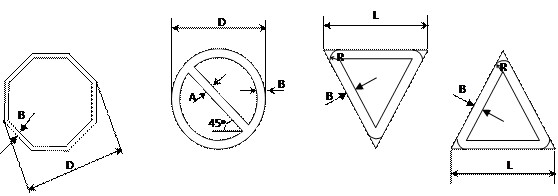




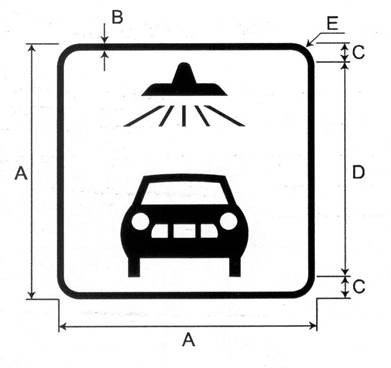
Figure 1 - Dimensions of sign types
Schedule 1 - Basic dimensions of traffic signs with multiplier of 1
Unit: cm
|
Type of sign |
Dimensions |
Value |
|
Circular sign |
Outer diameter, D |
70 |
|
Width of red outline, B |
10 |
|
|
Width of red line, A |
5 |
|
|
Octagonal sign |
Outer diameter, D |
60 |
|
Width of white outline, B |
3 |
|
|
Triangular sign |
Side length, L |
70 |
|
Width of red outline, B |
5 |
|
|
Curve radius of red outline, R |
3,5 |
|
|
Spacing from curve apex to triangle vertex, C |
3 |
|
|
Rectangular sign |
Spacing from curve apex to rectangle vertex, C |
2-3 |
Schedule 2 - Multiplier of sign dimensions
|
Type of road |
Expressway |
Dual-carriageway outside of city |
Regular road (*) |
Urban road (***) |
|
Prohibitory sign, sign giving orders, warning sign |
2 |
1,8 |
1,25 |
1 |
|
Information sign |
(**) |
2,0 |
1,5 |
1 |
|
Note: (*) Regular road means roads other than expressways, dual-carriageways, urban roads. (**) Multiplier of dimensions of information signs under Schedule 2 does not apply to expressway. Expressway shall be subject to separate provisions under Chapter 9 hereof. (***) In respect of signs mounted on gantries or cantilever posts of dual-carriageway in cities, dimension multiplier applicable to dual-carriageways outside of cities shall be applied. In special cases such as when consistency between traffic signs on a road or road section with consistent roadway width and inconsistent divider placement or inconsistent roadway width due to presence of short sections is desired, sign dimensions shall be the same throughout the road or road section in order to allow road users to see and maintain aesthetics. |
||||
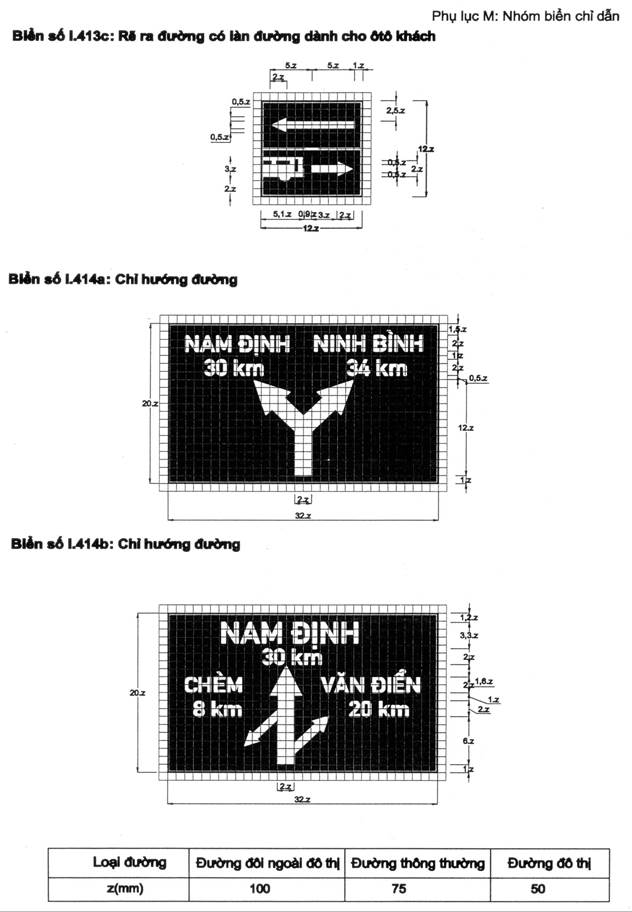
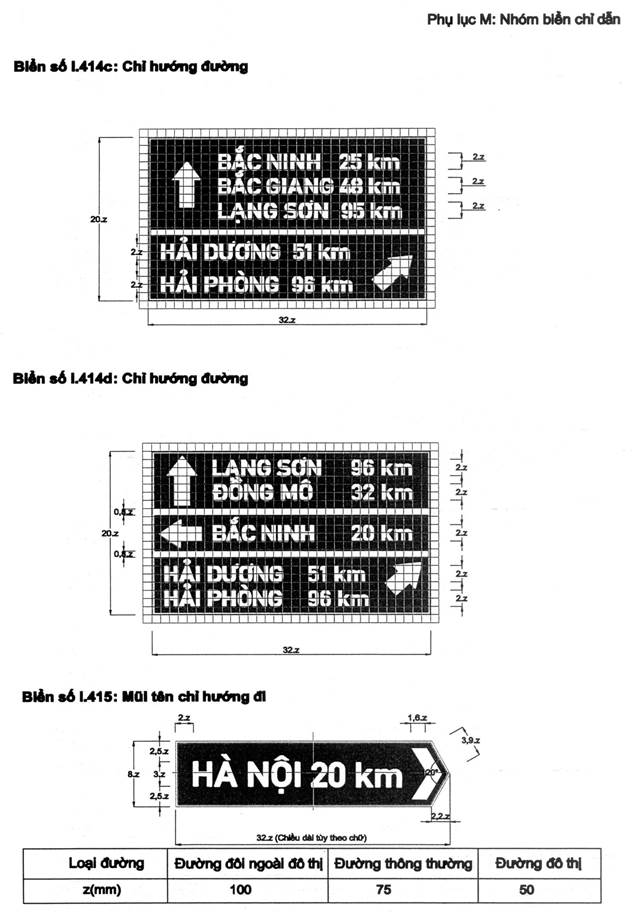
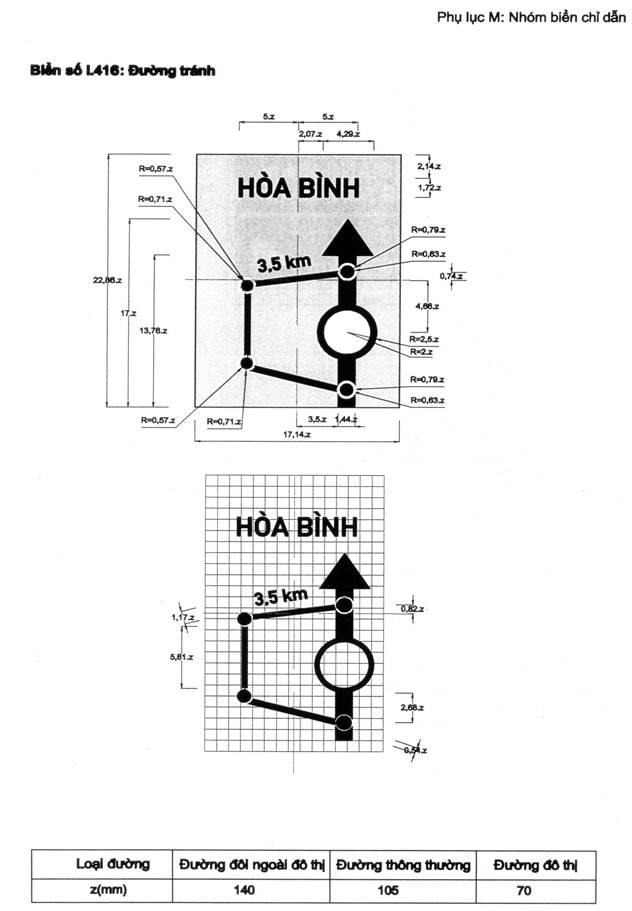
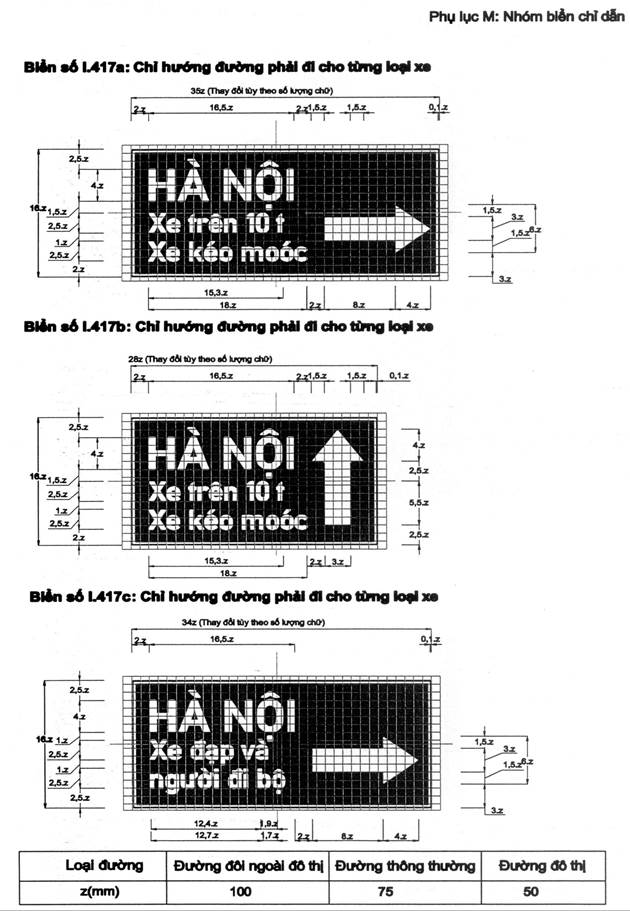
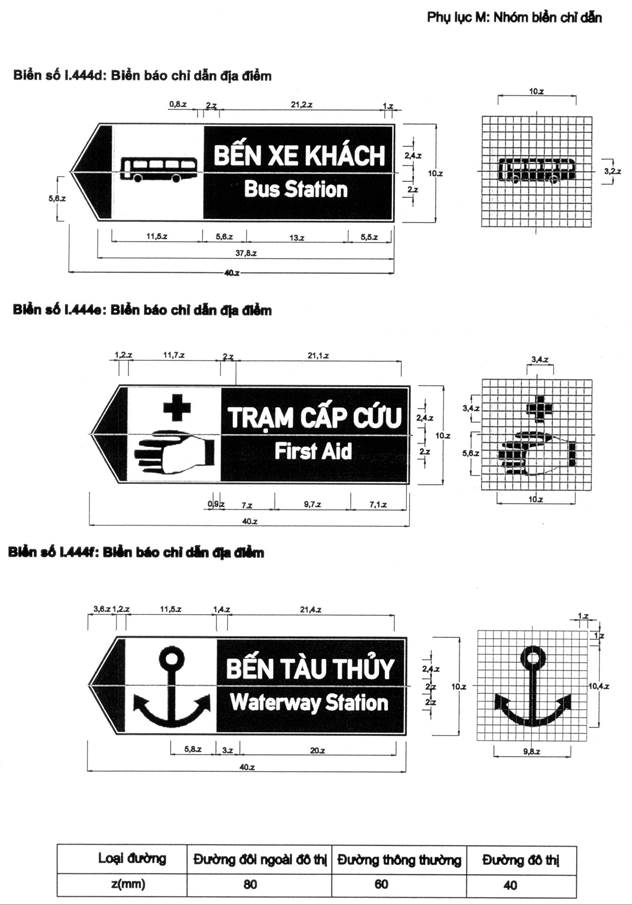
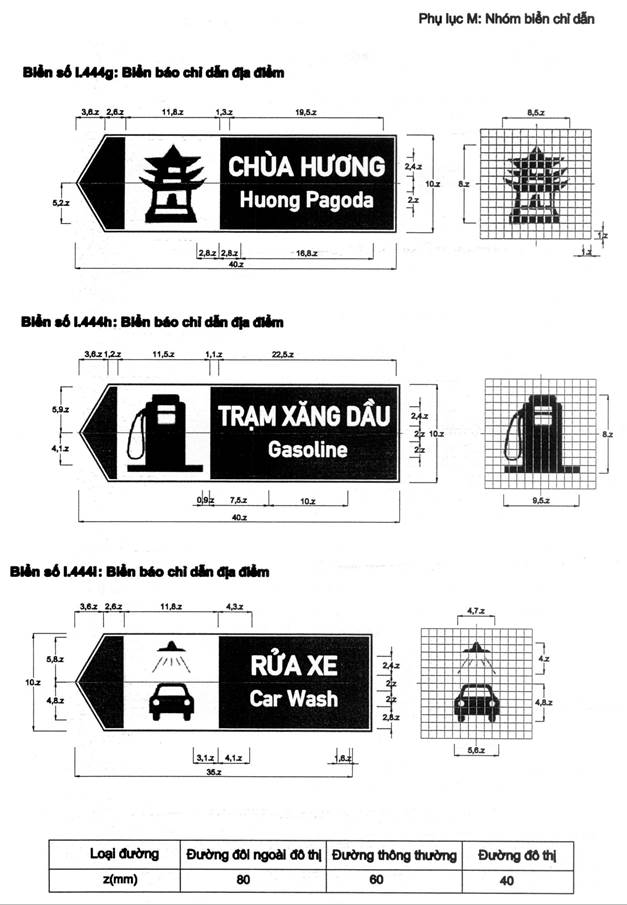
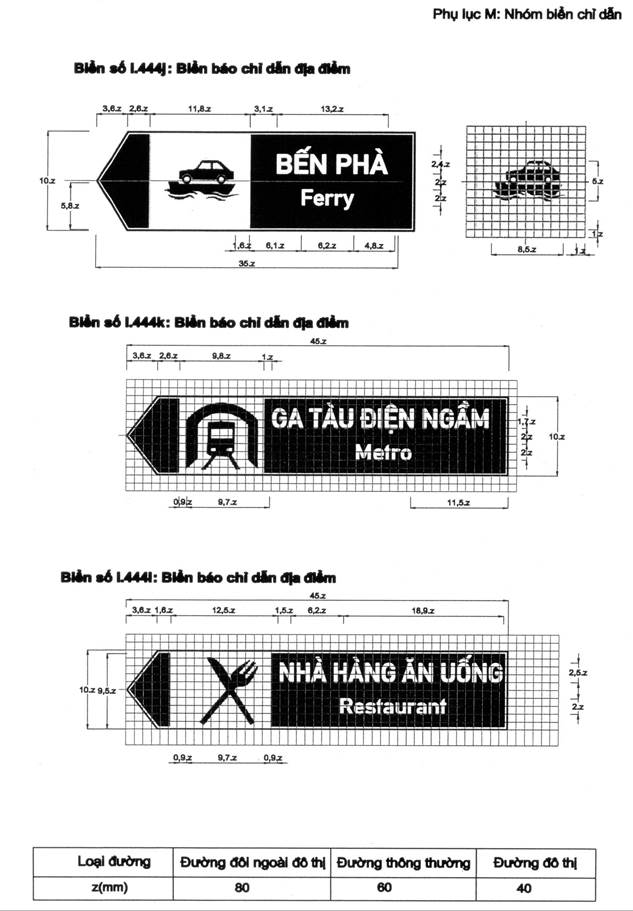
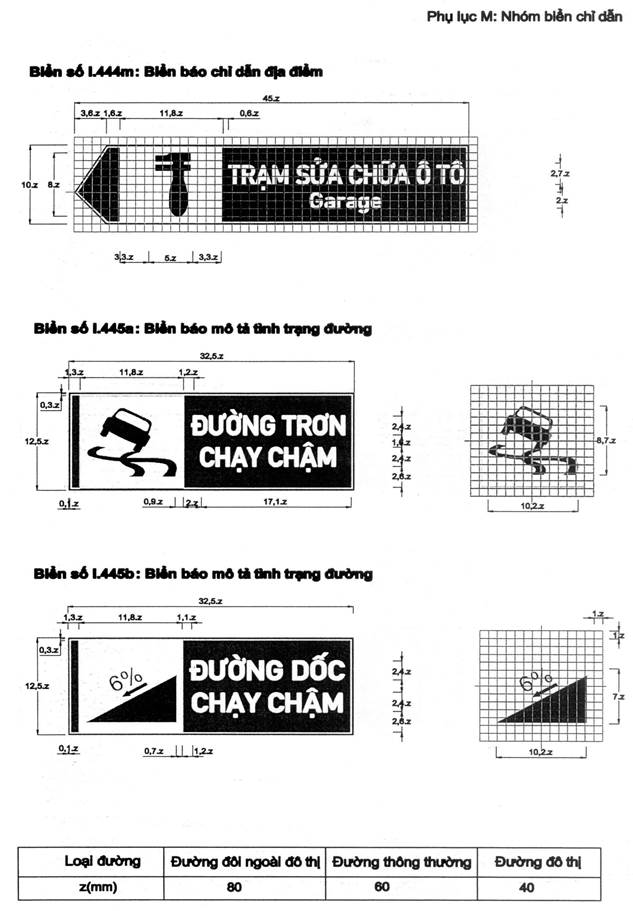
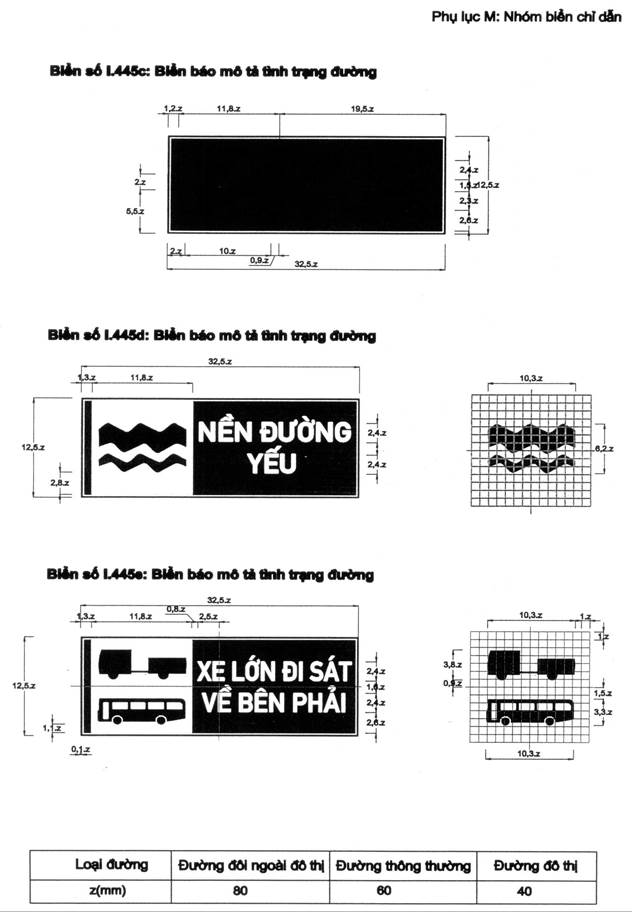
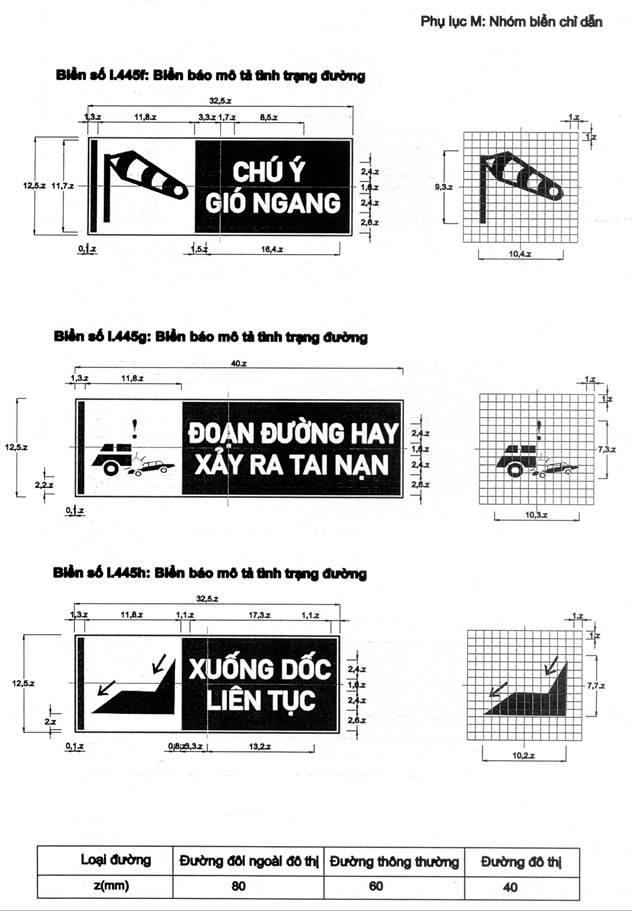
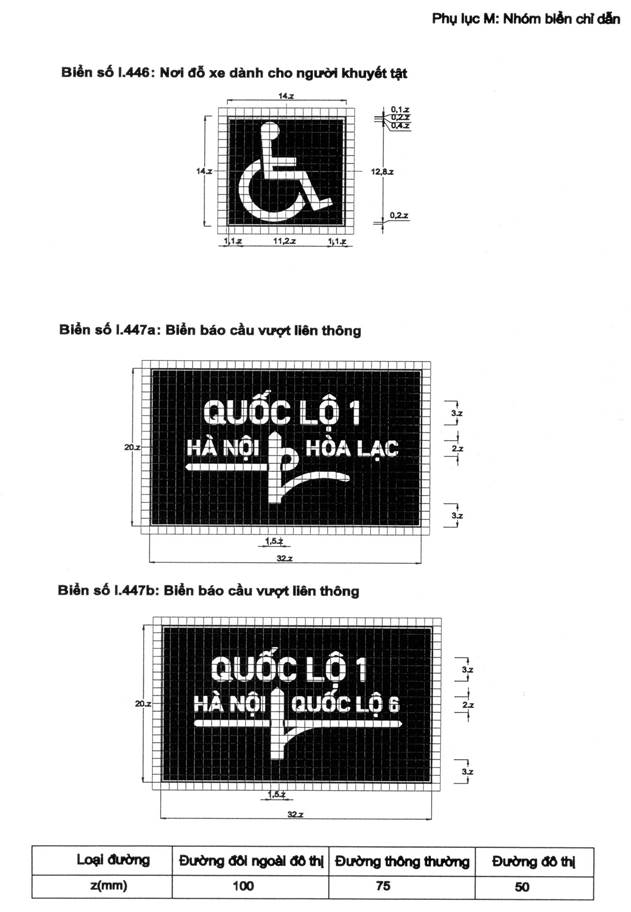
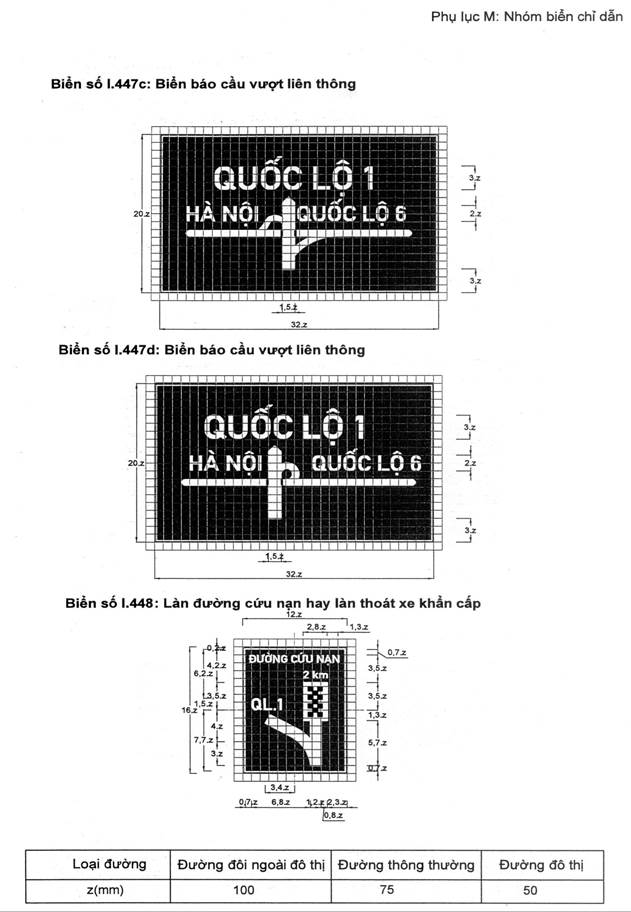
16.3. Detail parameters pertaining to sign text, sign dimensions, sign illustration are specified under Appendices K, M, and P hereof. Dimension of information signs can be adjusted depending on practical conditions to maintain information clarity, symmetry, and aesthetics of the signs.
16.4. In respect of roads with low technical grade (grade V or grade VI or not yet classified) and rural roads, multipliers 1,25 or 1 or 0,75 shall be adopted depending on scale and working environment.
16.5. Dimension multiplier of mobile signs, temporary signs, and signs used in special cases (such as signs installed on narrow dividers or narrow shoulders, visually obscured signs, signs installed in small alleys, and sign illustrations in combined signs) shall be 0,5 or 0,75 (and rounded as per the law).
16.6. Dimensions of text-only signs on international roads shall be so adjusted to accommodate all the texts in accordance with this document.
Article 17. Traffic sign text, color, and symbols
17.1. Traffic sign text shall conform to regulations on font size under Appendix K hereof unless adjustment is required to maintain symmetry and achieve information clarity, in which:
17.1.1. Sign text shall use standard fonts “gt1 - Compressed font” and “gt2 - Normal font”.
17.1.2. All capitals in normal font or compressed font are used to indicate directions, proper nouns, or to emphasize information and attract attention of road users. Compressed font should only be used if sign dimension must be limited.
17.1.3. Small capitals are used for proper nouns in English, service information, and in supplementary signs.
17.1.4. Each line shall consist of letters of the same case.
17.1.5. Texts on traffic signs shall be Vietnamese texts with full diacritics. Spacing between letters shall be 25% - 40% letter height; spacing between words on the same row shall be 75% - 100% letter height. Minimum spacing between lines shall be 50% - 75% the height of the highest letter of the next line. Minimum spacing between the topmost line to the top of the sign and between the bottommost line to the bottom of the sign shall be 40% the height of the highest letter in respective line. Minimum horizontal spacing between letters on the topmost and bottommost lines to edge of the sign shall be 60% the height of all capitals and 100% the height of small capitals.
17.1.6. Spacing between letter of measurement unit (t, m, km) and the preceding number shall be 50% the height of the letter of measurement unit.
17.1.7. Letter height shall be so determined that road users can read with ease regardless of time of day while driving at specific speed. Minimum letter height on information signs shall be 100 mm in case of normal roads and urban roads; 150 mm for dual-carriageways outside of cities; and 300 mm for expressways. Minimum height of texts indicating proper nouns of locations and direction shall be 150 mm. Larger font sizes are recommended as long as symmetry and aesthetic are maintained.
17.1.8. Texts shall be as concise and comprehensible as possible; information on traffic signs shall be consistent with other information.
17.1.9. The following text coloring schemes shall be used: white on black or blue or red background; black on white or yellow background; or yellow on blue background.
17.1.10. Texts on information signs on expressways shall adhere to 49.3 of Article 49 hereof in addition to 17.1 of Article 17.
17.2. Sign colors
Sign colors shall adhere to technical regulations on colors and be consistent with sign groups used in road network.
17.3. Sign symbols and illustrations
Symbols and illustrations shall be elaborated on a case-by-case basis. Illustration of vehicle types shall depict: motor vehicles in general and buses in form of front view projection, specific types of vehicles in form of side projection. Depending on traffic arrangement situation, where existing signs in the Regulation apply to different subjects, existing subjects (vehicle illustrations) shall be replaced by new subjects (vehicle illustrations). Taxis shall be depicted by symbol of motor vehicle accompanied by the text “TAXI” above; rapid buses shall be depicted by symbol of bus accompanied by the text “BRT” above; vehicles equipped with ETC devices shall be depicted by symbol of the corresponding vehicle type accompanied by the text “ETC” above. Vehicle types for which symbols have not been determined shall be depicted by texts.
Symbol associated to each vehicle type:
|
|
|
|
|
|
|
|
|
|
|
|
Motor vehicle |
Car |
Truck |
Bus |
Passenger coach |
Semi-trailer truck |
Trailer truck |
Motorbike (Scooter) |
Moped |
Bicycle |


If load rating or seating capacity of truck or passenger coach must be presented, texts indicating the number of tonne and seats (for example, for truck > 3,5 tonne, specify > 3,5t on truck illustration; for passenger coach less than 16 seats, specify < 16c on passenger coach illustration) shall be added.
Article 18. Variable message sign and temporary sign
18.1. Variable message sign (VMS): means an electronic sign that displays various messages. These signs shall be used when information therein changes depending on traffic situations. Depending on purpose of use, information displayed on these signs can be directional instructions, prohibition, orders, or danger warnings. VMS shall not be used for advertising. VMS shall not display animated, flashing images or moving images.
Where a static traffic sign and a VMS are contradictory to one another and located in the same area, road users shall comply with the VMS.
18.2. Information display on VMS
18.2.1. Information displayed on VMS can be texts, illustrations, or symbols.
18.2.2. If information is displayed in form of texts, the message shall contain no more than 3 lines each of which must contain no more than 20 letters and numerals. Spacing between letter and symbols shall be 25% - 40% the letter height. Spacing between words in a line shall be 75% - 100% the letter height. Spacing between lines shall be 50% - 75% the letter height. Messages shall be Vietnamese with full diacritics. Minimum letter height shall be 450 mm for roads with top speed limit of at least 70 km/h and 300 mm for roads with top speed limit below 70 km/h. Messages depicted on VMS shall be clear and concise.
18.2.3. Width to height ratio of letters shall be 0,7 to 1,0 and can be reduced to a minimum of 0,2 in case of compressed font.
18.2.4. Luminous intensity of electronic signs shall meet technical requirements and be visible regardless of time of day. The texts shall be illuminated against black background or dimmed background.
18.2.5. Red texts shall indicate prohibition, yellow texts indicate warnings, white texts indicate orders, blue texts indicate instructions, orange texts indicate temporary orders, neon pink texts indicate real-time traffic arrangement, and neon yellow - green texts inform cyclists and pedestrians.
18.2.6. Each message shall contain no more than 2 sentences. Each sentence shall consist of no more than 3 lines. Sentences shall be coherent, comprehensible, and incapable of causing misunderstanding.
18.2.7. Messages shall be displayed instantaneously and shall not use effects such as: flashing, fade-in, fade-out, horizontal slide, vertical slide.
18.3. Temporary signs: are signs used for short-term traffic arrangement such as for events, traffic incidents, or road construction or repair. Where temporary signs contradict existing signs, road users shall adhere to the temporary signs in which case supplementary signs that read “TẠM THỜI” (TEMPORARY) shall be installed.
Article 19. Priority of traffic signs
19.1. Warning signs and information signs shall only apply to lanes in the direction of travel.
19.2. Prohibitory signs and signs giving orders shall apply to all lanes or some lanes or a lane depending on the signs.
19.3. In case of stand-alone signs, road users shall adhere to the signs. Where signs are to be used in combination with traffic lights, road users shall comply with orders of traffic signs and traffic lights in the order of priority specified under Article 4 hereof.
Article 20. Traffic sign placement along and across the road
20.1. Traffic signs shall be located at a position that road users can see and have ample time to prepare, decelerate, or change direction without obscuring visibility and mobility of road users.
20.2. Signs shall be placed upright and facing towards oncoming vehicles. Signs shall be located to the right or above roadway (except for special cases). Additional signs can be located on the left of direction of travel on a case-by-case basis.
20.3. Where signs are mounted on posts (lamp posts, utility posts), horizontal spacing between the edge of the signs and roadway shall be at least 0,5 m and at most 1,7 m. Where road shoulders or sidewalks are not available or visibility is obscured or other special cases occur, the horizontal spacing can be adjusted as long as the edge of the signs does not encroach upon the roadway and is no more than 3,5 m away from the roadway.
Article 21. Gantry and cantilever post
21.1. Gantries and cantilever posts are structures that can withstand their own weight, weight of traffic signs, and local wind speed publicized by Ministry of Natural Resources and Environment.
21.2. Supporting structure of gantries and posts of cantilever posts shall be located on road shoulders, sidewalks, dividers, traffic islands that are at least 0,5 m away from edge of roadway (including where emergency lanes, acceleration lanes, deceleration lanes are located).
21.3. Where traffic signs are mounted on gantries or cantilever posts, the bottom side of the signs (or the bottom side of the beam, whichever is lower) shall be at least 5,2 m away from expressway surface and 5,0 m away from road surface (see Figure 2).
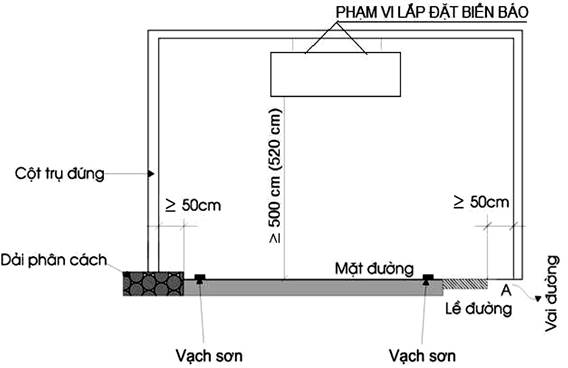
Figure 2. Gantry
Article 22. Sign mounting height and combination
22.1. Signs shall be fixed to posts in accordance with Article 24 hereof. In some cases, traffic signs can be mounted on electric posts, trees, or other architectural elements as long as the signs can be seen with ease and aesthetics are maintained.
22.2. Where signs are mounted on posts, vertical distance from the lowest points of the signs to the road surface shall be 1,8 m for roads outside of residential zones, and 2,0 m for roads in residential zones. Sign No. 507 “Turn direction” shall be located at a height of 1,2 m to 1,5 m. Sign types applicable solely to non-motorized vehicles and pedestrians shall be 1,8 m away from road surface, road shoulder, or sidewalk. The aforementioned distance can be adjusted accordingly to a minimum of 1,2 m and a maximum of 5,0 m in special cases decided by road authority.
22.3. Where multiple signs are mounted in the same location, up to 3 signs can be mounted on the same post in the following order: prohibitory sign, sign giving orders, danger or warning sign, information signs (see examples in Figure 3).
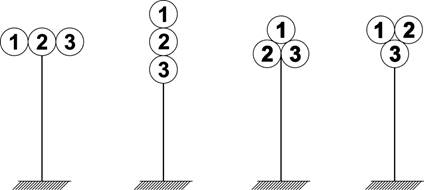
Note: the numbers indicate order of priority
Figure 3. Illustration of sign arrangement on a post
Spacing between signs from the edges shall be 5 cm; distance from the lowest point of signs in a group to road surface shall be 1,7 m for roads outside of residential zones and 2,0 m for roads in residential zones.
22.4. Where installation compliant with 22.3 of this Article is difficult or where the number of signs to be installed is high enough, it is possible to use a rectangular or square signs of sufficient dimensions depicting combined component signs in the specified order. Spacing between component signs in a combined sign and between a sign to a combined sign shall be 10 cm.
22.5. Where one or multiple prohibitory signs, danger or warning signs, signs giving orders must be combined with supplementary signs, it is possible to attach illustrations or symbols of supplementary signs and the primary signs to a square or rectangular combined sign of sufficient dimensions.
Article 23. Reflective surface of sign
Surface of signs shall be determined on the basis of operating conditions. Where reflective films are applied onto traffic signs, such reflective films shall conform to technical regulations on reflective films.
Article 24. Regulations on sign posts
24.1. Sign posts shall be of sturdy materials (of steel or other materials of equivalent strength) and having minimum cross section diameter of 8 cm (± 5mm).
24.2. Sign posts in areas where visibility is frequently obscured by fog or nighttime collision is likely shall be made of reflective materials to increase visibility.
Chapter 4
PROHIBITORY SIGN
Article 25. Functions of prohibitory sign
Prohibitory sign indicates prohibitions. Road users must comply with prohibitory signs.
Article 26. Interpretations of prohibitory signs
26.1. Prohibitory signs shall be identified by the code P (prohibition) and DP (end of prohibition) with sign names as follows:
|
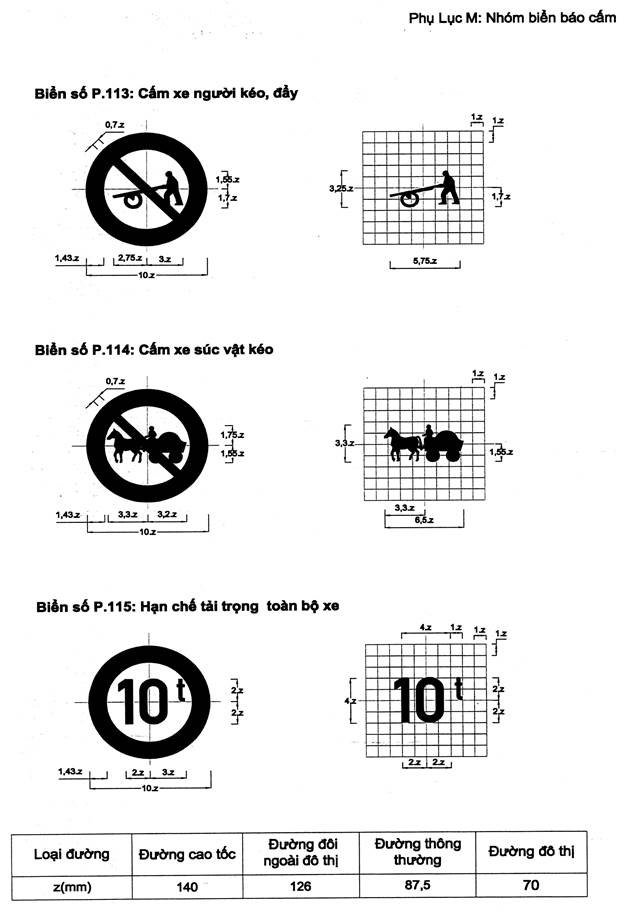
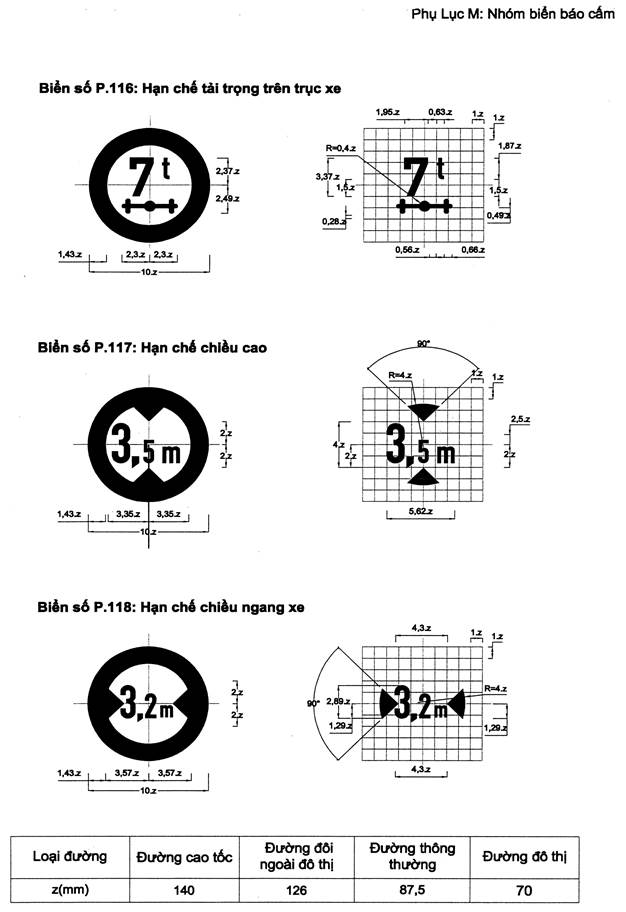
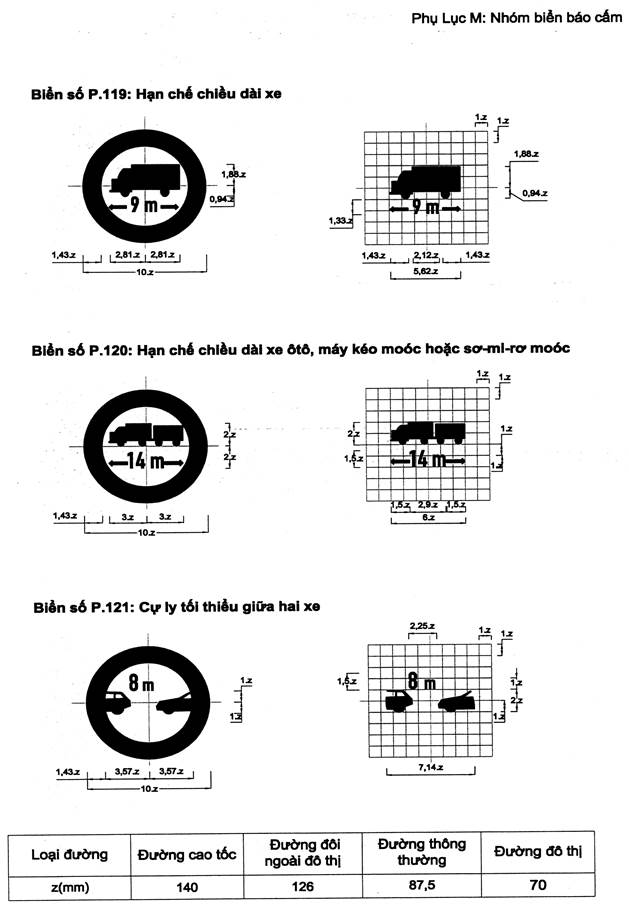
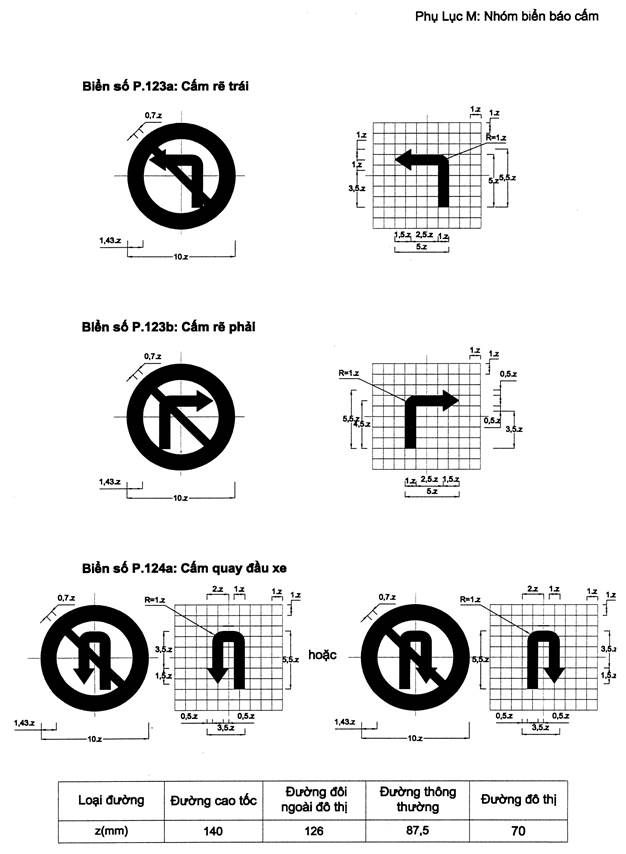
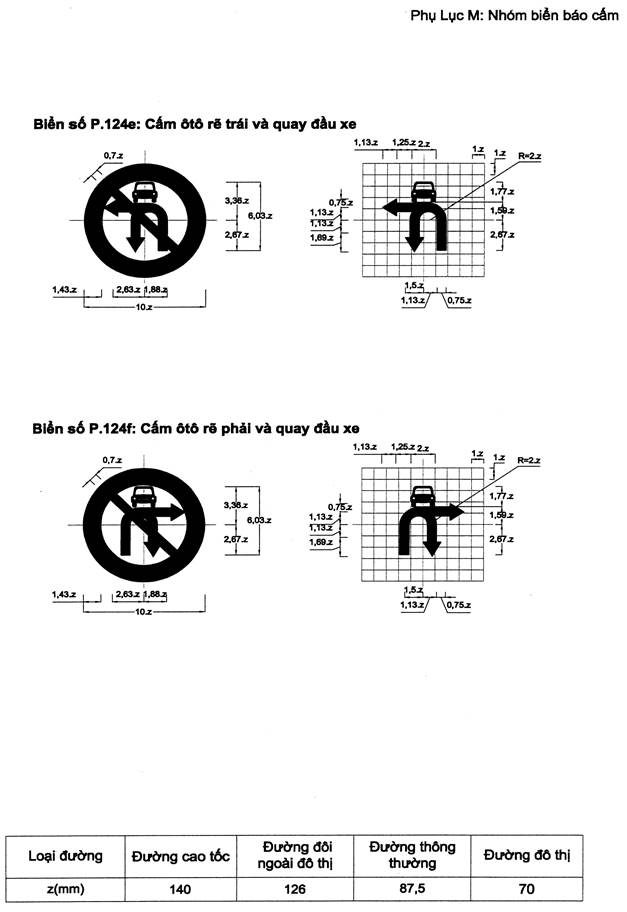
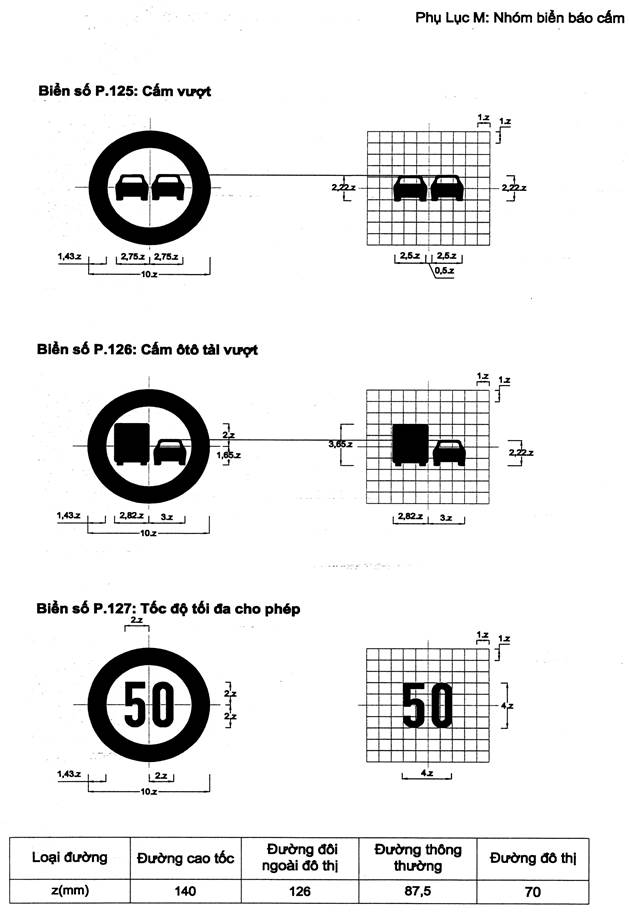
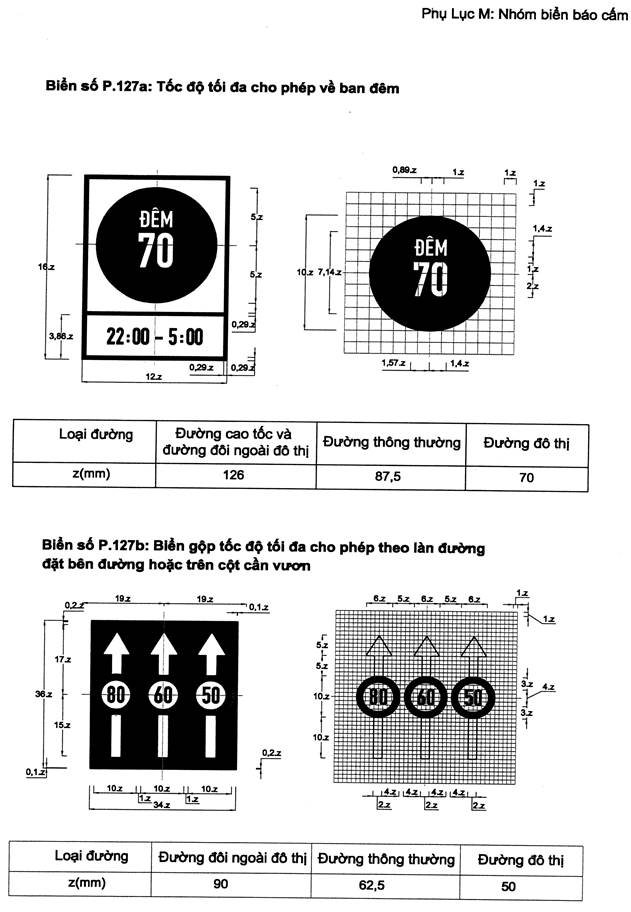
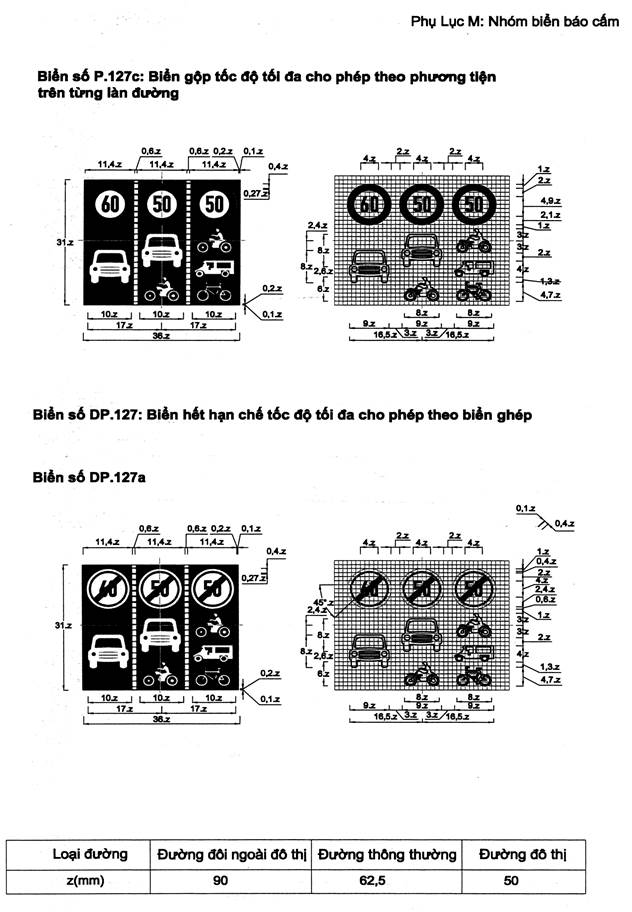
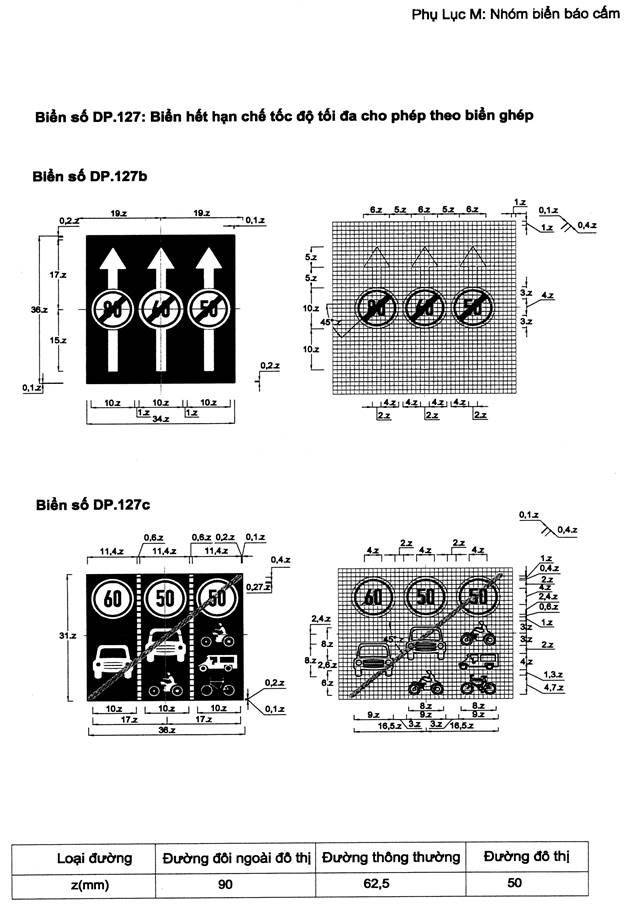
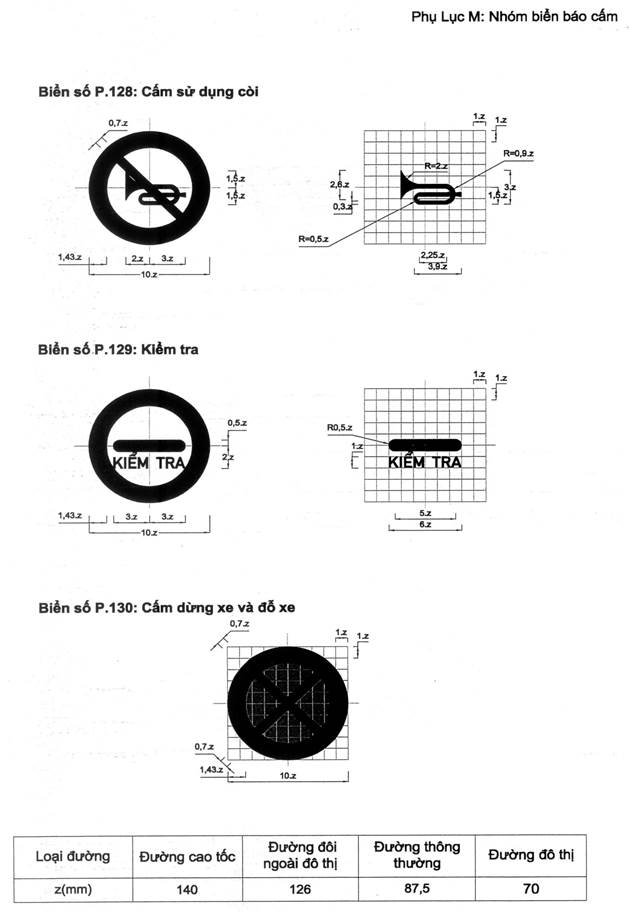
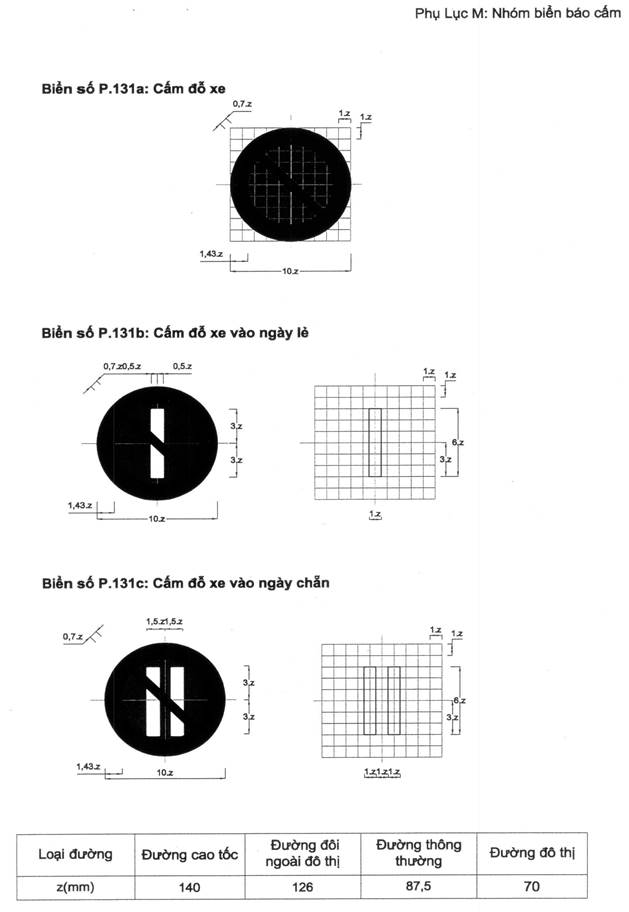
- Sign No. P.101: Road closed; - Sign No. P.102: Wrong way; - Sign No. P.103a: No motor vehicles; - Sign No. P.103 (b,c): No left turn for motor vehicles; No right turn for motor vehicles; - Sign No. P.104: No motorcycles; - Sign No. P.105: No motor vehicles and motorcycles; - Sign No. P.106 (a,b): No trucks; - Sign No. P.106c: No hazardous goods vehicles; - Sign No. P.107: No passenger coaches and cargo trucks; - Sign No. P.107a: No passenger buses; - Sign No. P.107b: No taxis; - Sign No. P.108: No trailer trucks; - Sign No. P.108a: No semi-trailer trucks; - Sign No. P.109: No tractors; - Sign No. P.110a: No bicycles; - Sign No. P.110b: No cargo bicycles; - Sign No. P.111a: No moped; - Sign No. P.111 (b) or (c): No motorized three-wheeled vehicles (motorized rickshaw); - Sign No. P.111d: No non-motorized three-wheeled vehicles (cycle rickshaws); - Sign No. P.112: No pedestrians; - Sign No. P.113: No human-powered vehicles; - Sign No. P.114: No animal-powered vehicles; - No. P.115: Gross weight limits; - Sign No. P.116: Axle load limits (single axle); - Sign No. P.117: Height limits; - Sign No. P.118: Width limits; - Sign No. P.119: Length limits; - Sign No. P.120: Length limits of motorized vehicles towing trailers or semi-trailers; - Sign No. P.121: Minimum safe following distance; - Sign No. P.123 (a,b): No left turns; No right turns; - Sign No. P.124 (a,b): No u-turns; No u-turns for motor vehicles; - Sign No. P.124 (c,d): No left turns and no u-turns; No right turns and no u-turns; - Sign No. P.124 (e,f): No left turns and no u-turns for motor vehicles; No right turns and no u-turns for motor vehicles; - Sign No. P.125: No overtaking; - Sign No. P.126: No overtaking for trucks; - Sign No. P.127: Speed limits; - Sign No. P.127a: Nighttime speed limits; - Combined sign No. P.127b: Per-lane speed limit; - Combined sign No. P.127c: Per-lane and per-vehicle speed limits; - Sign No. DP.127: End of speed limits on combined sign; - Sign No. P.128: No horns; - Sign No. P.129: Inspection; - Sign No. P.130: No pull over and no parking; - Sign No. P.131 (a,b,c): No parking; - Sign No. P.132: Yielding to oncoming motorized vehicle in narrow roads; - Sign No. DP.133: End of no overtaking; - Sign No. DP.134: End of speed limits; - Sign No. DP.135: End of all restrictions; - Sign No. P.136: No straight ahead; - Sign No. P.137: No left turns, no right turn; - Sign No. P.138: No straight ahead, no left turn; - Sign No. P.139: No straight ahead, no right turn; - Sign No. P.140: No agricultural vehicles and similar vehicle type. |
26.2. Interpretation of individual signs shall be elaborated under Appendix B.
Article 27. Time-specific prohibitory sign
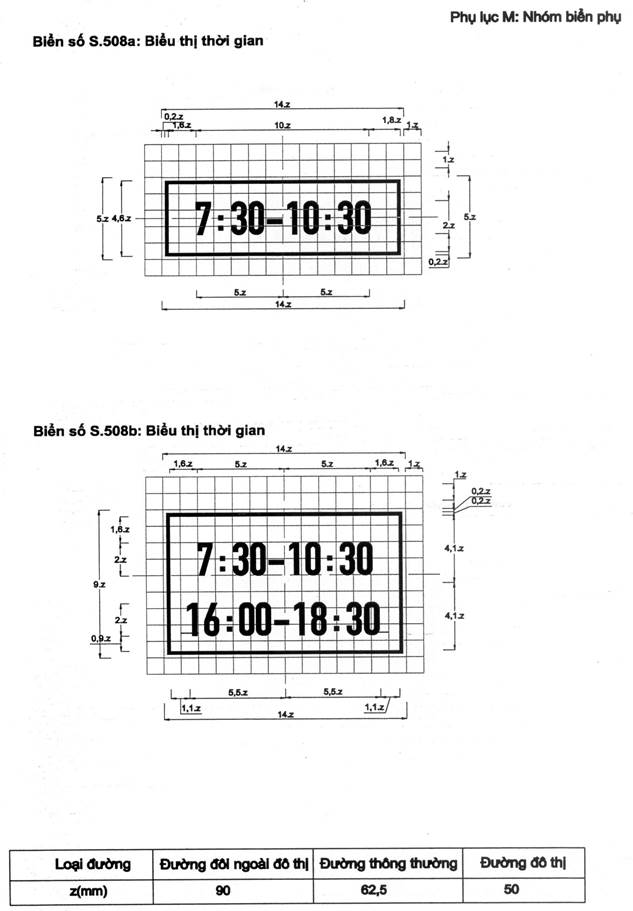
Where prohibitions are imposed in specific time, supplementary sign No. S.508 shall be attached below prohibition sign and containing explanation in Vietnamese and summary in English (if the area has high number of foreigners participating in traffic or international roads).
Article 28. Prohibitory signs applicable to multiple vehicles, subjects
For the purpose of indicating that multiple types of vehicle and subjects are prohibited from entering a road, it is possible to combine subjects of prohibition on a single sign as follows:
28.1. Motorized vehicle of all types shall be combined on the same sign;
28.2. Non-motorized vehicle of all types or other subjects of prohibition shall be combined on the same sign;
28.3. Each sign shall contain at most 2 types of vehicle.
Article 29. Dimensions, shape, and color of prohibitory sign
Dimensions, shape, and color of prohibitory signs shall be elaborated under Article 16, Article 17 Appendix B hereof.
30.1. Prohibitory signs shall be located at junctions or before a position on the road where prohibition is imposed.
Prohibitory signs shall take effect starting from their position. Where a prohibitory sign must be installed at position other than where the prohibition is to be imposed, supplementary sign No. S.502 shall be installed to indicate distance from the sign to the area where the prohibition is imposed.
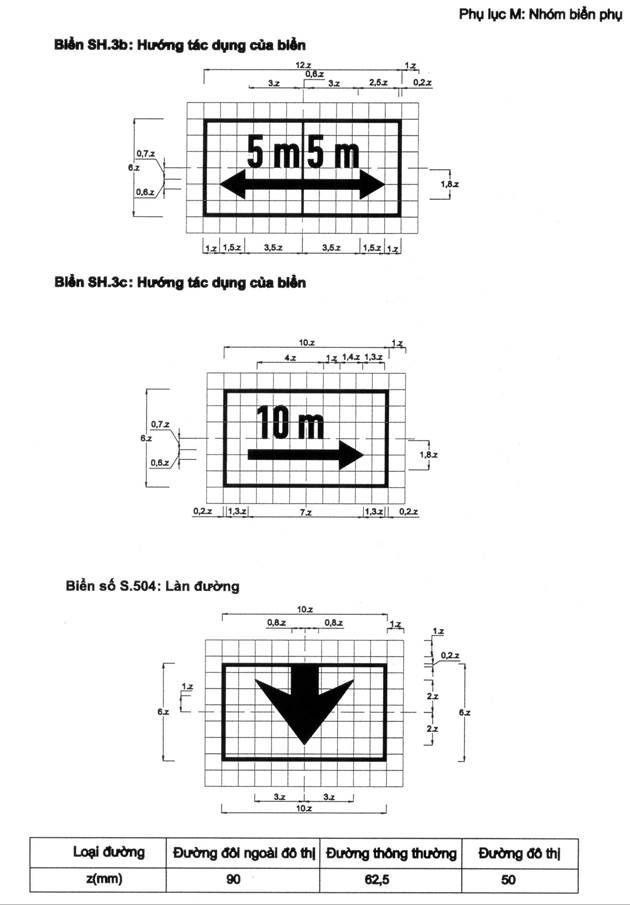
30.2. Where direction in which a prohibitory sign applies and starting point and/or ending point of the imposed prohibition must be specified, supplementary sign No. S.503 that reads “Hướng tác dụng của biển” (Applicable direction of sign).
30.3. Applicable area and signs indicating end of prohibition shall not be required in respect of prohibitory signs from No. P101 through P.120.
30.4. Signs indicating alternate direction for prohibited vehicles shall be installed in addition to signs under 30.3 when necessary in case roads or bridges are congested or damaged.
30.5. Sign No. P.121 and Sign No. P.128 shall be applicable throughout the distance specified on supplementary sign No. S.501 or until location of sign No. DP.135 “Hết tất cả các lệnh cấm” (End of all restrictions)
30.6. Sign No. P.123 (a,b) and Sign No. P.129 shall be applicable at their location.
30.7. Sign No. P.124 (a,b,c,d,e,f) shall be applicable at junction, interruption to dividers and shall not allow u-turn or allow u-turn via the use of supplementary sign No. S.503.
30.8. Signs No. P.125, P.126, P.127 (a,b,c), P.130, P.131 (a,b,c) shall be applicable until location of junctions or location of signs indicating end of prohibitions (signs No. DP.133, DP.134, DP.135, DP.127d). Signs No. P.130 and P.131 (a,b,c) shall also depend on supplementary signs.
30.9. Where roads on which prohibitory signs must be installed travel through junctions (except for junctions with alleys or entrances and exits to agencies or entities; or adjacent plots which can only be accessed through common paths), the same prohibitory signs shall also be installed in the same roads on the other side of the junctions unless otherwise stipulated by the law or accompanied by supplementary signs.
Chapter 5
WARNING SIGN
Article 31. Functions of warning signs
Warning sign warns road users about hazards in advance or conditions requiring special attention. Upon encountering warning signs, road users shall decelerate to a necessary degree, pay attention, and prepare for possible scenarios to prevent accidents.
Article 32. Interpretations of warning signs
32.1. Warning signs shall be identified by the code W with sign names as follows:
|
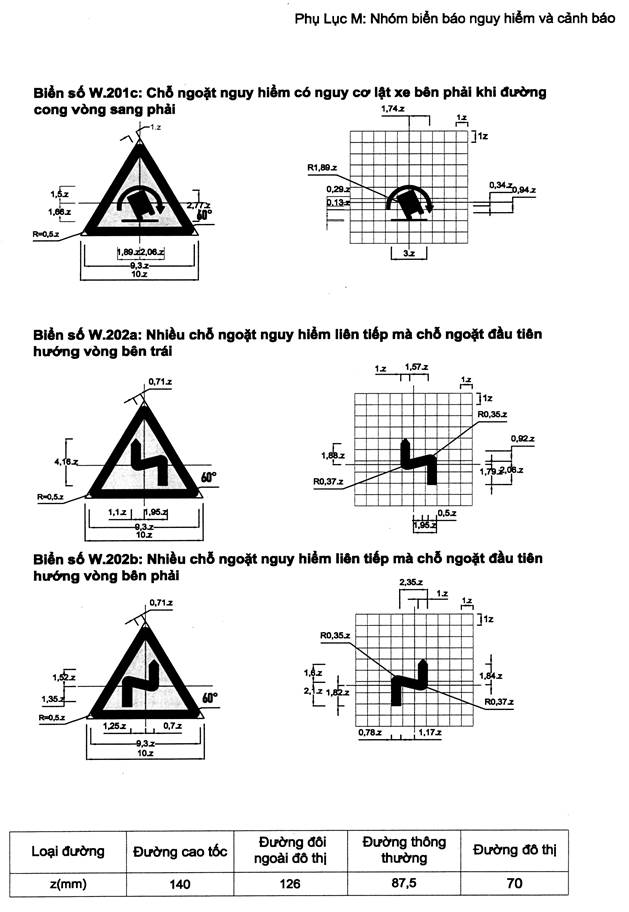
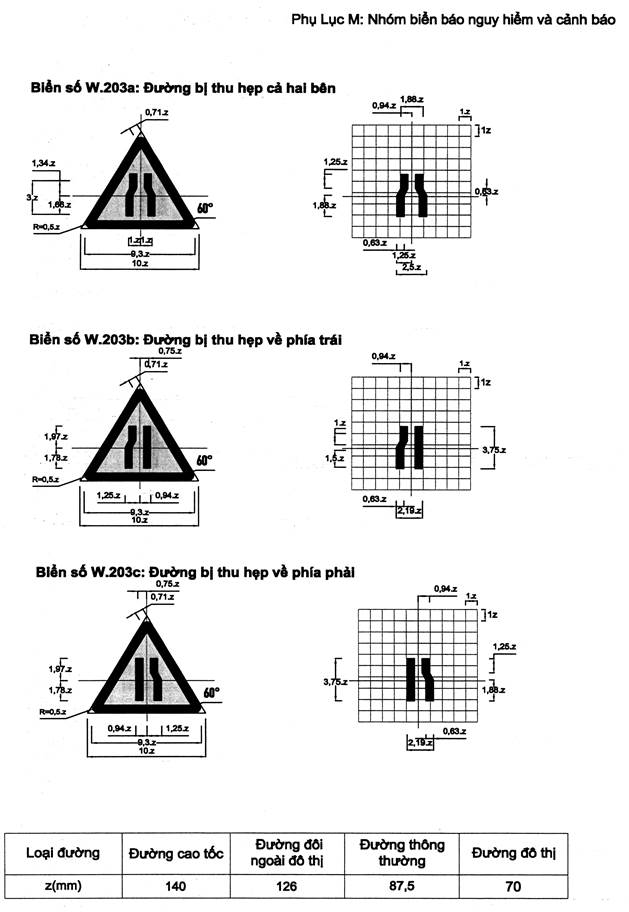
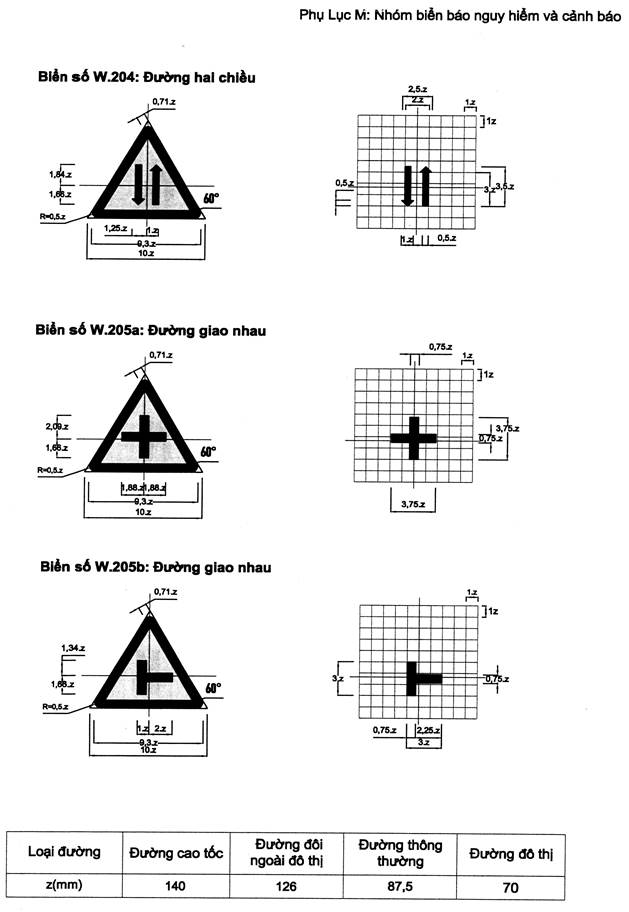
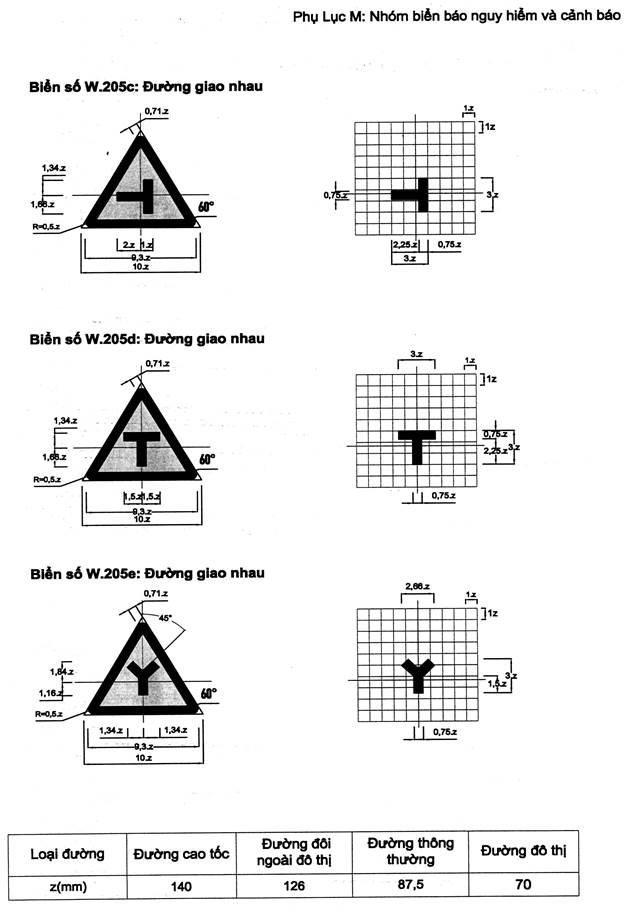
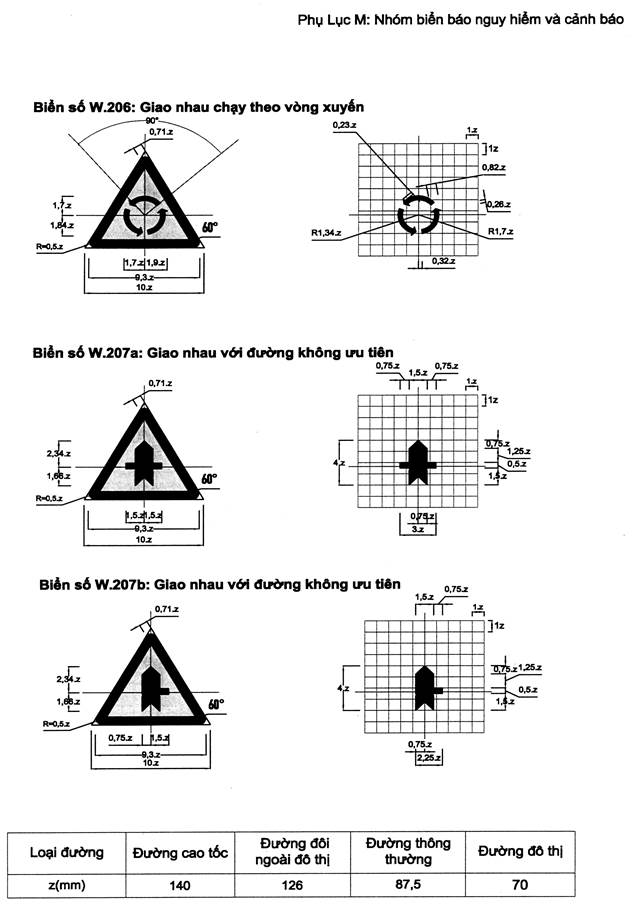
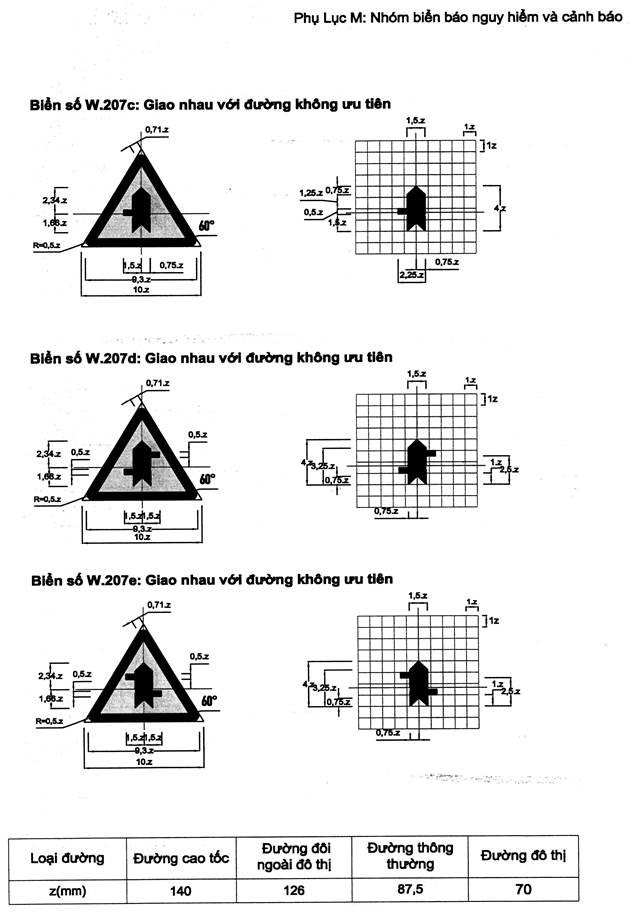
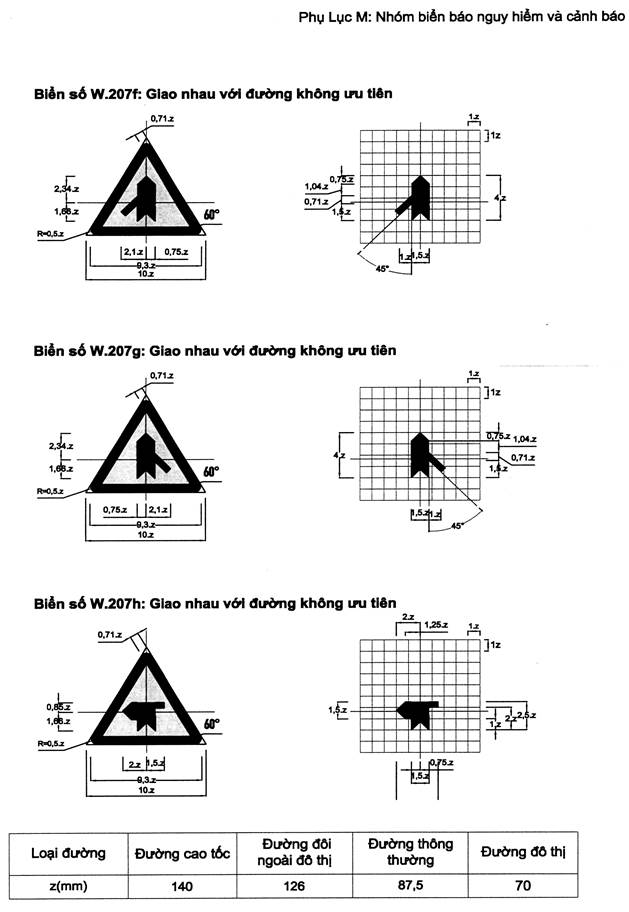
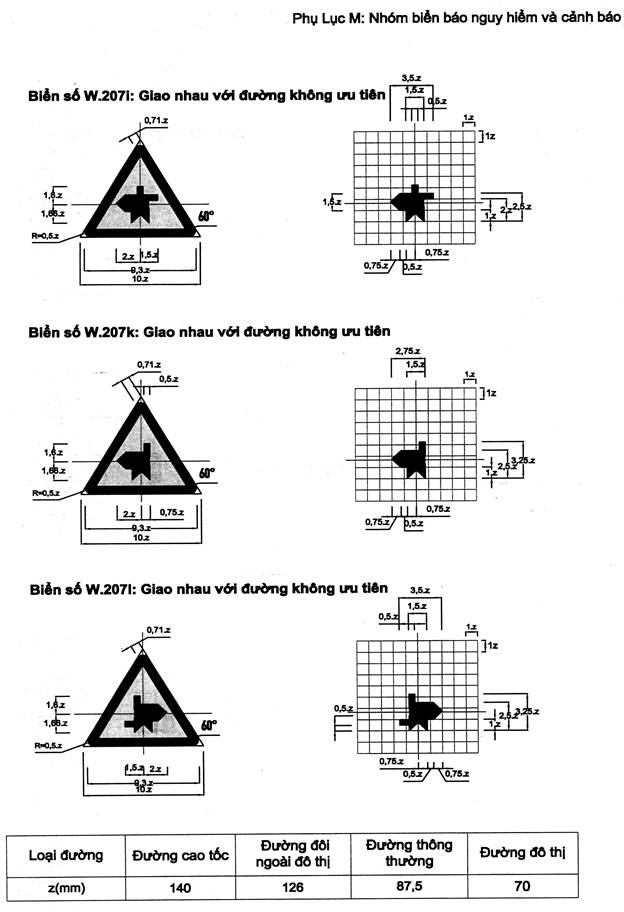
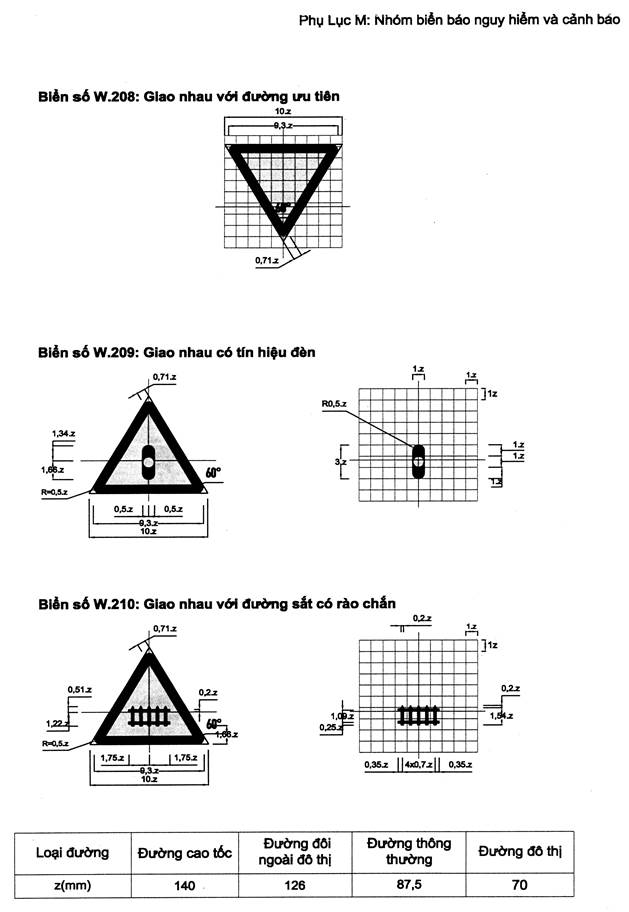
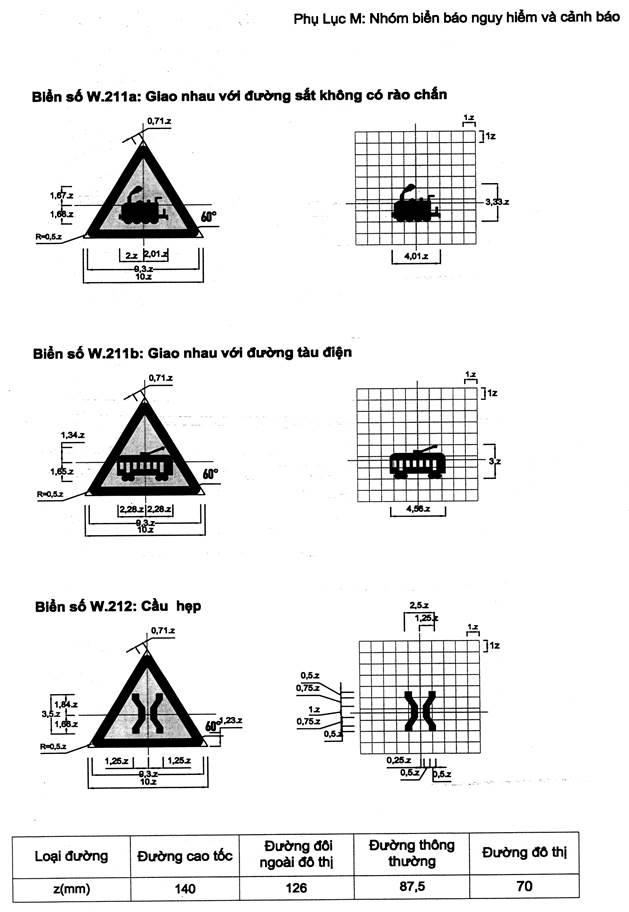
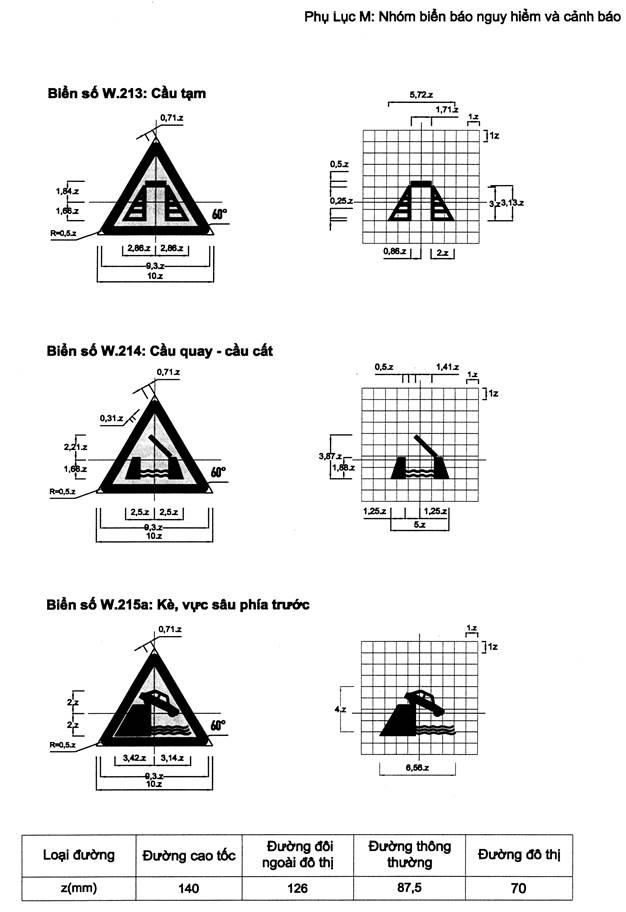
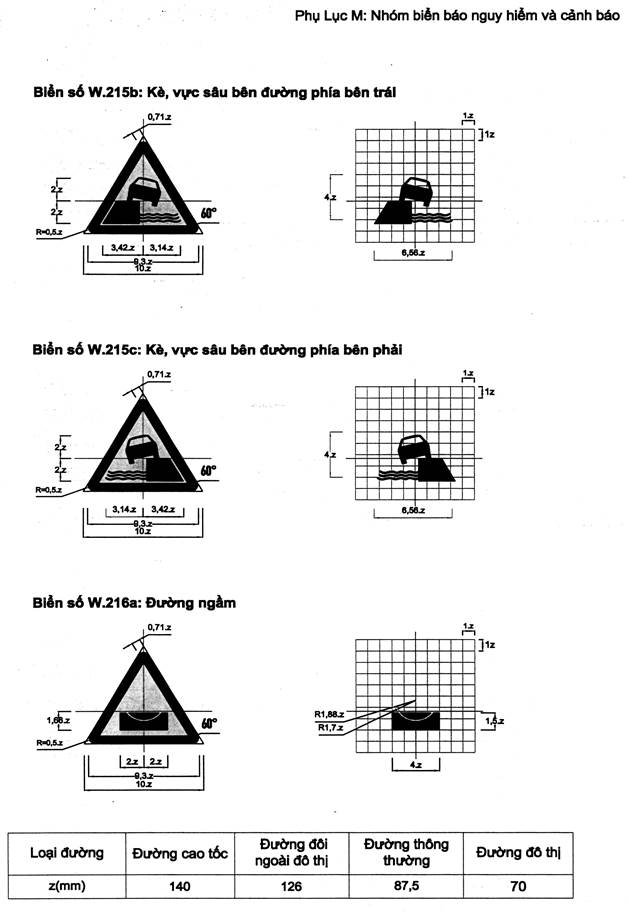
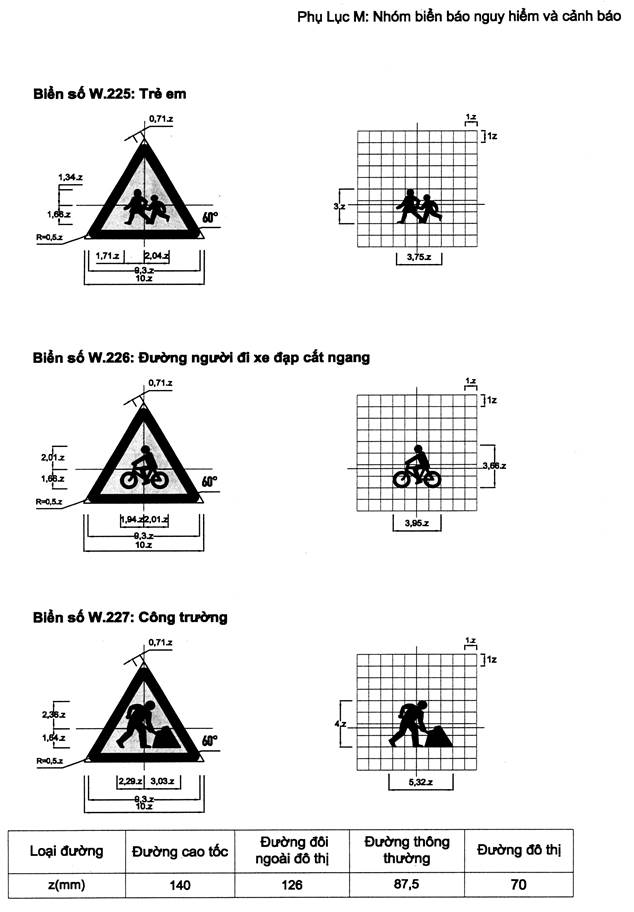
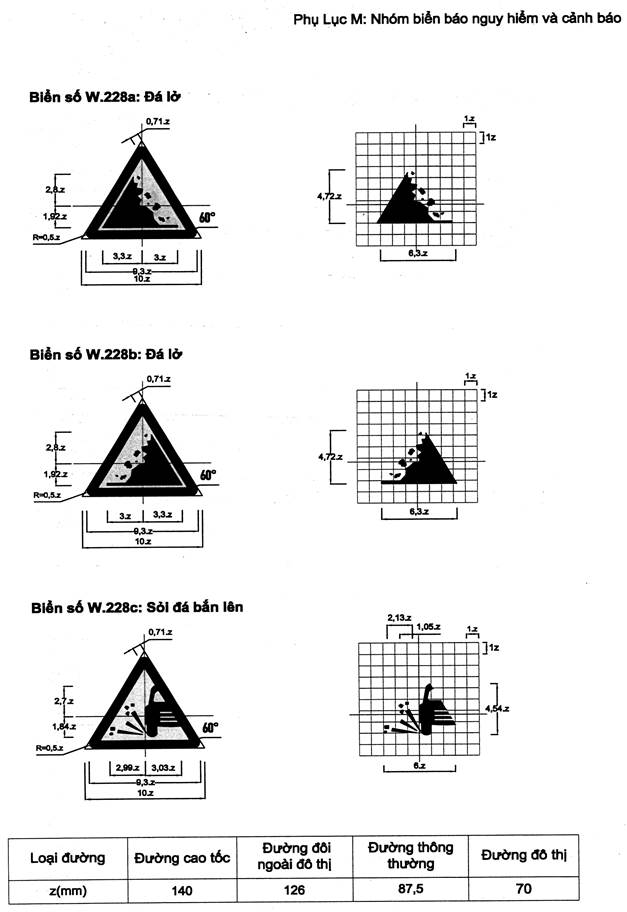
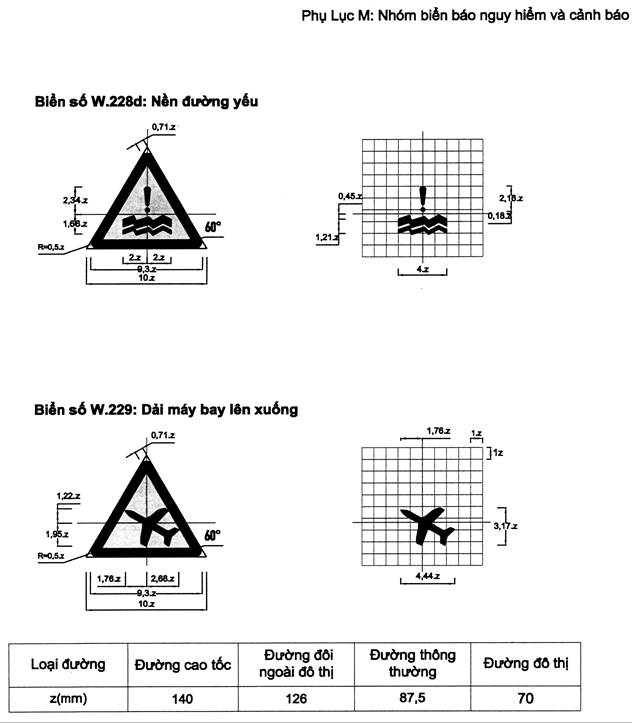
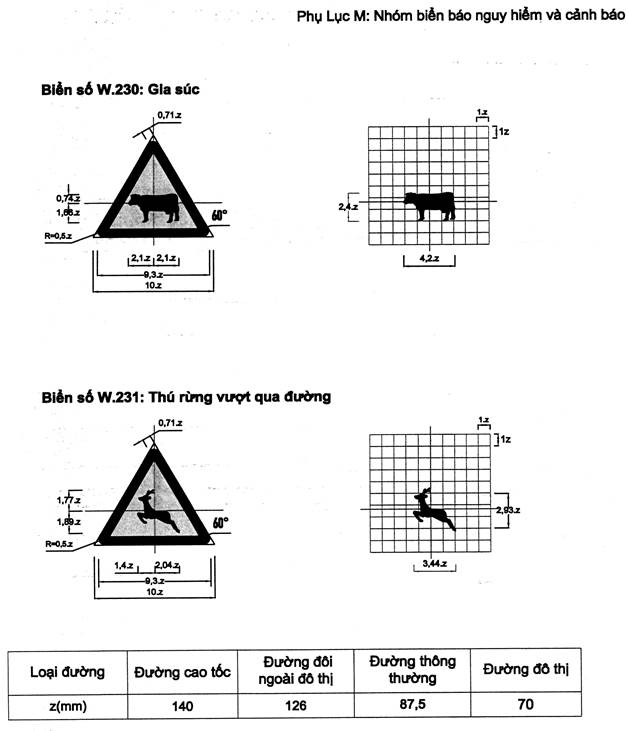
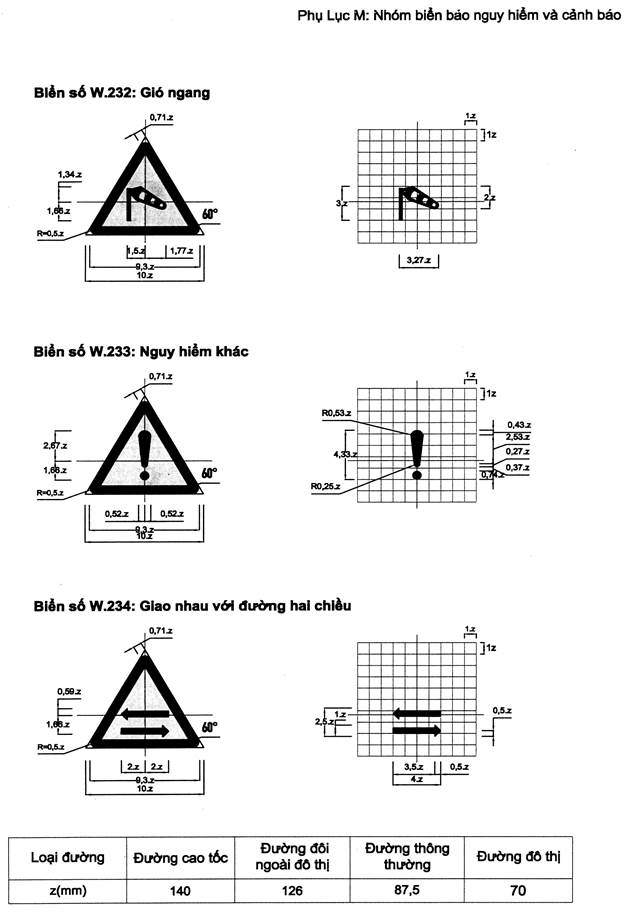
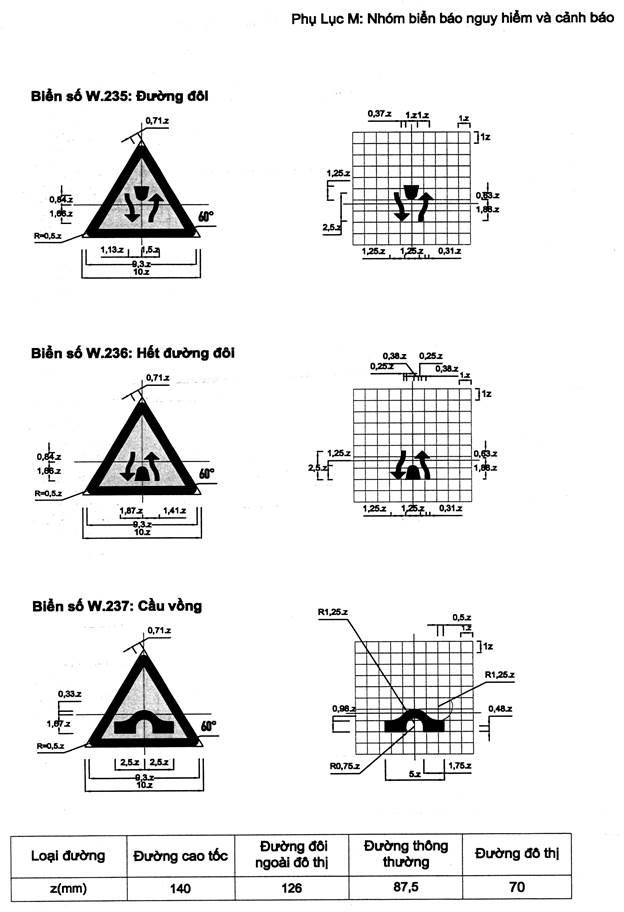
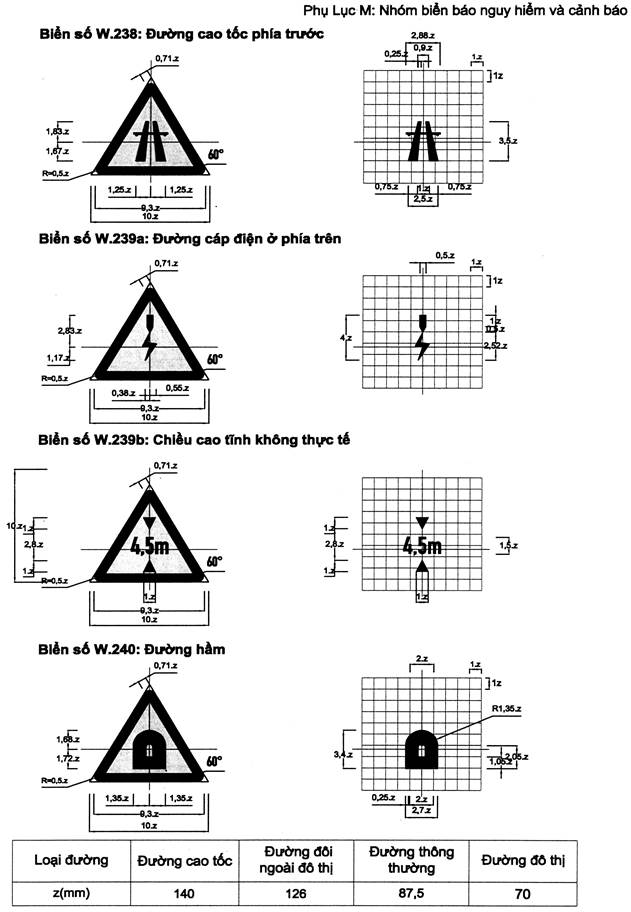
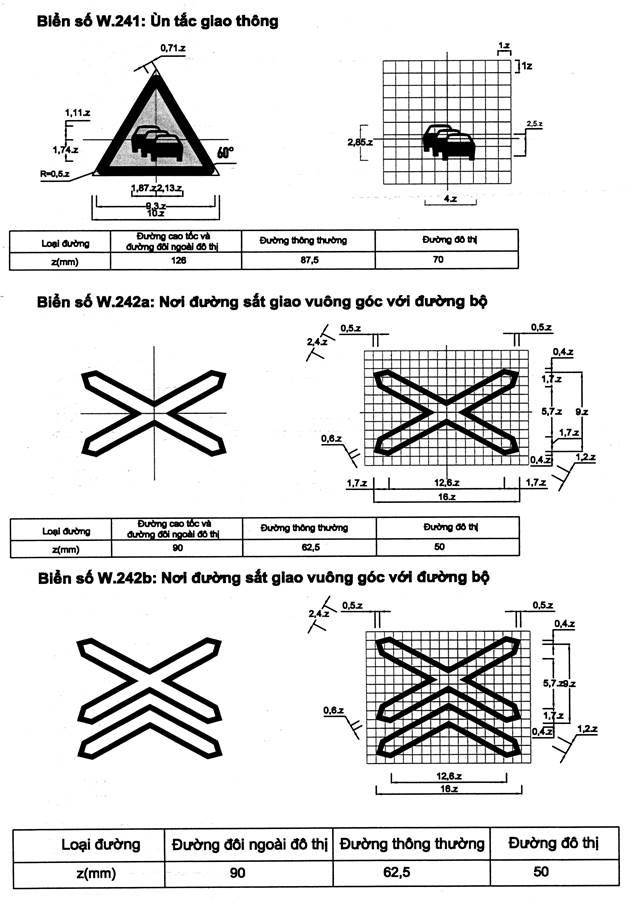
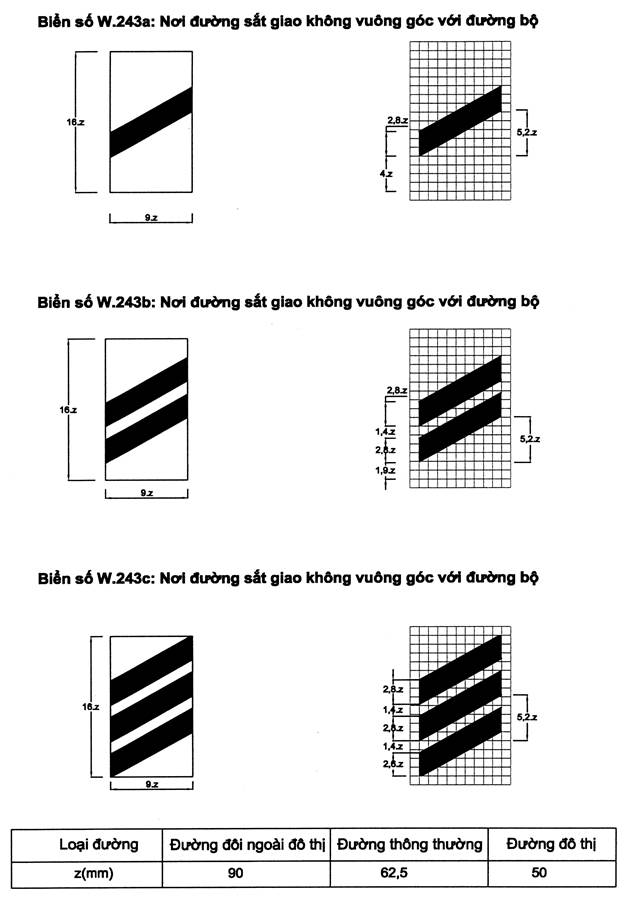
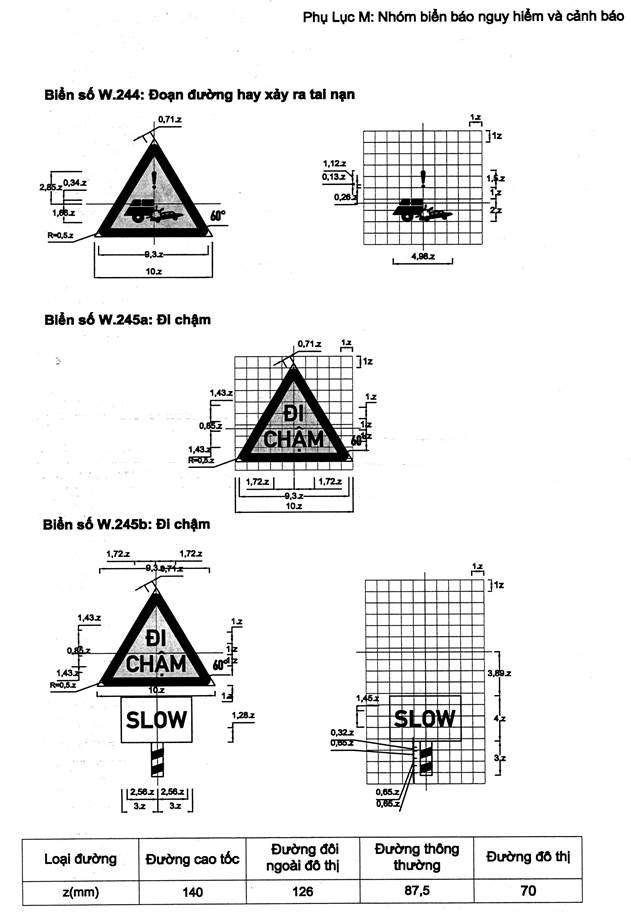
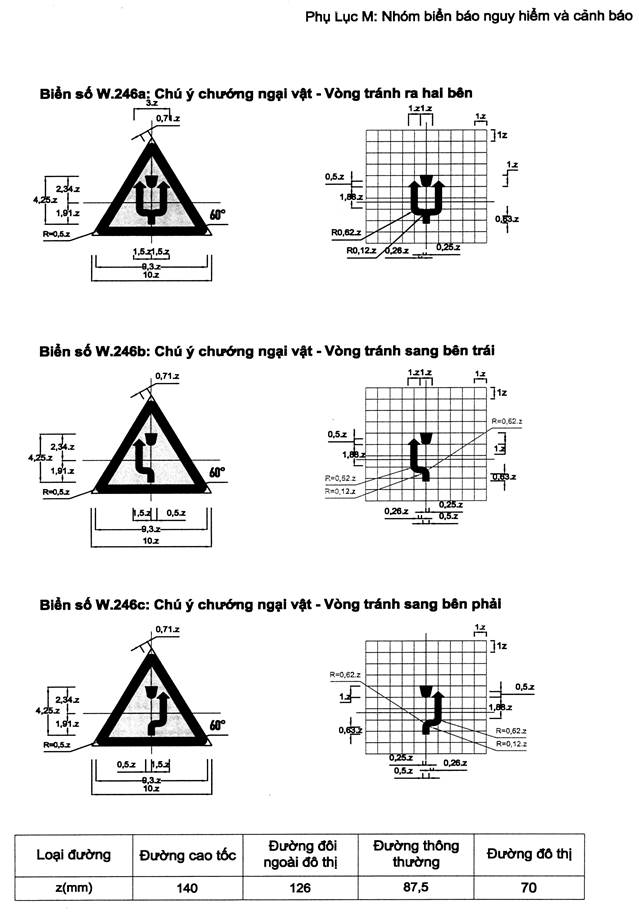
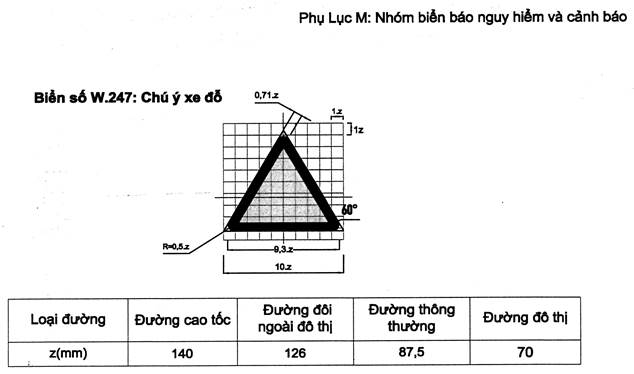
- Sign No. W.201 (a,b): Dangerous bend; - Sign No. W.201 (c,d): Dangerous bends with risk of rollover; - Sign No. W.202 (a,b): Consecutive dangerous bends; - Sign No. W.203 (a,b,c): Narrow road; - Sign No. W.204: Two-way road; - Sign No. W.205 (a,b,c,d,e): Junction; - Sign No. W.206: Roundabout; - Sign No. W.207 (a, b, c, d, e, f, g, h, i, k, l): Junction with non-priority road (side roads); - Sign No. W.208: Junction with priority road (main road); - Sign No. W.209: Signalized junction; - Sign No. W.210: Railway crossing with barrier; - Sign No. W.211a: Railway crossing without barrier; - Sign No. W.211b: Tramway crossing; - Sign No. W.212: Narrow bridge; - Sign No. W.213: Temporary bridge; - Sign No. W.214: Draw bridge; - Sign No. W.215a: Quayside or riverbank ahead; - Sign No. W.215 (b,c): Quayside or riverbank to the right; Quayside or riverbank to the left; - Sign No. W.216a: Ford; - Sign No. W.216b: Ford susceptible to flash flooding; - Sign No. W.217: Ferry station; - Sign No. W.218: Underpass; - Sign No. W.219: Steep descent; - Sign No. W.220: Steep ascent; - Sign No. W.221a: Uneven road; - Sign No. W.221b: Speed bump; - Sign No. W.222a: Slippery road; - Sign No. W.222b: Dangerous road shoulders; - Sign No. W.223 (a,b): Dangerous cliff; - Sign No. W.224: Pedestrian crossing; - Sign No. W.225: Children; - Sign No. W.226: Bicycle crossing; - Sign No. W.227: Construction; - Sign No. W.228 (a,b): Falling rocks; - Sign No. W.228c: Loose road surface; - Sign No. W.228d: Weak road; - Sign No. W.229: Low-flying aircraft; - Sign No. W.230: Cattle or livestock; - Sign No. W.231: Wild animal crossing; - Sign No. W.232: Crosswinds; - Sign No. W.233: Other danger; - Sign No. W.234: Two-way traffic crossing; - Sign No. W.235: Dual-carriageway; - Sign No. W.236: End of dual-carriageway; - Sign No. W.237: Hump bridge; - Sign No. W.238: Expressway ahead; - Sign No. W.239a: Overhead electric cables; Sign No. W.239b: Actual overhead clearance; - Sign No. W.240: Tunnel; - Sign No. W.241: Traffic congestion; - Sign No. W.242 (a,b): Perpendicular railway crossing; - Sign No. W.243 (a,b,c): Non-perpendicular railway crossing; - Sign No. W.244: Accident-prone area; - Sign No. W.245 (a,b): Slow (a), Slow with additional sign in English (b); - Sign No. W.246 (a,b,c): Obstacles ahead; - Sign No. W.247: Watch out for parking vehicles. |
32.2. Interpretation of individual signs shall be elaborated under Appendix C.
Article 33. Dimensions, shape, and color of warning signs
33.1. Warning signs shall be primarily presented as equilateral triangle with rounded vertices, horizontal side at the bottom and the corresponding vertex pointing upwards except for sign No. W.208 “Giao nhau với đường ưu tiên” (Junction with priority road) where this vertex points downwards.
33.2. Specific dimensions of illustrations and colors shall be elaborated under Appendix C and Article 16, Article 17 hereof.
34.1. Warning signs shall be a set distance away from whichever hazards the signs warn about. This distance shall be determined in accordance with types of vehicle and on-site conditions so as to aid visibility.
34.2. Distance from warning signs to hazards warned by the signs shall be consistent throughout road segment with similar average speed. In particularly necessary cases, the aforementioned distance can be increased or decreased at which point supplementary sign No. S.502 “Khoảng cách đến đối tượng báo hiệu” (Distance to hazard).
34.3. Sign No. W.208 “Giao nhau với đường ưu tiên” (Junction with priority road) shall be located before junction with priority road in residential zones and accompanied by supplementary sign No. S.502 outside of residential zones depending on whether the sign is installed closer or further from the junction.
34.4. Each warning sign shall warn about a hazard that can occur at a location or a segment of the road. Where hazard occurs along a road segment, supplementary sign No. S.501 “Phạm vi tác dụng của biển” (Applicable area of the sign) shall be installed below signs No. W.202 (a,b), W.219, W.220, W.221a, W.225, W.228, W.231, W.232 to indicate the length of the road susceptible to the hazard. Where the length of road susceptible to the hazard is significant, additional warning signs shall be installed in combination with supplementary signs No. S.501 that specify the remaining length of road susceptible to the hazard.
34.5. Warning signs shall not be used excessively if the hazards do not actually harm road users.
34.6. In respect of roads with speed limit:
34.6.1. Where signs limiting speed to at most 40 km/h have been installed at dangerous bends, signs No. W.201 (a,b) and signs No. W.202 (a,b) shall not be required;
34.6.2. Where roads are rough, slippery, or uneven and signs limiting speed to less than 50 km/h have been installed, warning signs for uneven, slippery roads (signs No. W.221 (a,b) and sign No. W.222a) shall not be required;
34.6.3. Signs No. W.205 (a, b, c, d, e) “Đường giao nhau” (Junction) shall not be required on residential roads with slow and continuous traffic that meet at three-way junctions or four-way junctions.
34.7. Where priority roads meet other roads at locations that are not considered junction in accordance with this document, signs No. W.207 and W.208 shall not be required. However, these signs can still be used or replaced by hatching road markings when necessary.
CHAPTER 6
SIGN GIVING ORDERS
Article 35. Functions of signs giving orders
Signs giving orders inform road users about orders that must be adhered to.
Article 36. Interpretations of signs giving orders
36.1. Signs giving orders shall be identified by code R and R.E with sign names as follows:
|
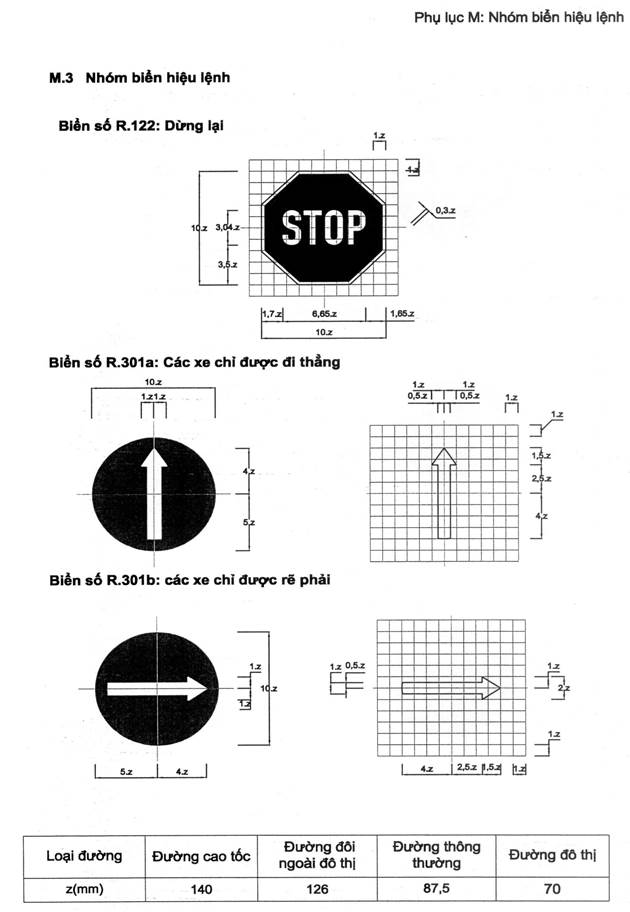
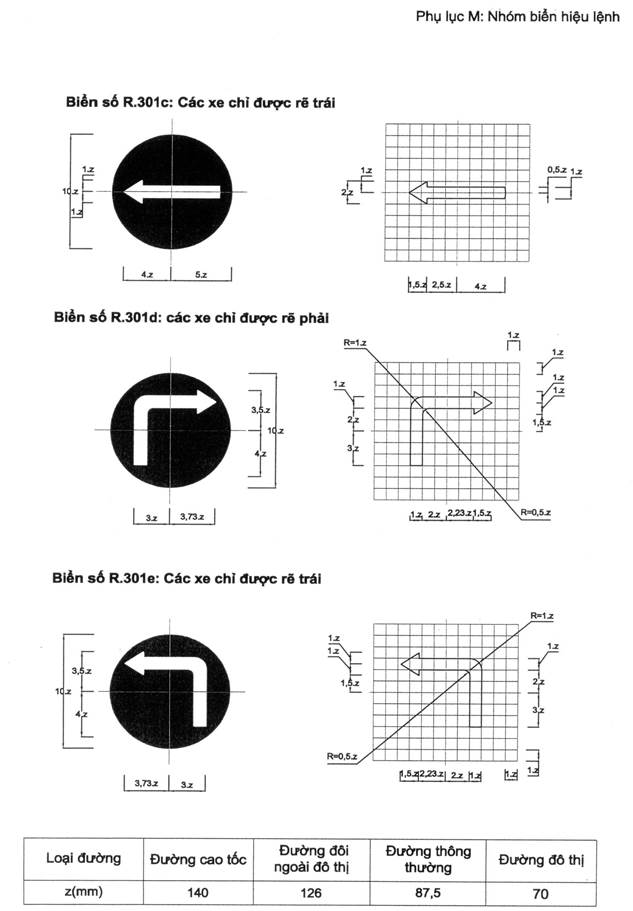
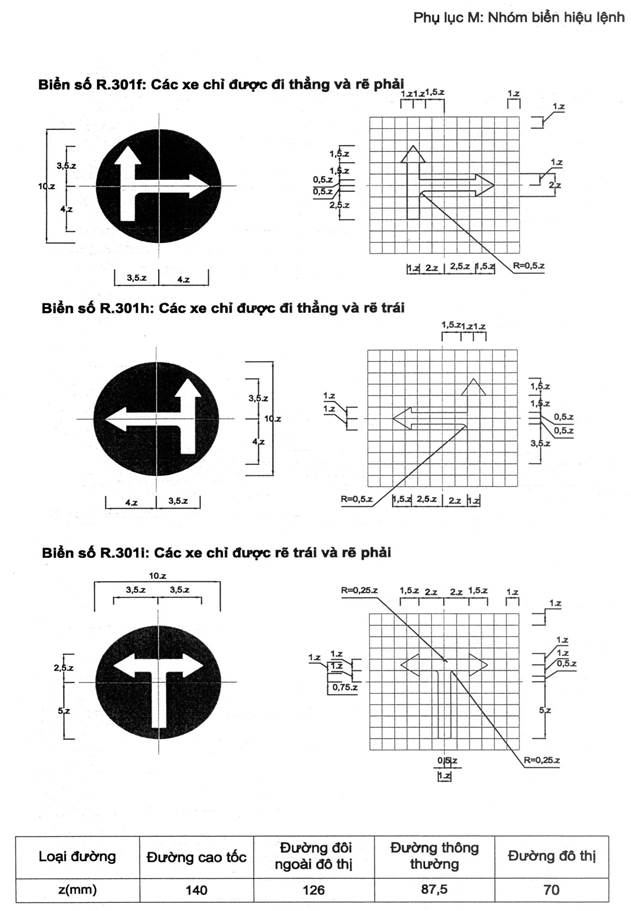
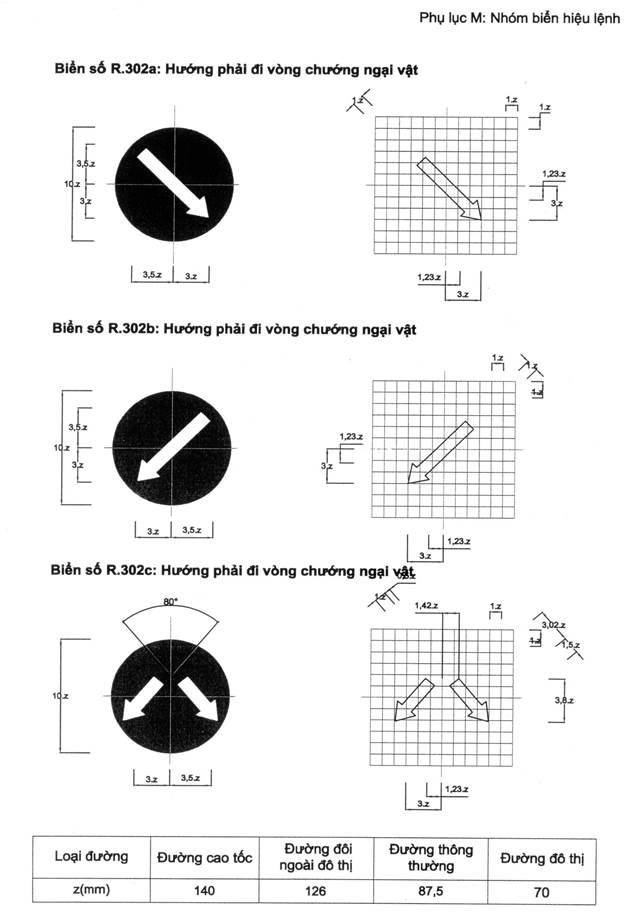
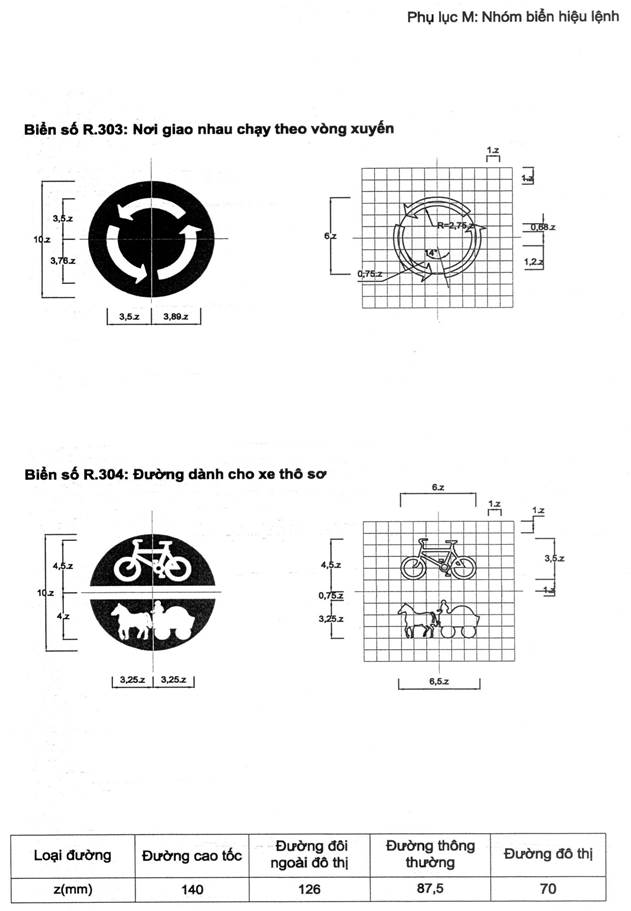
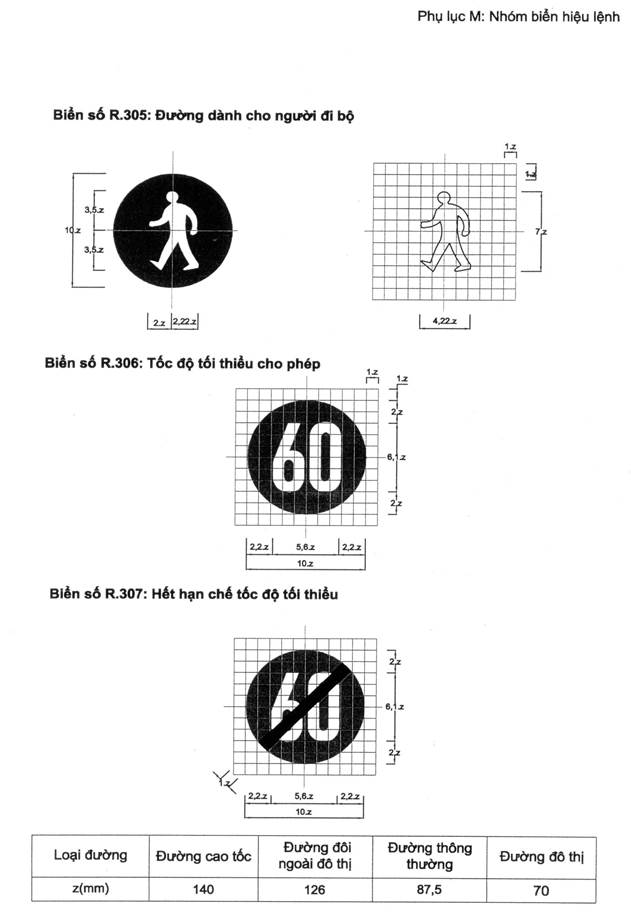
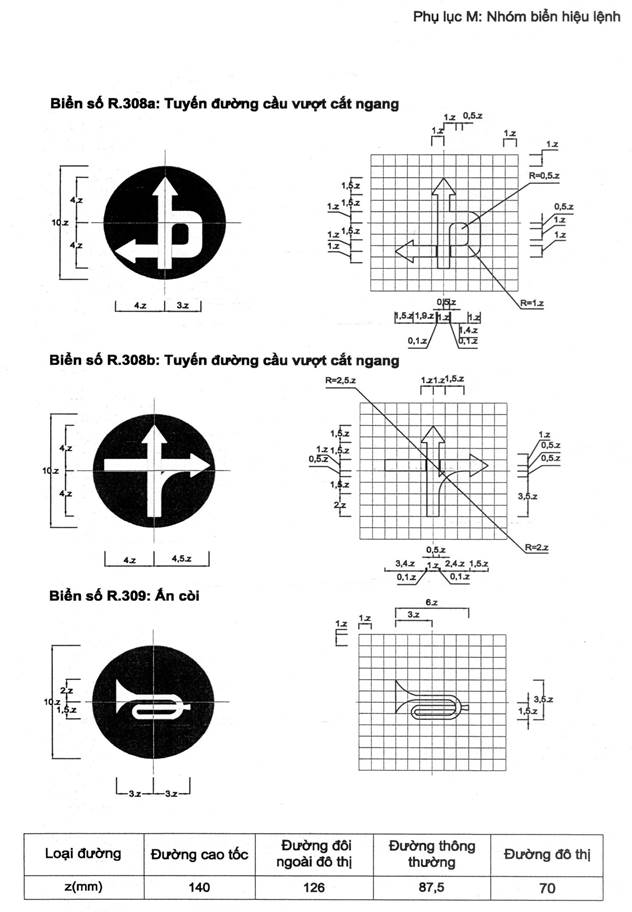
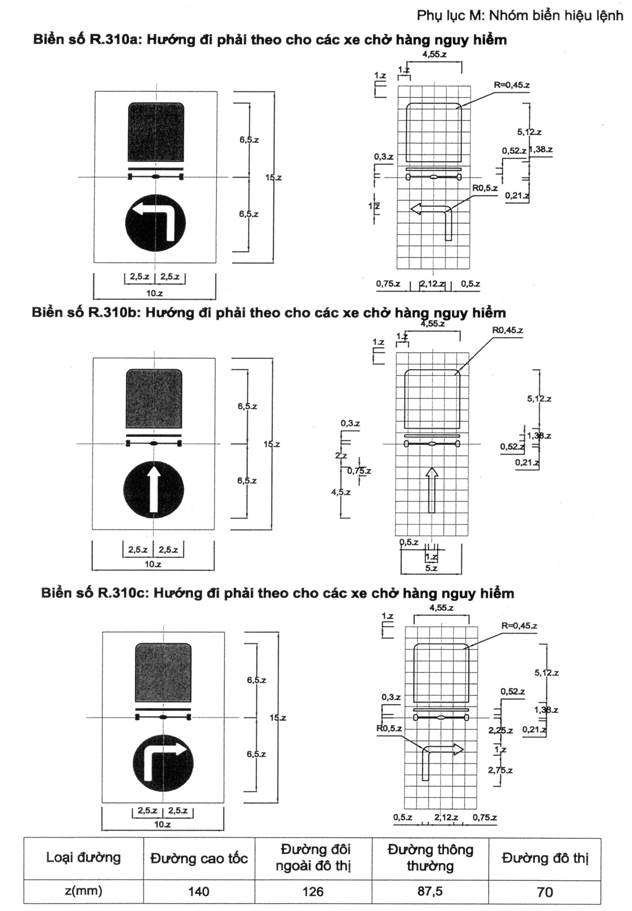
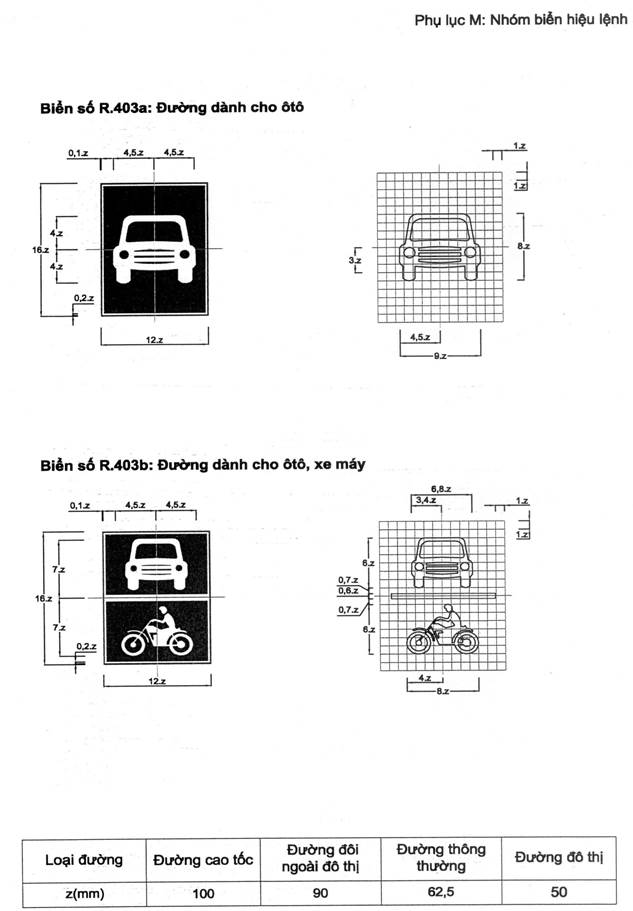
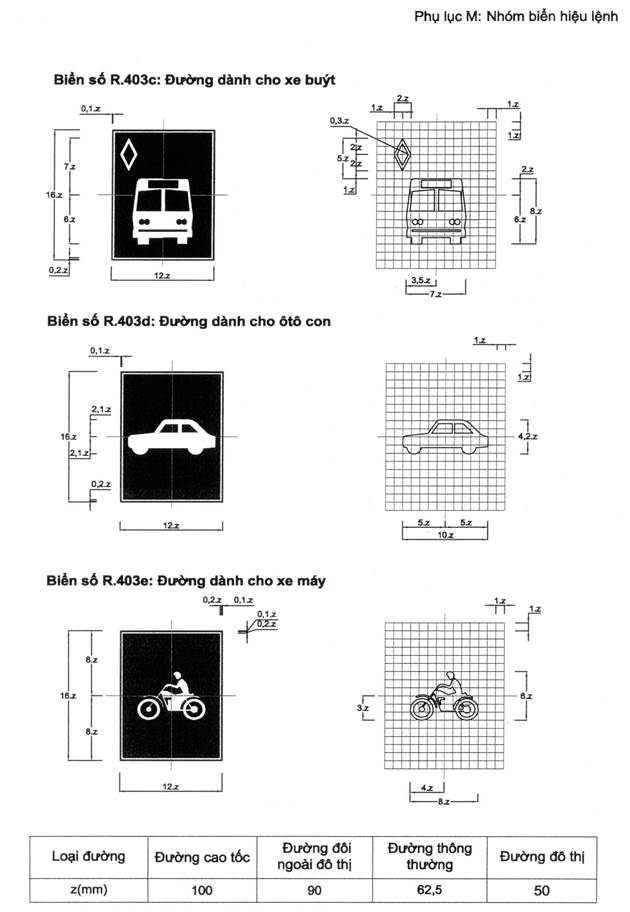
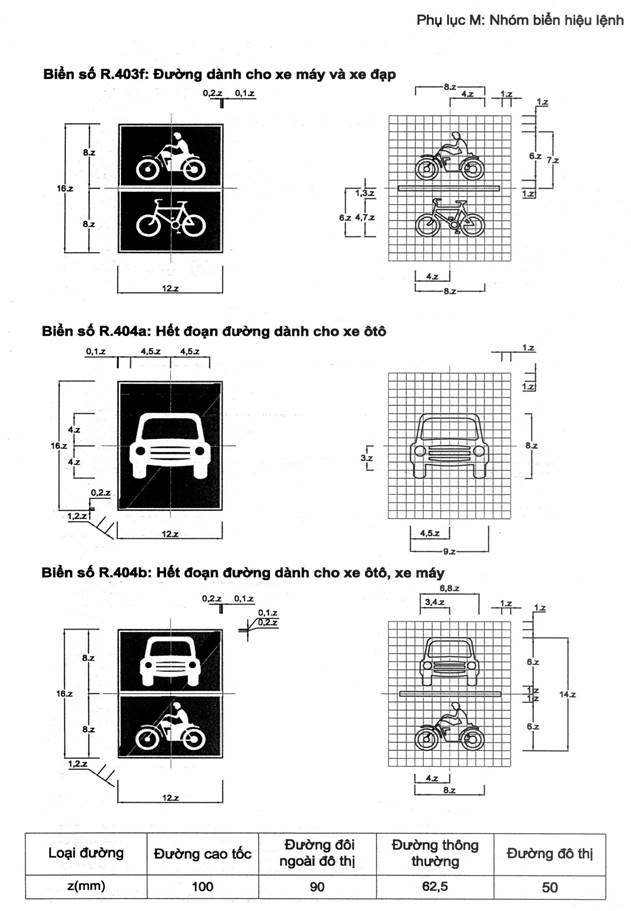
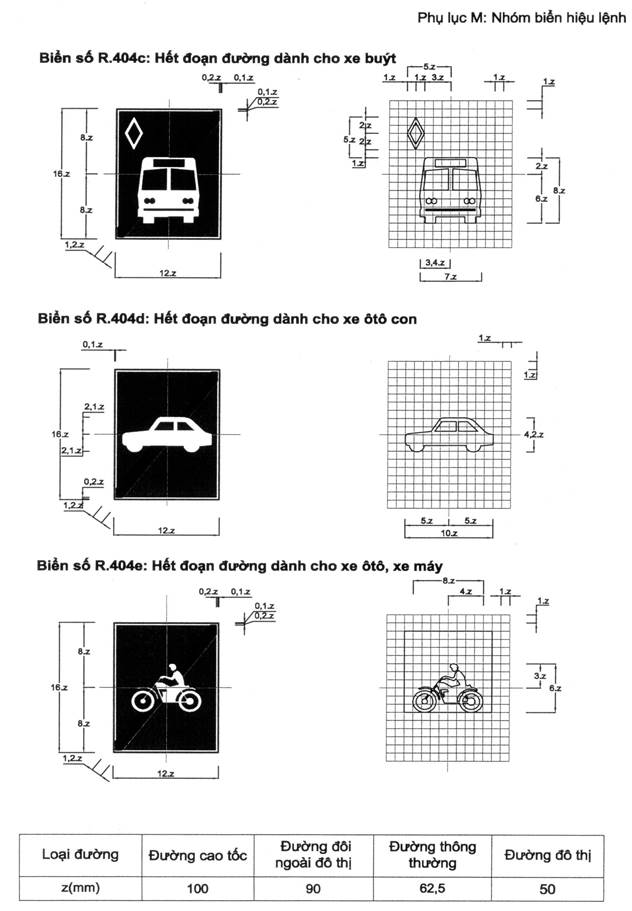
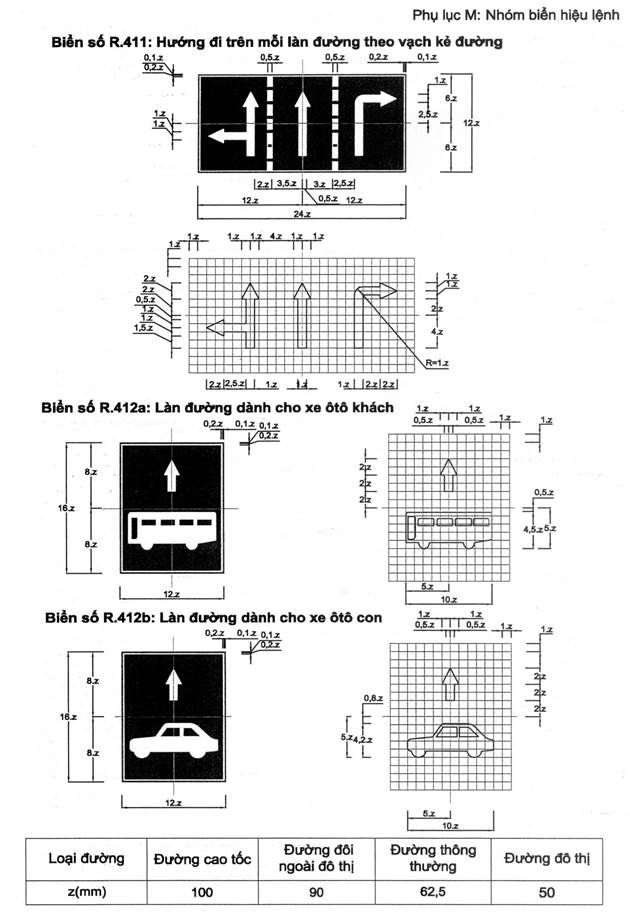
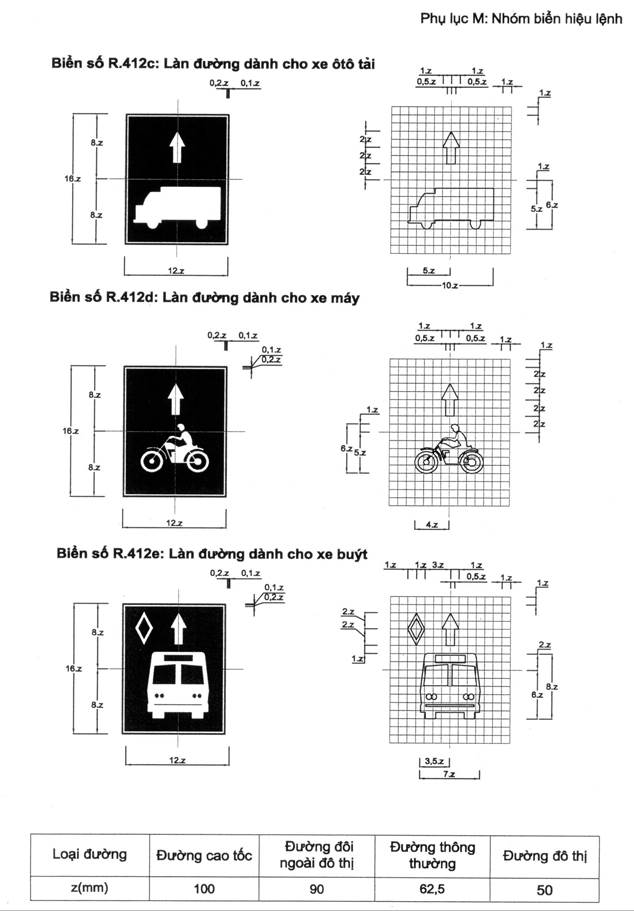
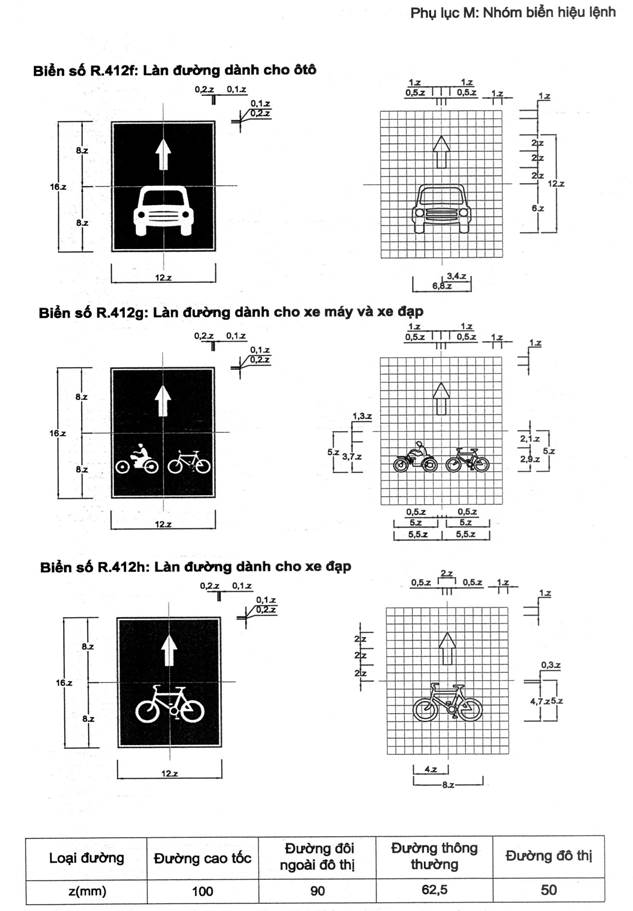
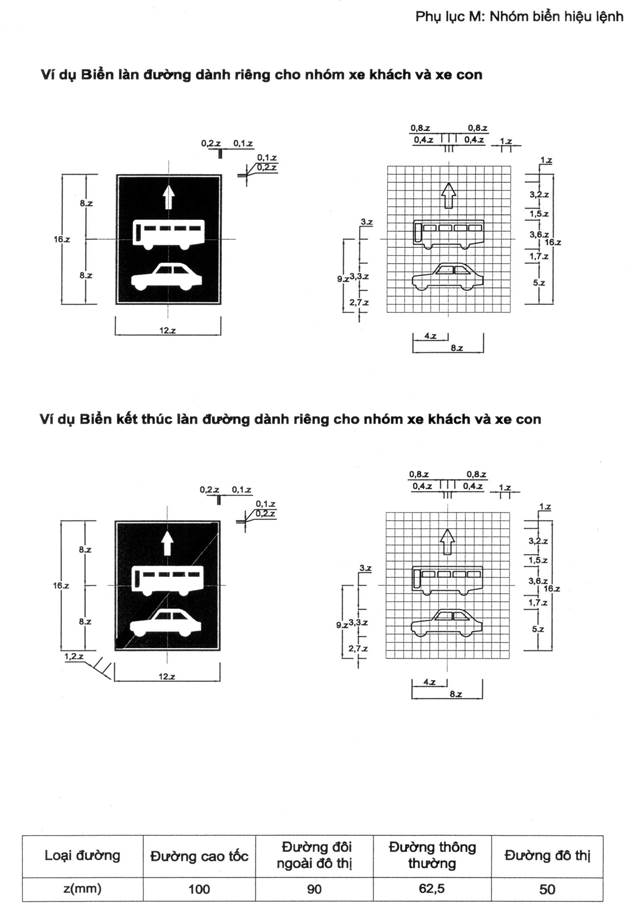
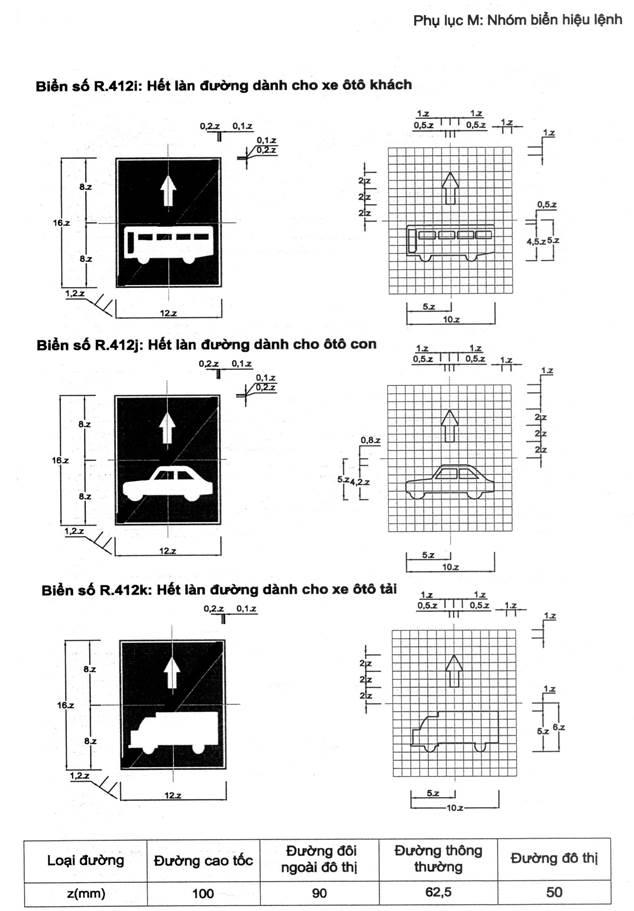
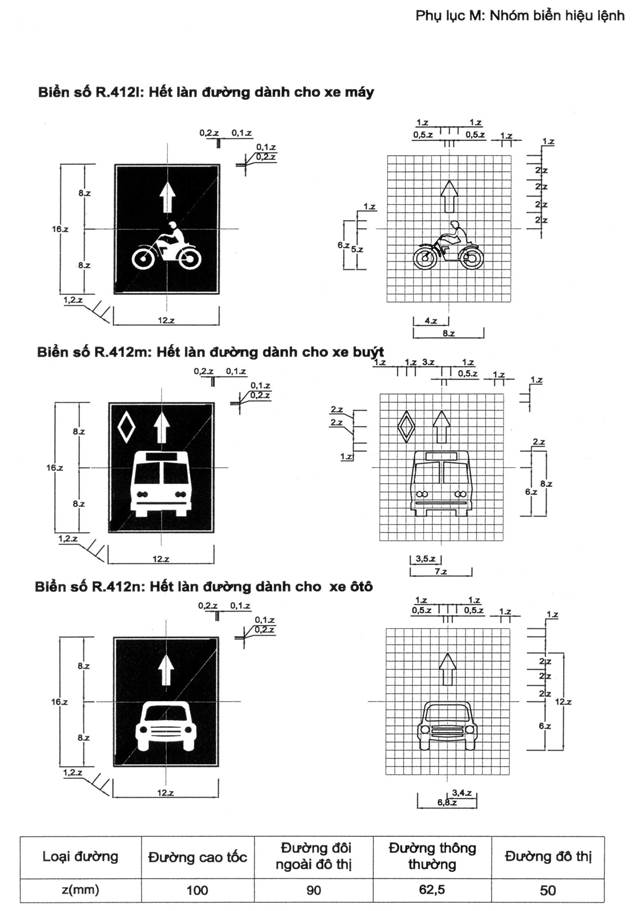
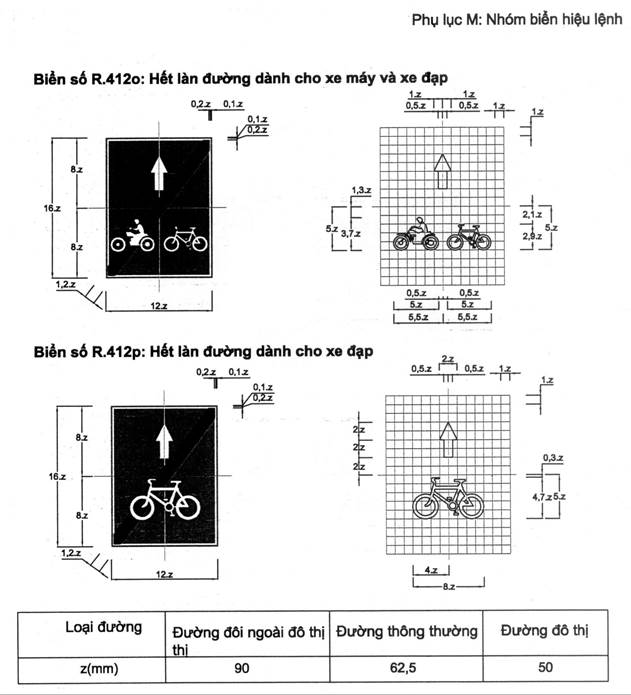
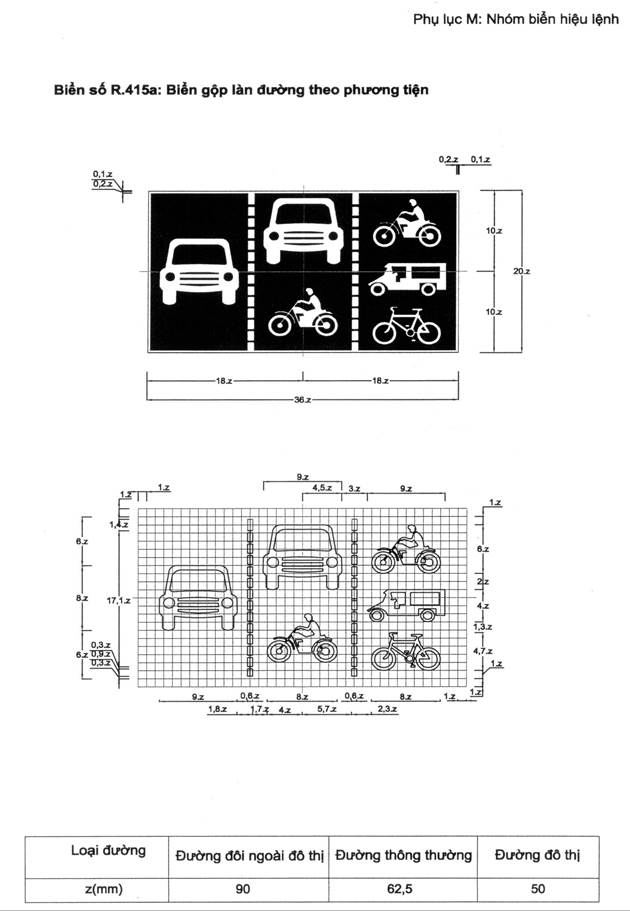
- Sign No. R.122: Stop; - Sign No. R.301 (a,b,c,d,e,f,g,h): Direction; - Sign No. R.302 (a,b,c): Detour; - Sign No. R.303: Roundabout; - Sign No. R.304: Non-motorized vehicle road; - Sign No. R.305: Foot traffic road; - Sign No. R.306: Minimum speed limit; - Sign No. R.307: End of minimum speed limit; - Sign No. R.308 (a,b): Overpass; - Sign No. R.309: Honking; - Sign No. R.310 (a,b,c): Directions to follow by vehicles transporting hazardous goods; - Sign No. R.403a: Motor vehicle road; - Sign No. R.403b: Motor vehicle and motorbike road; - Sign No. R.403c: Bus road; - Sign No. R.403d: Car road; - Sign No. R.403e: Motorbike road; - Sign No. R.403f: Motorbike and bicycle road; - Sign No. R.404a: End of motor vehicle road; - Sign No. R.404b: End of motor vehicle, motorbike road; - Sign No. R.404c: End of bus road; - Sign No. R.404d: End of car road; - Sign No. R.404e: End of motorbike road; - Sign No. R.404f: End of motorbike, bicycle road; - Sign No. R.411: Direction on each lane; - Sign No. R.412a: Passenger coach-only lane; - Sign No. R.412b: Car-only lane; - Sign No. R.412c: Truck-only lane; - Sign No. R.412d: Motorbike-only lane; - Sign No. R.412e: Bus-only lane; - Sign No. R.412c: Truck-only lane; - Sign No. R.412g: Motorbike, bicycle-only lane; - Sign No. R.412h: Bicycle-only lane; - Sign No. R.412i: End of passenger coach-only lane; - Sign No. R.412j: End of car-only lane; - Sign No. R.412k: End of truck-only lane; - Sign No. R.412l: End of motorbike-only lane; - Sign No. R.412m: End of bus-only lane; - Sign No. R.412n: End of motor vehicle-only lane; - Sign No. R.412o: End of motorbike, bicycle-only lane; - Sign No. R.412p: End of bicycle-only lane; - Sign No. R.415: Combined per-vehicle lane; - Sign No. R.420: Start of residential zone; - Sign No. R.421: End of residential zone; - Sign No. R.E,9a: No parking; - Sign No. R.E,9b: No parking in specific hours; - Sign No. R.E,9c: Parking area; - Sign No. R.E,9d: Maximum speed limit; - Sign No. R.E,10a: End of no parking; - Sign No. R.E,10b: End of hour-specific parking restrictions; - Sign No. R.E,10c: End of parking area; - Sign No. R.E,10d: End of maximum speed limit; - Sign No. R.E,11a: Tunnel; - Sign No. R.E,11b: End of tunnel. |
36.2. Interpretation of individual signs shall be elaborated under Appendix D.
Article 37. Dimensions, shape, and color of signs giving orders
37.1. Signs giving orders shall be primarily presented as circular or rectangular signs with blue background and white illustrations. End of orders shall be usually signified by red lines connecting the top right corner of the sign and the bottom left corner of the sign against white illustrations.
37.2. Specific dimensions of illustrations on signs shall be elaborated under Article 16 and Article 17 and Appendix D hereof.
38.1. Signs giving orders shall be located where road users must be informed about respective orders. Where signs giving orders must be installed before the intended locations relative to the direction of travel, supplementary sign No. S.502 shall be required.
38.2. Signs giving orders shall start to take effect from where the signs are installed. Where signs No. R.301a are installed after the next junction, signs giving orders shall start to take effect from where the signs are installed to the next junction. Signs No. R.301 (a,b,c,d,e,f,g,h), R.302(a,b,c), R.411, R.412 (a,b,c,d,e,f,g,h), and R.415 shall not prohibit vehicles from turning left or right for the purpose of entering, exiting residential buildings, alleys, agencies, entities located within the area affected by the signs.
38.3. Where roads on which signs giving orders must be installed travel through junctions (except for junctions with alleys or entrances and exits to agencies or entities; or adjacent plots which can only be accessed through common paths), the same signs giving orders shall also be installed in the same roads on the other side of the junctions except for signs No. R.420 and R.421, locally affecting signs, and unless otherwise stipulated by the law.
Chapter 7
INFORMATION SIGNS ON NON-EXPRESSWAY HIGHWAY
Article 39. Functions of information signs
Information signs are used to indicate direction of travel or other necessary information to assist road users in vehicle operation and coordinate traffic conveniently, safely.
Article 40. Interpretations of information signs
40.1. Information signs on non-expressway highways shall be identified by the code “I” with the following sign names:
|
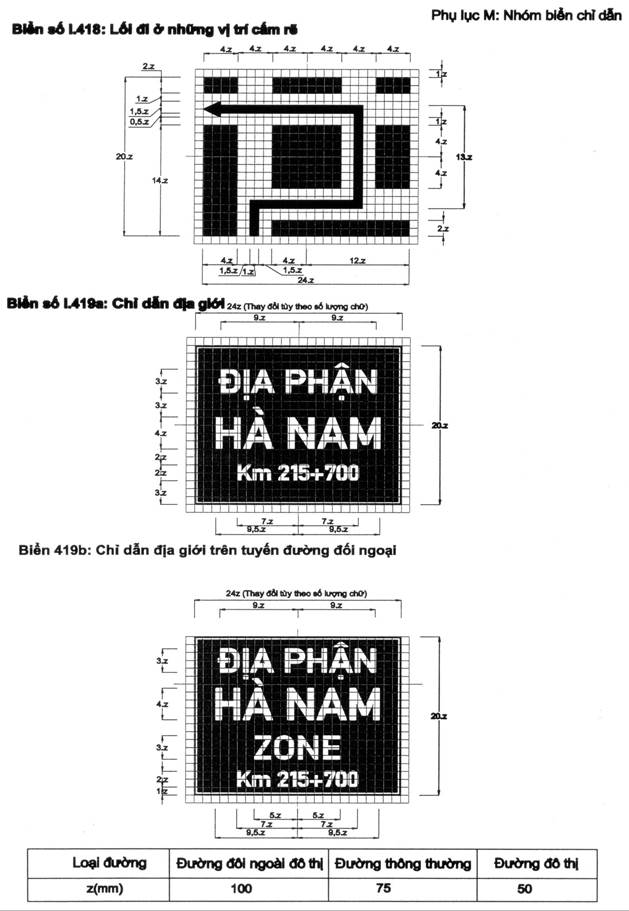
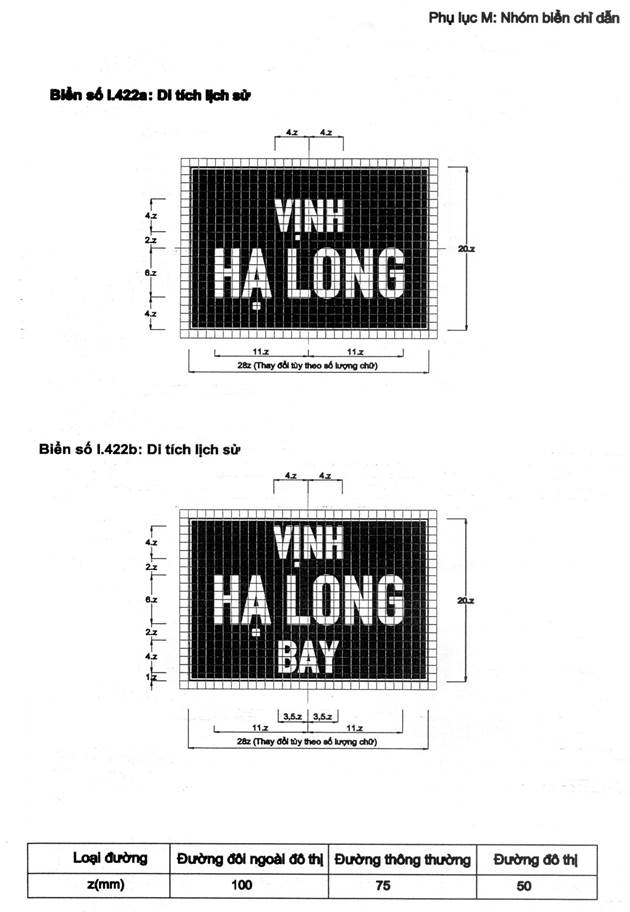
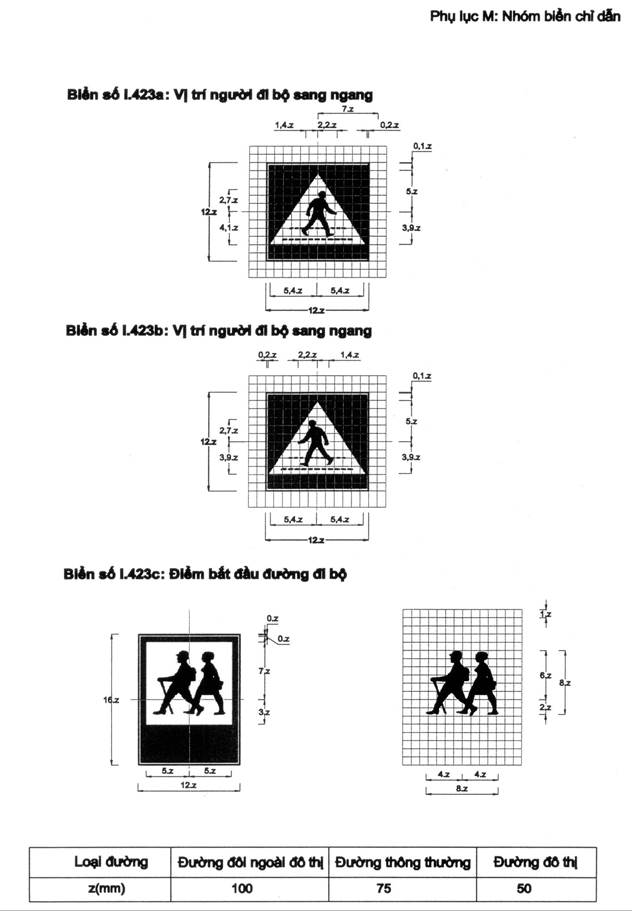
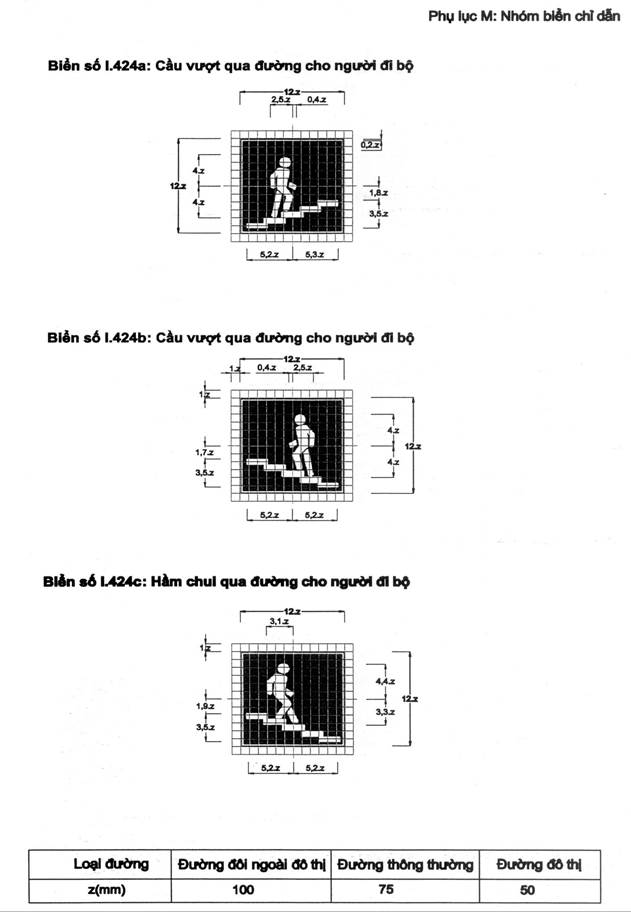
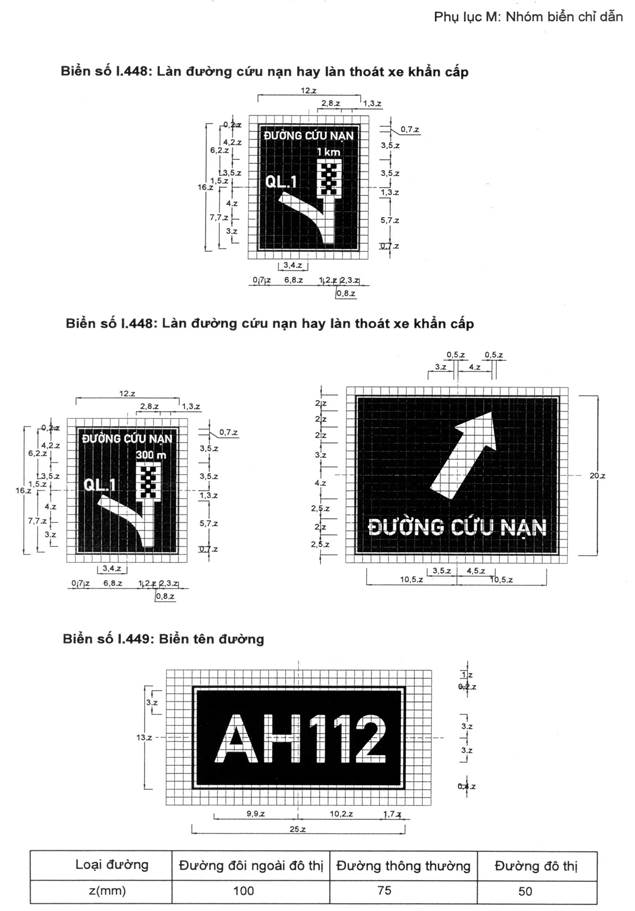
- Sign No. I.401: Start of priority road; - Sign No. I.402: End of priority road; - Sign No. I.405 (a,b,c): Dead end; - Sign No. I.406: Priority in narrow road; - Sign No. I.407 (a,b,c): One-way road; - Sign No. I.408: Parking; - Sign No. I.408a: Partial parking on sidewalk; - Sign No. I.409: U-turn; - Sign No. I.410: U-turn area; - Sign No. I.413a: Oncoming passenger coach-only lane ahead; - Sign No. I.413 (b,c): Turning to passenger coach-only lane; - Sign No. I.414 (a,b,c,d): Direction of traffic; - Sign No. I.415: Direction to location; - Sign No. I.416: Bypass; - Sign No. I.417 (a,b,c): Direction for each vehicle type; - Sign No. I.418: Alternate route for no-turning location; - Sign No. I.419a: Boundary sign; - Sign No. I.419b: Boundary sign on international road; - Sign No. I.422a: Historical site; - Sign No. I.422b: Historical site on international road; - Sign No. I.423 (a,b): Pedestrian crossing; - Sign No. I.423c: Start of footpath; - Sign No. I.424 (a,b): Pedestrian overpass; - Sign No. I.424 (c,d): Pedestrian underpass; - Sign No. I.425: Hospital; - Sign No. I.426: First aid; - Sign No. I.427a: Repair shop; - Sign No. I.427b: Weigh station; - Sign No. I.428: Petrol station; - Sign No. I.429: Car wash; - Sign No. I.430: Telephone; - Sign No. I.431: Rest area; - Sign No. I.432: Hotel; - Sign No. I.433a: Lounging area; - Sign No. I.433 (b,c,d): Camping site, recreational vehicle parking site; - Sign No. I.433e: Youth hostel; - Sign No. I.434a: Bus stop; - Sign No. I.434b: Truck station; - Sign No. I.435: Tramway station; - Sign No. I.436: Traffic police station; - Sign No. I.439: Bridge name; - Sign No. I.440: Road under construction; - Sign No. I.441 (a,b,c): Construction ahead; - Sign No. I.442: Market; - Sign No. I.443: Trailer truck; - Sign No. I.444 (a, b, c, d, e, f, g, h, i, j, k, l, m): Direction to location; - Sign No. I.445 (a, b, c, d, e, f, g, h): Road conditions; - Sign No. I.446: Handicapped parking; - Sign No. I.447 (a, b, c, d): Complete overpass; - Sign No. I.448: Runaway ramp; - Sign No. I.449: Road name. |
40.2. Interpretations of individual signs shall be elaborated under Appendix E hereof.
Article 41. Guidelines pertaining to text on information signs
Text-only information signs located in cities, communes, and national highways frequented by vehicles operated by foreigners shall be accompanied by English translations below the Vietnamese text. The English text shall be small capitals.
Article 42. Dimensions, shape, and color of information signs
42.1. Information signs shall be square or rectangular in shape.
42.2. Information signs shall have blue background and white illustrations and text. Information signs that have white background shall contain black illustrations and text unless otherwise specified under Appendix E hereof.
42.3. Detailed dimensions of illustrations and text, and color of signs are elaborated under Article 16, Article 17, and Appendix E hereof.
Depending on characteristics of each information sign, information signs shall be placed as follows:
43.1. Signs No. I.401 and I.402 shall be placed at the beginning and at the end respectively of priority roads and motor vehicle-only roads.
43.2. Signs No. I.407 (a,b,c), I.413 (a,b,c), and I.418 shall be located at junctions:
- Signs No. I.407a and I.413a shall be located after junctions;
- Signs No. I.407 (b,c) and I.413 (b,c) shall be located before junctions;
- Sign No. I.418 shall be located before no-turning signs and at least 30 m away from junctions depicted on the sign.
43.3. Signs No. I.405 (a,b,c), I.414 (a, b, c, d), I.416, and I.417 (a,b) primarily serve as instructions for motorized vehicle of all types and are located 20 m to 50 m away from junctions. Where warning signs are not installed, the aforementioned information signs can be located away from junctions by a set distance which is elaborated under Article 34 hereof.
43.4. Signs No. I.406, I.408, I.409, I.410, I.417c, and from I.422 to I.436 shall be located before and close to roads of which instructions or information is presented or accompanied by supplementary signs No. S.502 where they are located further away from these roads.
Article 44. Regulations on directional traffic signs on non-expressway highways
44.1. Directional traffic signs (signs No. I.414 (a,b,c,d)) shall be located at junctions. In respect of residential zones, directional traffic signs shall only be located on primary roads connecting the residential zones with adjacent historical sites, cities, residential zones, tourist areas, and industrial parks.
44.2. Signs No. I.414 (a,b) shall only be used where a direction only leads to a single residential location. Signs No. I.414 (c,d) shall only be used where a direction leads to at least two residential locations.
44.3. At most three locations shall be depicted per direction. Locations shall be listed in ascending order of distance. Each location listed on directional traffic signs shall be repeated on subsequent signs until the sign at a location adjacent to the listed location.
44.4. Locations and distance shall be specified on signs as follows:
44.4.1. Locations for which directional instructions are provided shall be located on the roads. Locations presented on directional traffic signs shall be determined via the order of priority below on all road types (CT, QL, ĐT, ĐH, ĐX, ĐĐT) except for specialized roads:
- Name of central-affiliated city;
- Name of province-level city;
- Name of administrative center of a province: not name of province unless name of province is the same as name of administrative center of that province;
- Name of commune;
- Name of administrative center of district: not name of district unless name of district is the same as name of administrative center of that district;
- Name of town;
- Historical site or scenery site;
- Name of major junction, name of starting point or end point of the road;
44.4.2. Directional traffic signs on specialized roads shall only contain location of junctions, starting points or end points of the road.
44.4.3. Distance specified on directional traffic signs shall be the distance from where the signs are installed to the center of locations listed on the signs (appropriate to information detailed on milestone kilometer markers) and rounded to the nearest kilometer if the distance is ≥ 1,0 km or rounded to the nearest 100 m if the distance is < 1 km. Distance of individual segments shall conform to the total distance and be consistent in both directions of travel.
Chapter 8
SUPPLEMENTARY SIGNS AND TEXT-ONLY SIGNS
Article 45. Supplementary sign
45.1. Functions of supplementary signs:
Supplementary signs are usually installed in combination with primary signs so as to elaborate primary signs except for sign No. S.507 “Turning” which is used as stand-alone signs.
45.2. Interpretations and use of supplementary signs:
45.2.1. Supplementary signs shall be identified by the codes S, SG, and SH with common sign names below:
- Sign No. S.501: Applicable area of primary sign;
- Sign No. S.502: Distance to hazard;
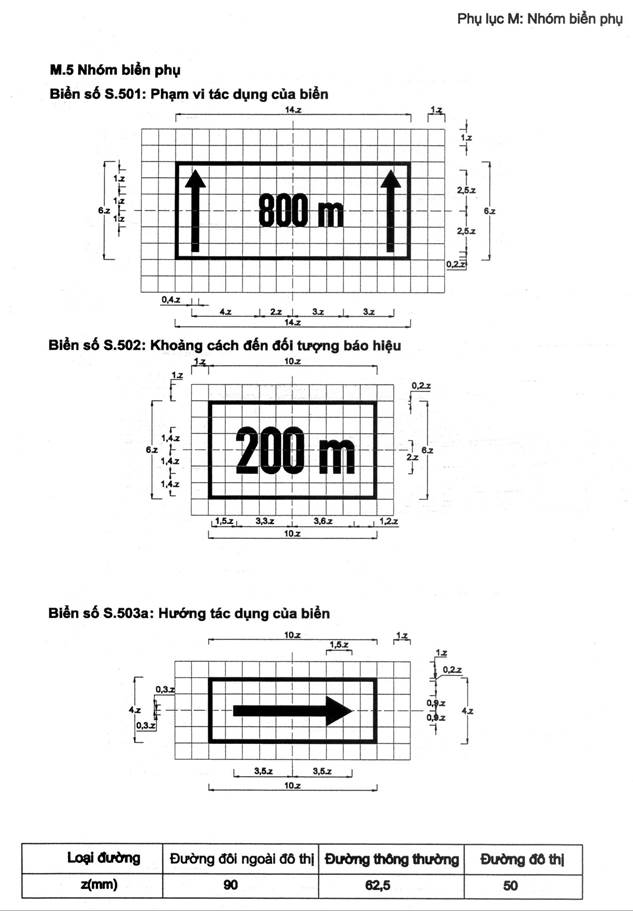
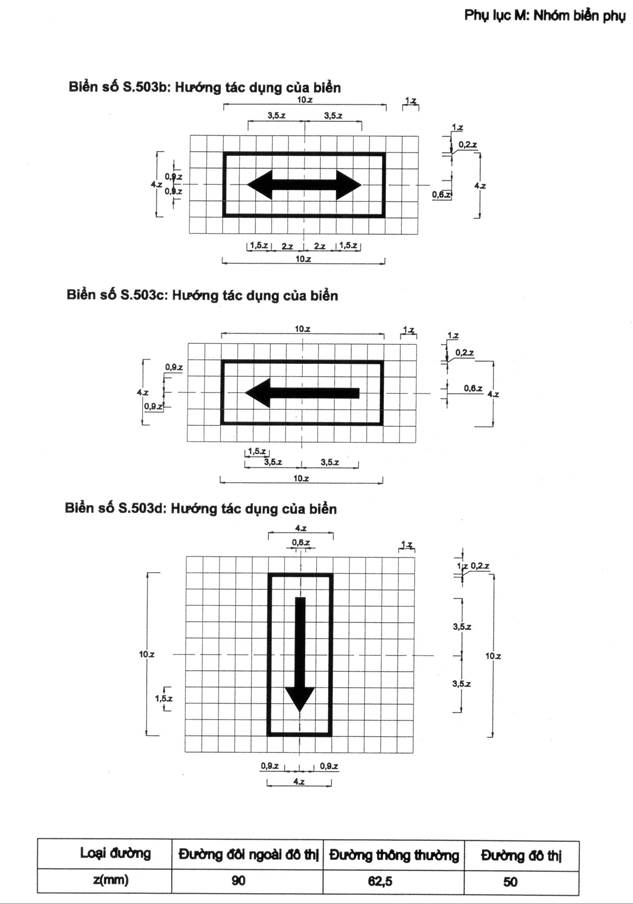
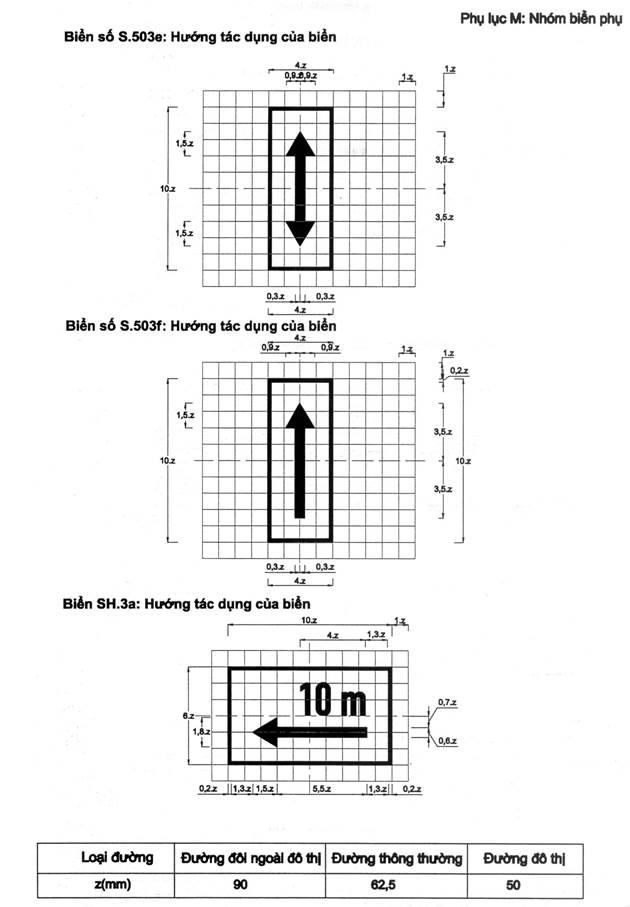
- Sign No. S.503 (a,b,c,d,e,f): Applicable direction of primary sign;
- Sign No. S.H,3 (a,b,c): Applicable direction of primary sign;
- Sign No. S.504: Lane;
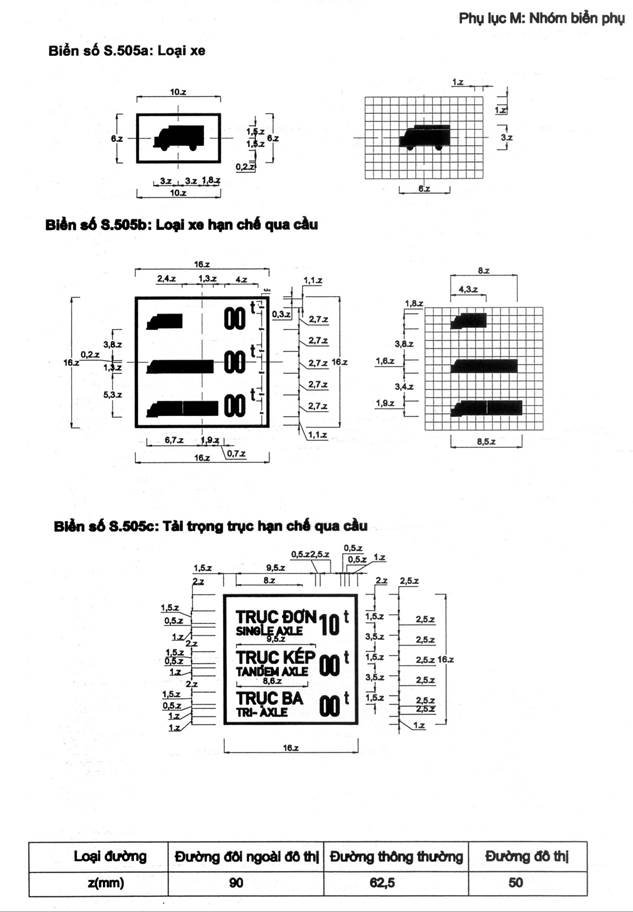
- Sign No. S.505a: Vehicle type;
- Sign No. S.505b: Bridge weight limits;
- Sign No. S.505c: Bridge axle load limits;
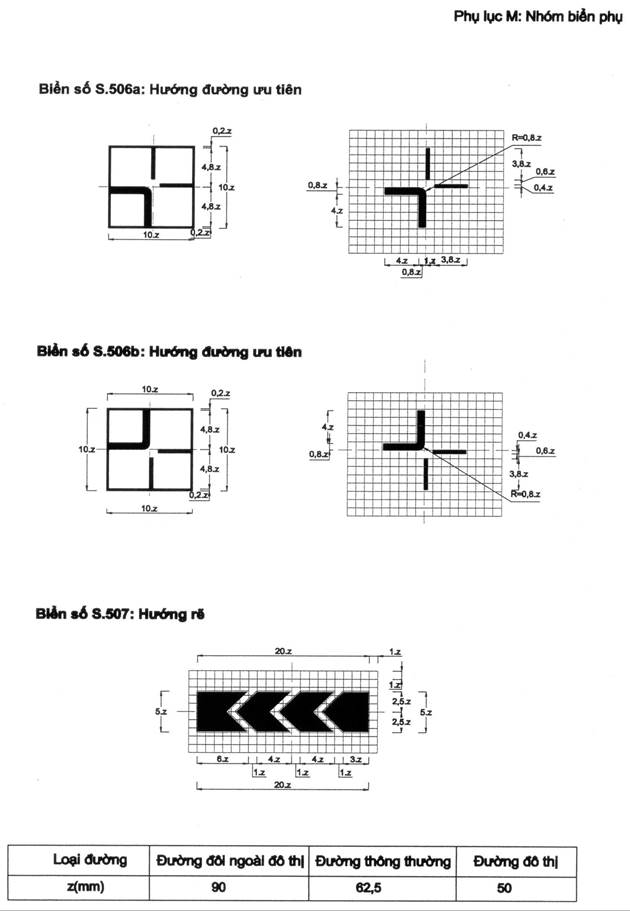
- Sign No. S.506 (a,b): Direction of priority road;
- Sign No. S.507: Direction of turn;
- Sign No. S.508 (a,b): Time;
- Sign No. S.509 (a,b): Explanation for primary sign;
- Sign No. S.510a: Icy road warning;
- Sign No. S.G,7: Camping site;
- Sign No. S.G,8: Youth hostel location;
- Sign No. S.G,9b: Parking space for transition to public transport;
- Sign No. S.G,11a; S.G,11c: Number of lanes and direction of each lane;
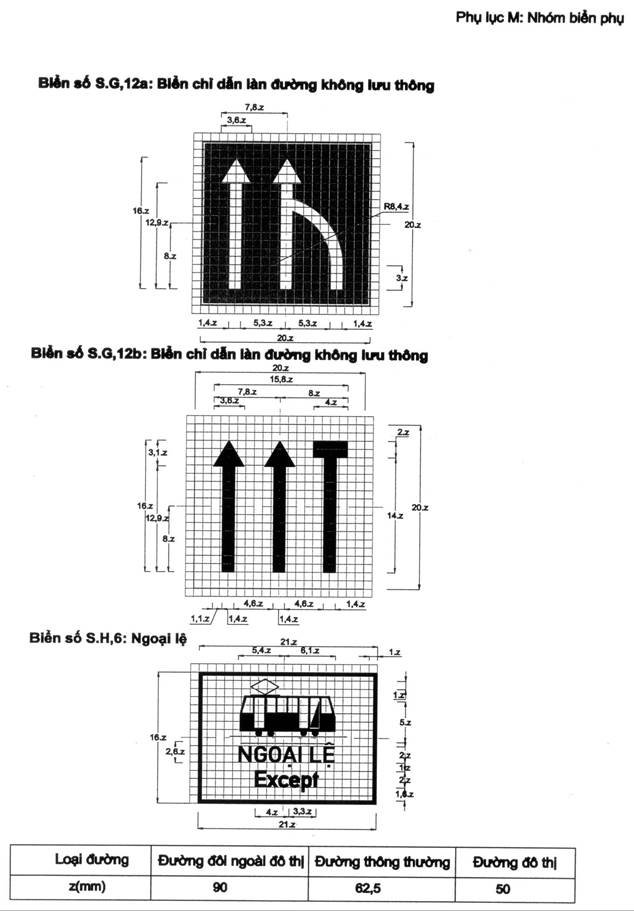
- Sign No. S.G,12a; S.G,12b: Lane(s) not open to public traffic;
- Sign No. S.H,6: Exception.
Other additional supplementary signs shall also be considered for installation on a case-by-case basis.
45.2.2. Interpretations of individual supplementary sign shall be elaborated under Appendix F hereof.
45.3. Dimensions, shape, and color of supplementary signs:
45.3.1. Supplementary signs shall be rectangular or square in shape.
45.3.2. Supplementary signs shall have white background and black illustrations and text or blue background and white text. Specificities to signs No. S.507 and S.508 (a,b) shall be elaborated under Appendix F hereof;
45.3.3. Detailed dimensions of illustrations and color of signs are elaborated under Article 16 and Article 17 and Appendix K hereof.
45.4. Placement of supplementary signs:
Supplementary signs shall be located directly below primary signs except for sign No. S.507 which is used as stand-alone sign and located on the outer curve facing oncoming traffic or on traffic islands at junctions.
46.1. Text-only signs shall be used if existing sign types are not suitable or in other necessary cases.
46.2. Text-only signs shall be rectangular in shape. Text-only signs providing instructions shall have blue background and white text, providing warnings shall have yellow background and black text, and informing restrictions or orders shall have red background and white text.
46.3. Text presented on signs shall vary depending on whether the signs provide instructions, warnings, restrictions, or orders as long as it is concise. Signs signifying restrictions shall start with the word “Cấm” (No).
46.4. It is possible to combine multiple rectangular signs to depict information that is too complicated for single signs.
Article 47. Shape, dimensions, and illustration of supplementary signs and text-only signs
Shape, dimensions, and illustrations of signs are elaborated under Article 16, Article 17, and Appendix K hereof. Minimum height of rectangular text-only signs shall be 20 cm.
Article 48. Texts and numerals of supplementary signs and text-only signs
48.1. All texts and numerals on milestone kilometer markers shall be consistent and one of the two following fonts: normal font and compressed font in accordance with Article 17 and Appendix K;
48.2. Normal font is usually used for lines of short to moderate length;
48.3. Compressed font is used for lines of greater length;
48.4. All letters on a line shall be of the same font;
48.5. Text height of the smallest text-only signs shall be 10 cm (corresponding to multiplier of 1). Minimum text height of combined signs shall be 5 cm.
CHAPTER 9
INFORMATION SIGNS ON EXPRESSWAY
Article 49. General provisions for information signs on expressways
49.1. Functions of information signs on expressways
Provide accurate and adequate information to enable vehicle operators to drive safely and reach desired locations, to be specific:
49.1.1. Instructions regarding road name and directions;
49.1.2. Instructions regarding location, direction, distance to cities, towns, roads;
49.1.3. Instructions regarding direction to industrial parks and public services such as: airports, ports, coach stations, docks, ferry stations, weigh stations, rest areas, lounging areas, scenery and recreational areas;
49.1.4. Notification about junctions, exits ahead;
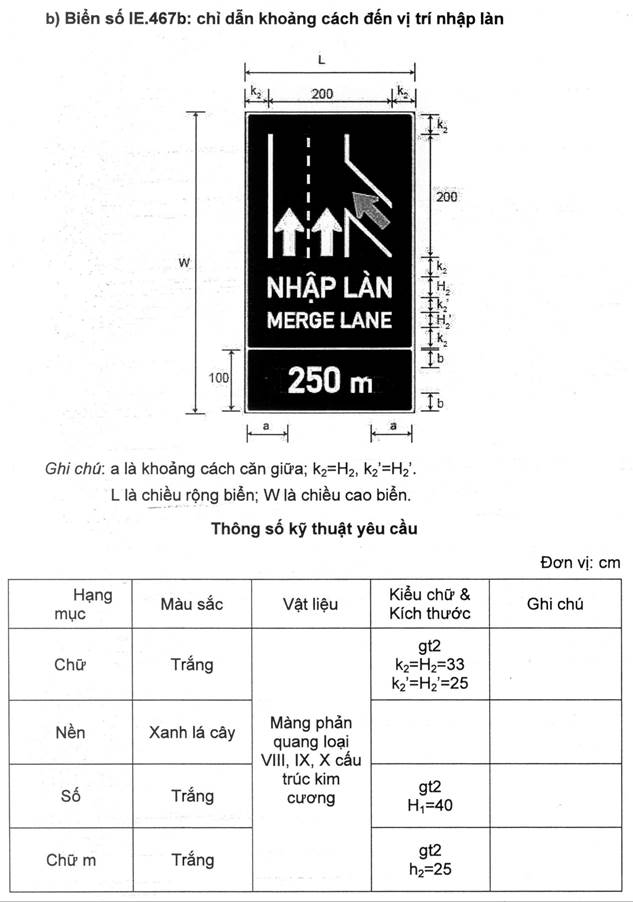
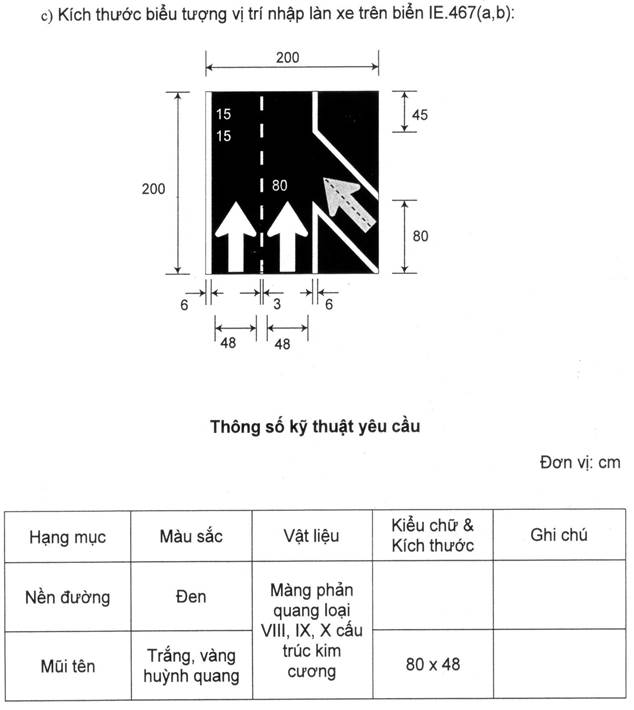
49.1.5. Instructions regarding merging and exit of expressways;
49.1.6. Instructions regarding maximum and minimum speed limit of expressways;
49.1.7. Instructions regarding safe driving distance;
49.1.8. Radio frequency that allows road users on expressways to be informed about traffic conditions, weather conditions, and other useful information.
49.1.9. Other information signs: instruction signs indicating locations; administrative divisions of provinces, cities; names of bridges, major structures.
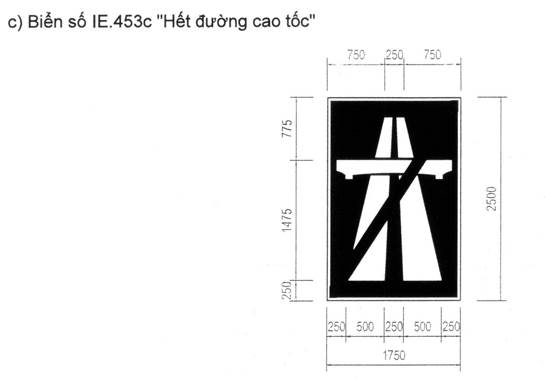
49.1.10. Information signs on expressways shall be coded as IE.
49.2. Requirements for information signs on expressways
Instruction signs on expressways shall meet requirements below:
49.2.1. Contents of instruction signs shall be concise, simple, comprehensive; prioritize symbols, data, and illustrations;
49.2.2 Texts, numerals, and symbols shall be large enough to allow vehicle operators to see and understand from a minimum distance of 150 m in normal weather conditions;
49.2.3 Information signs shall be coated with reflective films that meet national standards on “Reflective film for road signals”.
49.3. Dimensions of information signs on expressways
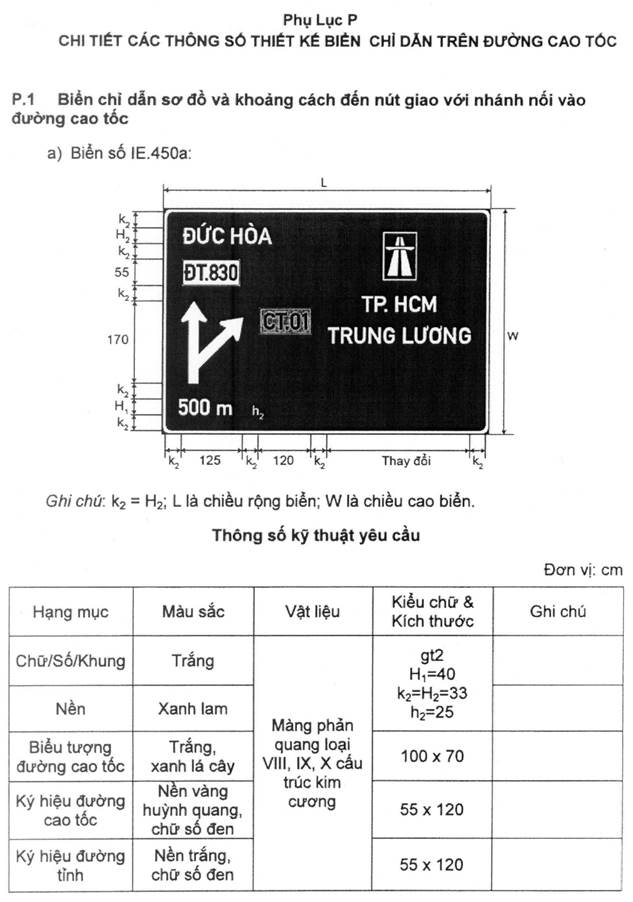
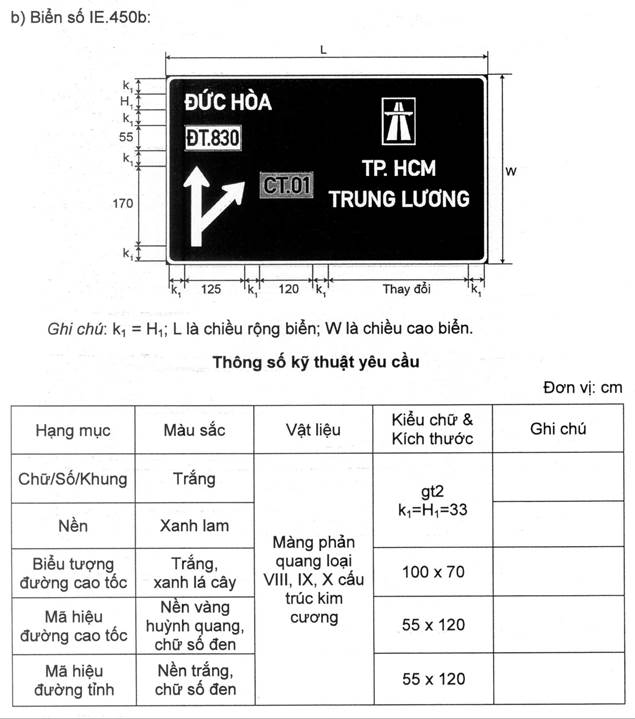
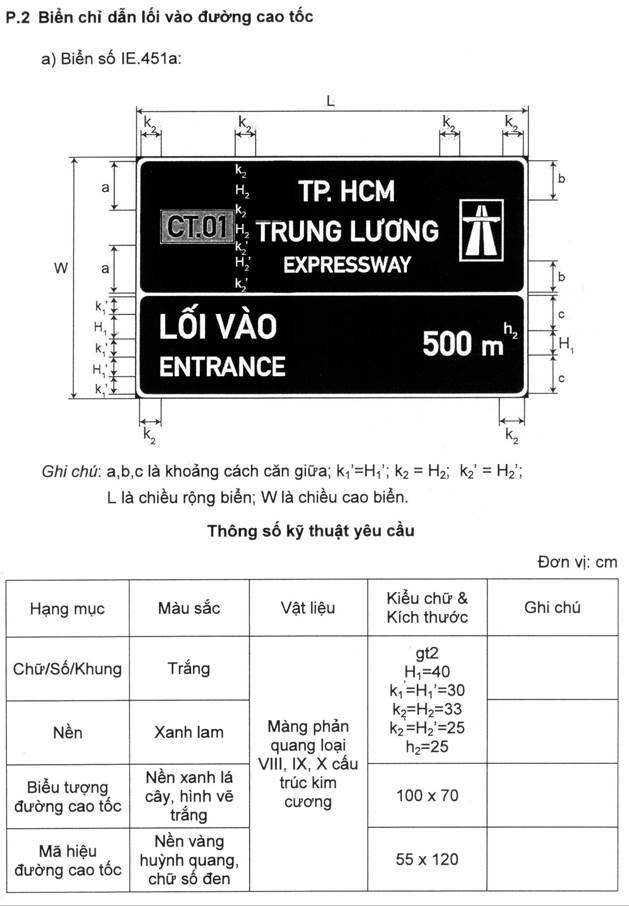
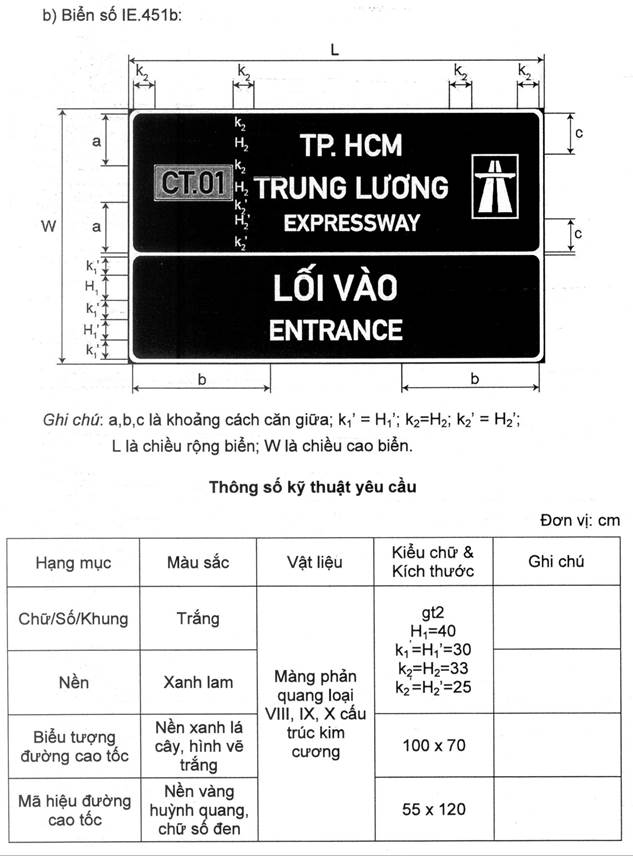
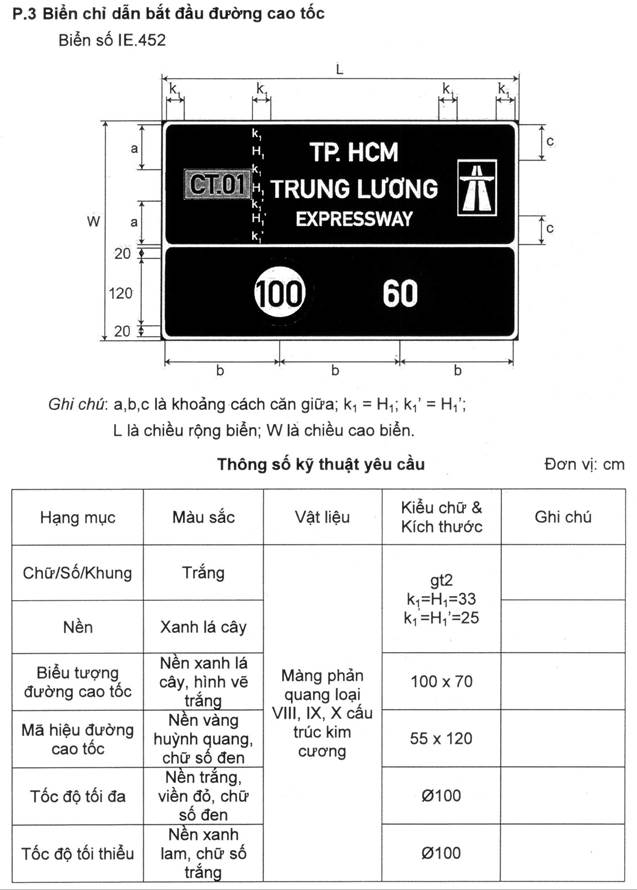
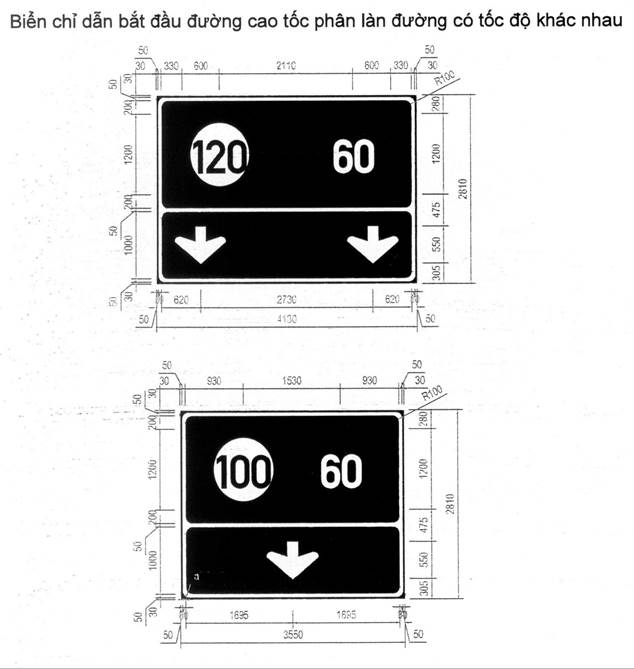
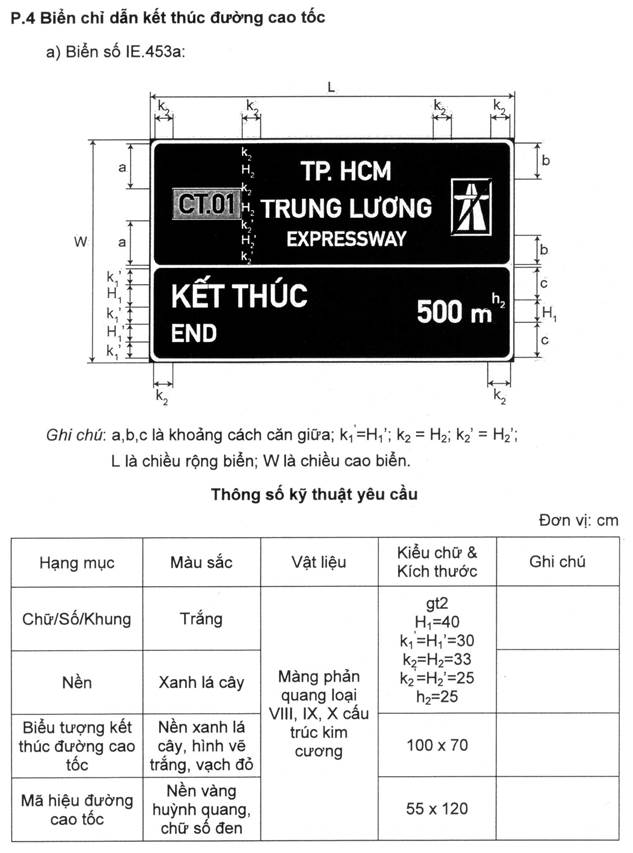
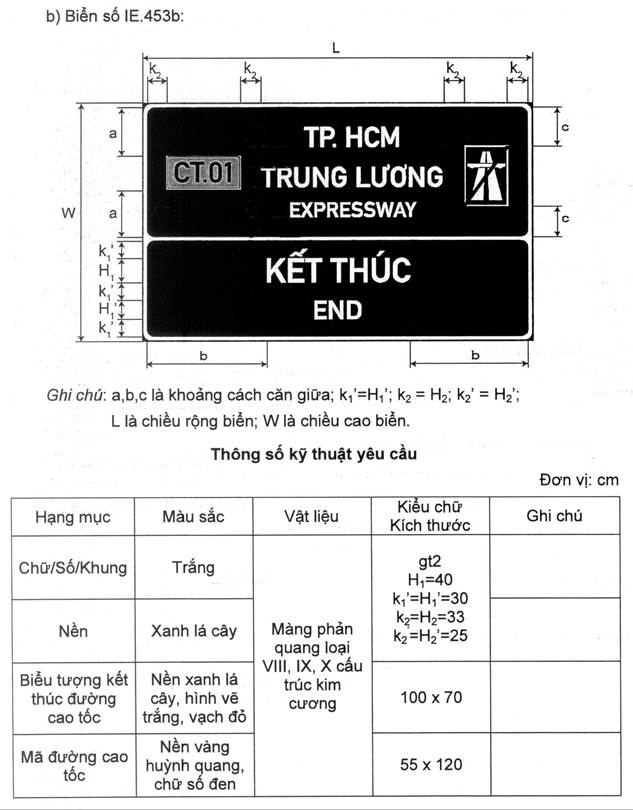
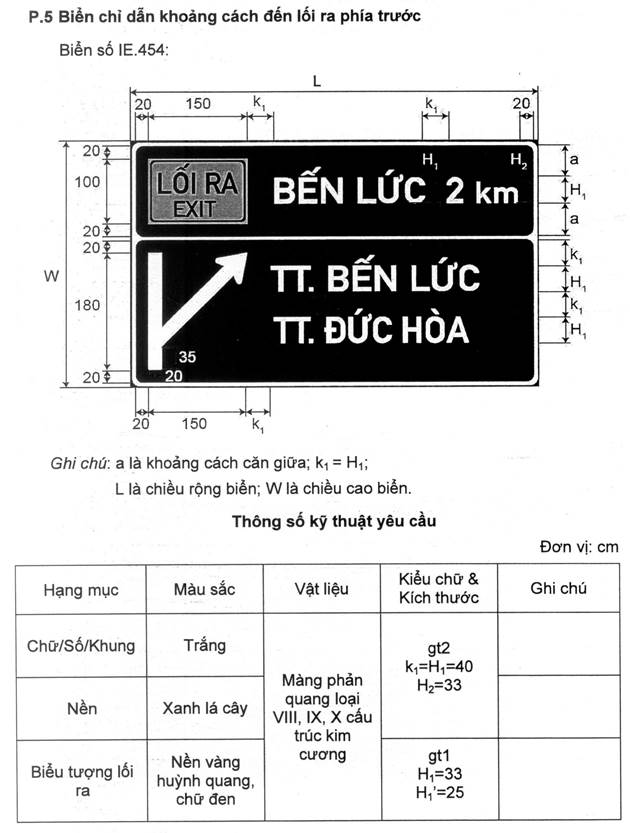
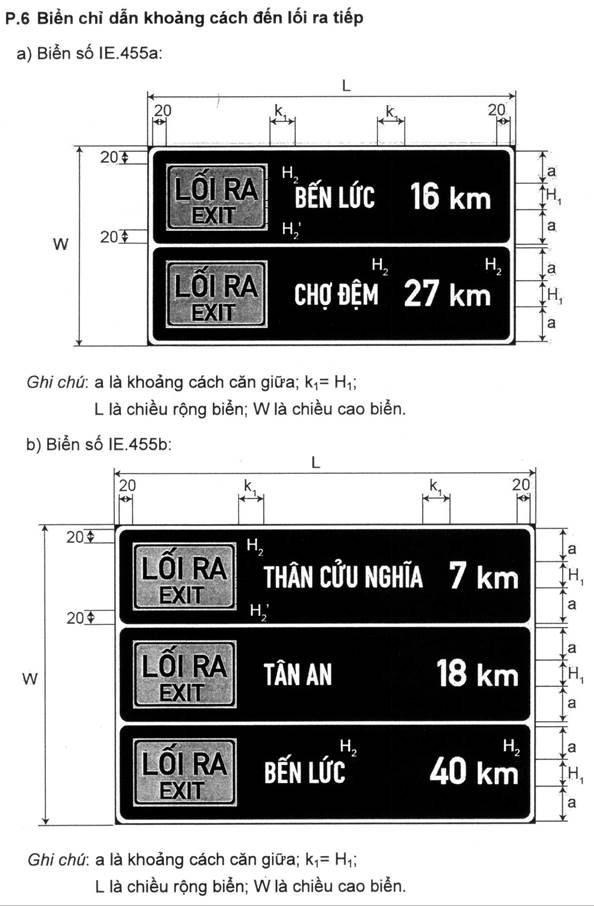
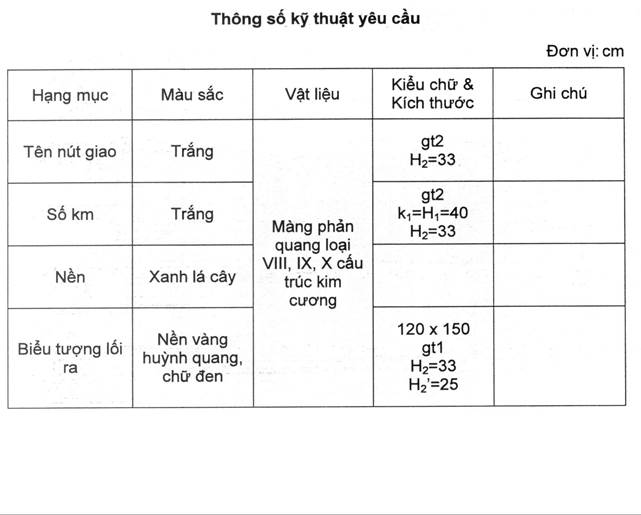
Dimensions of information signs on expressways shall be determined on the basis of area necessary to accommodate said information signs. Dimensions of type A information signs (for roads with design speed of 100 km/h and 120 km/h) are elaborated under Appendix P hereof. Dimensions of type B information signs (for roads with design speed of 60 km/h and 80 km/h) shall be adjusted on the basis of text height under Schedule 4 hereof accordingly. In special circumstances, localized adjustments can be made for the purpose of symmetry and information conciseness.
Article 50. Content of information signs on expressways
50.1. Content of information signs on expressways
50.1.1. Contents of information signs on expressways shall be a combination of the following information piece or pieces: location, road symbol, arrows indicating direction, arrows indicating lanes, texts, numerals, illustrations, and other symbols.
50.1.2. Presentation of information on information signs on expressways shall conform to the following principles:
a) Location, name of expressway, road symbol are written in all capitals;
b) Up to 3 destinations can be listed on an information sign leading up to or on an exit sign;
c) Name of a route and name of city on said route must not be specified on the same information sign;
d) Up to 3 lines of Vietnamese text can be presented in each information sign;
dd) Texts on information signs shall be presented in Vietnamese and English. Minimum Vietnamese and English text height shall be specified under Schedule 4. In special cases, dimensions of the signs and texts can be adjusted to fit road cross section proportion and save investment and must not be lower than minimum dimensions under Schedule 4.
Schedule 4. Minimum text height
|
Type of information sign |
Type B |
Type A |
||
|
Design speed, km/h |
60; 80 |
100; 120 |
||
|
Height of Vietnamese text, cm |
30,0 |
36,0 |
33,0 |
40,0 |
|
Height of English text, cm |
20,0 |
24,0 |
25,0 |
30,0 |
50.2. Distribution of texts and text dimensions on information signs on expressways
50.2.1. Distribution of texts on information signs on expressways:
a) Spacing between a line of Vietnamese text and a line of English text shall equal the height of English text;
b) Spacing between a line of English text and a subsequent line of Vietnamese text shall equal the height of English text;
c) Spacing above and below information signs shall equal the height of the largest Vietnamese text in those signs;
d) Spacing to the left and right sides of information signs (on the longest lines) shall equal the height of the largest Vietnamese text in those signs;
dd) Usually, lines of texts of instruction signs shall be at the center horizontally of information signs. Placement of symbols, junction illustrations, and lines of text on information signs shall conform to Appendices of this document.
50.2.2. Dimensions of texts, numerals, and spacing between letters are elaborated under Appendix K hereof.
50.3. Color of information signs on expressways
50.3.1. Background color, text color, and outline color of information signs on expressways:
a) In respect of directional traffic signs, texts, numerals, and illustrations on these signs shall be white against green background and white outline;
b) In respect of public announcement signs, texts, numerals, and illustrations on these signs shall be white against blue background and white outline;
c) In respect of directional warning signs, texts, numerals, and illustrations on these signs shall be black against neon yellow background and black outline;
d) In respect of recreational directional signs, texts, numerals, and illustrations on these signs shall be white against brown background and white outline;
dd) Unless otherwise specified, texts, numerals, and illustrations on signs shall be white against green background and white outline.
50.3.2. Specific details pertaining to background color, text color, and outline color of each sign shall be specified under Appendix P hereof. Text font, text color, and background color of information signs on expressways are specified under Schedule 5.
Schedule 5. Text font, text color of information signs
|
No. |
Sign description |
Font |
Text, numeral color |
Background color |
Outline color |
|
1 |
Expressway symbol |
gt2 |
black |
neon yellow |
black |
|
2 |
National highway, provincial road, district road symbol |
gt2 |
black |
white |
black |
|
3 |
Sign No. IE.450 (a,b) indicating layout, distance to junctions leading to approach to expressway |
gt2 |
white |
blue |
white |
|
4 |
Sign No. IE.451 (a,b) indicating entrance, distance to entrance of expressway |
gt2 |
white |
blue |
white |
|
5 |
Sign No. IE.452 indicating start of expressway |
gt2 |
white |
green |
white |
|
6 |
Sign No. IE.453 (a,b) indicating end, distance to end of expressway |
gt2 |
white |
green |
white |
|
7 |
Sign No. IE.454 indicating distance to exit ahead |
gt2 |
white |
green |
white |
|
8 |
Sign No. IE.455 (a,b) indicating distance to subsequent exits |
gt2 |
white |
green |
white |
|
9 |
Sign No. IE.456 (a,b,c) indicating distance and turn direction to rest area |
gt2 |
white |
green |
white |
|
10 |
Sign No. IE.457 (a,b) indicating parking space in rest area |
gt2 |
white |
green |
white |
|
11 |
Sign No. IE.458 indicating distance to subsequent rest areas |
gt2 |
white |
green |
white |
|
12 |
Sign No. IE.459 (a,b) indicating distance to tourist area |
gt2 |
white |
green |
white |
|
13 |
Sign No. IE.460 indicating milestone kilometer marker |
gt2 |
white |
green |
white |
|
14 |
Sign No. IE.461 (a,b,c) indicating distance to public area, recreational area |
gt2 |
white |
green |
white |
|
15 |
Sign No. IE.461d indicating turn direction to recreational area |
gt2 |
white |
brown |
white |
|
16 |
Sign No. IE.462 indicating radio frequency |
gt2 |
white |
green |
white |
|
17 |
Sign No. IE.463 (a,b,c) indicating distance and turn direction to weigh station |
gt2 |
white |
green |
white |
|
18 |
Sign No. IE.464 (a,b) indicating location and direction |
gt2 |
white |
green |
white |
|
19 |
Sign No. IE.465 (a,b) indicating location and distance |
gt2 |
white |
green |
white |
|
20 |
Sign No. IE.466 indicating layout of one-way exit |
gt2 |
white |
green |
white |
|
21 |
Sign No. IE.467 (a,b) indicating merging position, distance to merging position |
gt2 |
white |
green |
white |
|
22 |
Sign No. IE.468 (a,b,c) indicating obstacles ahead |
- |
- |
neon yellow |
black |
|
23 |
Sign No. IE.469 indicating turn direction |
- |
- |
neon yellow |
black |
|
24 |
Sign No. IE.470 indicating emergency phone number |
gt2 |
white |
green |
white |
|
25 |
Sign No. IE.471 indicating safe driving distance |
gt2 |
black |
neon yellow |
black |
|
26 |
Sign No. IE.472 (a,b,c,d,e) indicating distance to toll plaza, toll plaza, ETC toll plaza, card withdrawal, toll payment |
gt2 |
white |
green |
white |
|
27 |
Sign No. IE.473 indicating slow down |
gt2 |
black |
neon yellow |
black |
|
28 |
Sign No. IE.474 indicating exit |
gt2 |
white |
green |
white |
|
29 |
Other information signs: signs indicating location; administrative division of provinces, cities; signs indicating names of bridges, major structures. (Detail design of other information signs may conform to regulations on information signs for non-expressway highways unless otherwise specified under this Schedule) |
gt2 |
white |
green |
white |
50.4. Outline of information signs on expressways
50.4.1. Width of outline of information signs shall be:
a) 5 cm for signs ≥ 300,0 x 100,0 cm;
b) 3 cm for signs < 300,0 x 100,0 cm.
50.4.2. Curve radius of outline of information sign shall equal 2% the length of the longest side of the sign.
50.5. Arrows on information signs on expressways
50.5.1. In respect of information signs indicating exit, arrows pointing upwards diagonally indicate exit; whether the arrows point left or right depends on the direction of the exit.
50.5.2. Arrows indicating lanes shall point straight downwards (only used in signs installed on gantries and cantilever posts) to indicate a lane traveling to a location or a road.
50.5.3. Dimensions of arrows shall be elaborated below:
a) Arrow indicating lane:
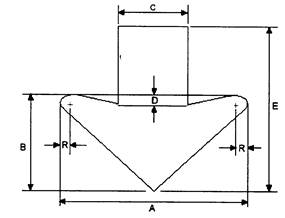
Arrow dimension
Unit: cm
|
A |
B |
C |
D |
E |
R |
|
80,0 |
40,0 |
16,25 |
7,5 |
55,0 |
2,5 |
b) Arrow indicating direction:

Arrow dimension
Unit: cm
|
A |
B |
C |
D |
E |
R |
|
48,0 |
40,0 |
18,0 |
4,0 |
80,0 |
3,0 |
Arrow indicating direction must point in the same direction as the direction depicted by the arrow.
50.6. Road code in information signs on expressways
50.6.1. Road code is contained in a rectangular box of fixed dimensions and consists of 2 parts: abbreviated road type and road number. Abbreviated road type (Expressway - CT, National Highway - QL, Provincial Road - ĐT, District Road - ĐH). Road number is elaborated under Decree No. 11/2010/ND-CP dated February 24 of 2010 of the Government. Abbreviated road name and road number is separated by a period. Font gt2 (normal font) shall be used to specify road code where, depending on length of road code, width of letters and letter spacing can be adjusted to fit the rectangular box with fixed dimensions. Depending on approved development planning for Vietnamese expressway network until 2020 and orientation to 2030, code of expressway under approved planning is elaborated under Appendix N hereof. Dimensions of expressway code are elaborated under Appendix O hereof.
50.6.2. Color of background, text, and numerals in road code:
a) Expressway code shall be black against neon yellow background and black outline according to Figure 4a;
b) National highway, provincial road, and district road code shall be black against white background, and black outline (according to Figures 4b, 4c, and 4d).
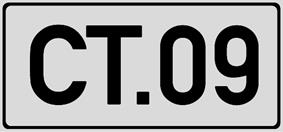
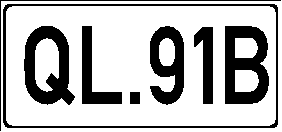
a) Expressway code b) National highway code
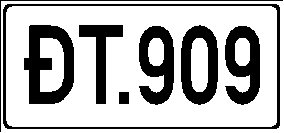
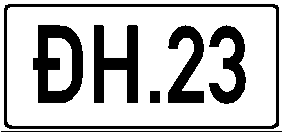
c) Provincial road code d) District road code
Figure 4. Road code
50.7. Symbol of industrial park, public service establishment, recreational area
Symbols of industrial parks, public service establishments, and recreational areas are used as subjects of several signs for the purpose of delivering concise and comprehensive information to road users.

a) Traffic police station


b) Airport c) Passenger coach station d) Railway station


e) Dock f) Industrial park g) Hydroelectricity dam



h) Public telephone i) Repair station k) Petrol station



l) Eating and drinking establishment m) Restroom n) Hospital, first aid


o) Youth hostel p) Access for disabled people q) Information desk



r) Carwash s) Golf course t) Eco forest
Figure 5. Symbol of industrial park, public service establishment, recreational area
In principle, symbols of industrial park, public service establishment, and recreational area are depicted black against white background and black outline (Figure 5). However, color of some symbols shall adhere to the Vienna Convention on road signals. See Appendix P (P.8) and Appendix P (P.13) for dimensions of these symbols.
50.8. Number and name of information sign
|
No. |
Number |
Name of sign |
|
1 |
Sign No. IE.450 (a,b) |
Layout and distance to junction with approach to expressway |
|
2 |
Sign No. IE.451 (a,b) |
Entrance and distance to entrance to expressway |
|
3 |
Sign No. IE.452 |
Start of expressway |
|
4 |
Sign No. IE.453 (a,b) |
End of expressway |
|
5 |
Sign No. IE.454 |
Distance to exit ahead |
|
6 |
Sign No. IE.455 (a,b) |
Distance to subsequent exits |
|
7 |
Sign No. IE.456 (a,b,c) |
Rest area and distance to rest area |
|
8 |
Sign No. IE.457 (a,b) |
Parking space in rest area |
|
9 |
Sign No. IE.458 |
Distance to subsequent rest areas |
|
10 |
Sign No. IE.459 (a,b) |
Distance to tourist area |
|
11 |
Sign No. IE.460 |
Milestone kilometer marker |
|
12 |
Sign No. IE.461 (a,b,c,d) |
Public service establishment, recreational area |
|
13 |
Sign No. IE.462 |
Radio frequency |
|
14 |
Sign No. IE.463 (a,b,c) |
Weigh station |
|
15 |
Sign No. IE.464 (a,b) |
Location and direction |
|
16 |
Sign No. IE.465 (a,b) |
Location and distance |
|
17 |
Sign No. IE.466 |
Layout of one-way exit |
|
18 |
Sign No. IE.467 (a,b) |
Merging |
|
19 |
Sign No. IE.468 (a,b) |
Obstacle ahead |
|
20 |
Sign No. IE.469 |
Turn direction |
|
21 |
Sign No. IE.470 |
Emergency phone number |
|
22 |
Sign No. IE.471 |
Safe stopping distance |
|
23 |
Sign No. IE.472 (a,b) |
Toll plaza |
|
24 |
Sign No. IE.473 |
Slow down |
|
25 |
Sign No. IE.474 |
Exit |
50.9. Installation of information sign
Information signs on expressways shall be mounted on cantilever posts, gantries, pillars, or architectural elements as long as safety and aesthetics are guaranteed.
50.9.1. Information signs mounted on gantries, cantilever posts:
a) Information signs shall be mounted on gantries and cantilever posts in a manner that allow vehicle operators to see from afar. Gantries and cantilever posts shall be sturdy, capable of bearing loads and withstanding region-based wind level published by the Ministry of Natural Resources and Environment.
b) Minimum height from the bottom of information signs to the highest points of road surface shall be 5,2 m. Support pillars of gantries and cantilever posts shall be at least 0,5 m away from the outermost edge of road shoulder (Figure 6).
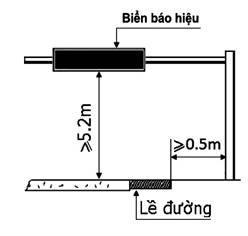
Figure 6. Support structure for mounting information sign on expressway
50.9.2. Installation of information sign on road shoulder of expressway:
Location of information signs on road shoulder of expressway shall adhere to Article 20 hereof.
Article 51. Types of information sign on expressways
51.1. Layout and distance to junction with approach to expressway
51.1.1. Sign No. IE.450a for indicating distance to junction leading to expressway (Figure 7a) informs distance to junction leading to expressway where the presented distance is rounded to the nearest 100 m. Depending on network of connecting roads, sign No. IE.450a can be located at all junctions within a 5 km radius (or further at major transportation hubs) to inform road users about entrance to expressways in advance.
51.1.2. Sign No. IE.450b depicts layout to approach leading to expressway (Figure 7b). Minimum distance from where this sign is located to junction leading to expressway shall equal one-way sight distance of road type in accordance with Schedule 6.
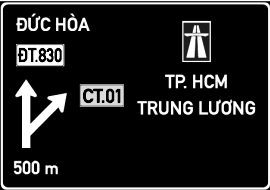
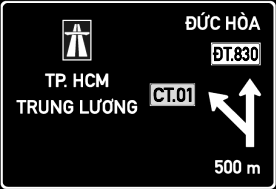
a) Sign No. IE.450a
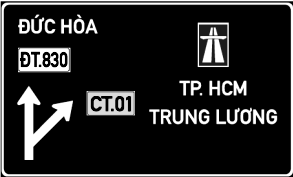
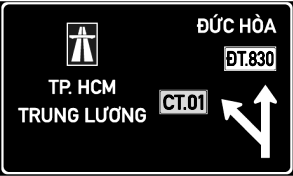
b) Sign No. IE.450b
Figure 7. Sign No. IE.450 illustrates layout and distance to junction leading to expressway
Schedule 6. Minimum sight distance on side road
|
Design speed on side road, km/h |
80 |
60 |
50 |
40 |
35 |
30 |
|
Sigh distance, m |
110 |
75 |
65 |
45 |
35 |
30 |
51.2. Entrance and distance to entrance to expressway
51.2.1. Sign No. IE.451a for indicating distance to entrance to expressway shall be located on approach to expressway (Figure 8a); for informing distance to entrance to expressway in advance. Location of this sign shall be determined on the basis of length of expressway approach.
51.2.2. Sign No. IE.451b for indicating entrance to expressway (Figure 8b). This sign shall be located at the end of expressway approach.

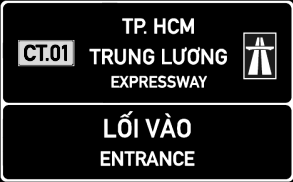
a) Sign No. IE.451a b) Sign No. IE.451b
Figure 8. Sign No. IE.451 indicating entrance
and distance to expressway entrance
51.3. Start of expressway
Sign No. IE.452 indicates start of expressway (Figure 9a). This sign is presented with green background and white text and includes information on name and code of expressway, maximum and minimum speed limit. Where lanes have different speed limits, respective speed limits shall be depicted on the bottom line of the sign (Figure 9b).

Figure 9a. Sign No. IE.452 indicating start of expressways
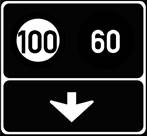
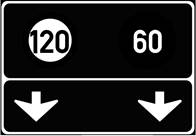
Figure 9b. Sign indicating start of expressway
with differentiated per-lane speed limit
51.4. End of expressway
51.4.1. Sign No. IE.453a for indicating distance to end of expressway (Figure 10) and Sign No. IE.453b for indicating end of expressway (Figure 10b). Dimensions of sign No. IE.453 are elaborated under Appendix P (P.4) hereof.
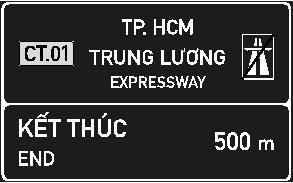
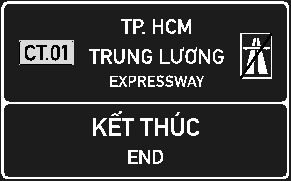
a) Sign No. IE.453a b) Sign No. IE.453b
51.4.2. Sign No. IE.453c “End of expressway”
Sign No. IE.453c “End of expressway” (Figure 10c) shall be installed to signify end of expressway
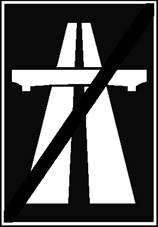
c) Sign No. I.453c
Figure 10. Sign No. IE.453c for indicating distance to end of expressway; Sign No. IE.453c for indicating end of expressway
51.5. Distance to exit ahead
Sign No. IE.454 indicates distance to exit ahead (Figure 11). Depending on the size of junctions, up to 2 signs that are 1 km and 2 km away from the junctions or only 1 sign that is 1 km away from the junction shall be installed. Distance specified on the sign shall be whole numbers rounded to the nearest kilometer. Dimensions of sign indicating distance to exit ahead shall be elaborated under Appendix P (P.5) hereof.
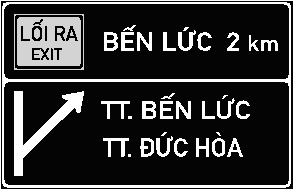
Figure 11. Sign No. IE.454 indicating distance to exit ahead
At exit, sign No. IE.464b shall be located at dividers defining the exit
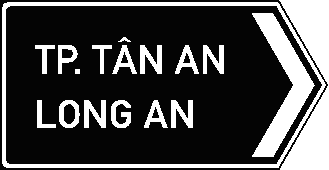
Figure 11’. Sign No. IE.464b direction at exit
51.6. Distance to subsequent exits
Sign No. IE.455 for indicating distance to subsequent exits (Figure 12) shall be installed to notify before entering areas with multiple junctions ahead. Usually, signs indicating distance to subsequent exits shall depict exits at the next 2 or 3 junctions on expressway. Signs shall be installed before junction and on road shoulder to indicate distance to subsequent exits. Dimensions of sign indicating distance to subsequent exits shall be elaborated under Appendix P (P.6) hereof.
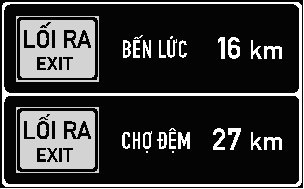
a) Information sign indicating two subsequent exits
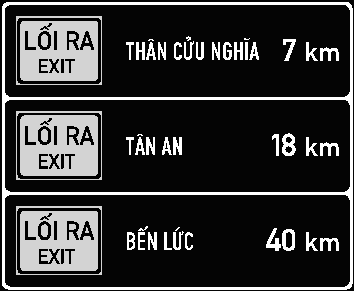
b) Information sign indicating three subsequent exits
Figure 12. Sign No. IE.455 for indicating distance to subsequent exits
51.7. Rest area
51.7.1. Sign No. IE.456 for indicating distance and direction to rest area shall be installed on shoulder of expressway. These information signs show direction to rest areas that contain three or four basic services, the three of which include: petroleum and gasoline - eating and drinking - information access. The fourth service shall be any of the following: telephone; youth hostel; repair station; first aid; truck parking space; services for disabled people, etc. Services available in rest areas shall be depicted in form of simple illustrations and symbols. Dimensions of service symbols shall be elaborated under Appendix P (P.13) hereof.
51.7.2. Sign No. IE.456a indicating distance to rest area (Figure 13); sign No. IE.456b indicating direction to rest areas shall be approximately 150 m away from junction leading to the rest areas (Figure 14); Sign No. IE.456c indicating entrance to rest areas shall be located at entrance to rest areas (Figure 15).
51.8. Parking space in rest area
Usually, sign No. IE.457a indicating distance to parking space in rest area (Figure 16) is installed in conjunction with sign indicating direction to rest area. Sign No. IE.457b indicates direction to parking lot in rest area Detail dimensions of sign indicating parking space in rest area shall be elaborated under Appendix P (P.9) hereof.
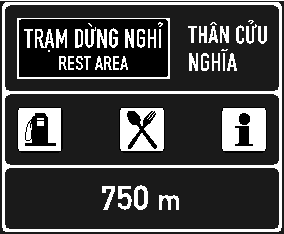
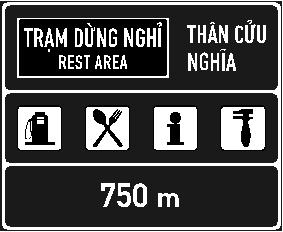
Sign depicts three services Sign depicts four services
Figure 13. Sign No. IE.456a indicating distance to rest area
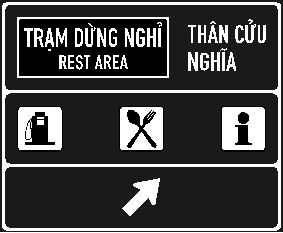
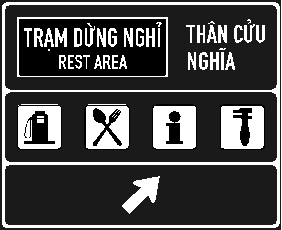
Sign depicts three services Sign depicts four services
Figure 14. Sign No. IE.456b indicating direction to rest area
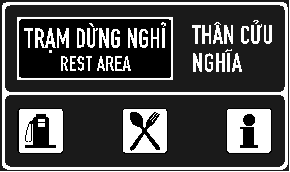
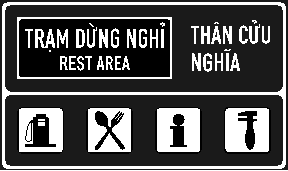
Sign depicts three services Sign depicts four services
Figure 15. Sign No. IE.456c indicating direction to rest area
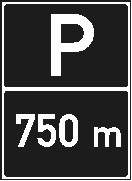
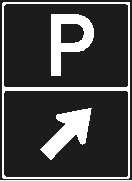
a) Sign No. IE.457a b) Sign No. IE.457b
Figure 16. Sign No. IE.457 indicating parking space in rest area
51.9. Distance to subsequent rest areas
Sign No. IE.458 indicating distance to subsequent rest areas This sign shall be located immediately after exit from rest area on shoulder of expressway (Figure 17). Details of sign indicating distance to subsequent rest areas shall be elaborated under Appendix P (P.10 ) hereof.
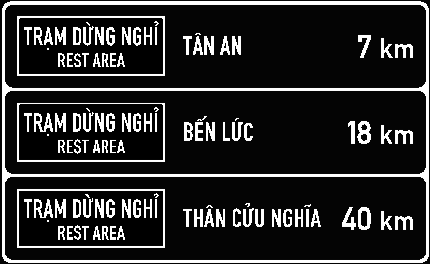
Figure 17. Sign No. IE.458 indicating distance to subsequent rest areas
51.10. Tourist area
51.10.1. Sign No. IE.459 indicating direction to tourist area shall be located on road shoulder (Figure 18). This sign indicates distance and direction of tourist area. Detail dimensions of sign indicating direction to tourist area shall be elaborated under Appendix P (P.11) hereof.
51.10.2. Sign No. IE.459a indicating distance to tourist area; sign No. IE.459b indicating direction to tourist area shall be approximately 150 m away from junction leading to the tourist area.
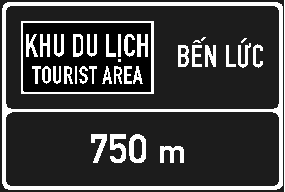
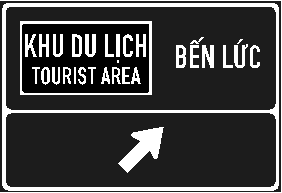
a) Sign No. IE.459a b) Sign No. IE.459b
Figure 18. Sign No. IE.459 indicating direction to tourist area
51.11. Milestone kilometer marker
Sign No. IE.460 indicating milestone kilometer marker shall be located on road shoulder (corresponding to milestone kilometer marker in form of rectangular sheet located on road shoulder in accordance with Article 66 hereof), consist of the word “Km” above followed by kilometric point numerals below, be presented with white outline against green background (Figure 19). Milestone kilometer marker shall be 0,5 m away from the edge of road shoulder. Details of milestone kilometer marker shall be elaborated under Appendix I hereof.



a) Sign No. IE.460a b) Sign No. IE.460b c) Sign No. IE.460c
Figure 19. Sign No. IE.460 indicating milestone kilometer marker
51.12. Public service establishment, recreational area
Sign No. IE.461 indicates distance and direction to public service establishment, recreational area. This sign is presented by white text against green background with symbols of corresponding services (Figure 20). This sign shall only be installed for the sole purpose of guiding road users to reach public service establishments such as airports, railway stations, coach stations, ports, docks, etc. or to recreational service establishments such as golf courses, fishing areas, beaches, forests. This sign shall be installed on road shoulder and close to junction leading to the service establishment. Details of sign indicating direction to public service establishment, recreational area shall be elaborated under Appendix P (P.12) hereof.
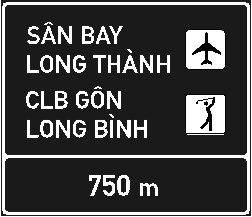
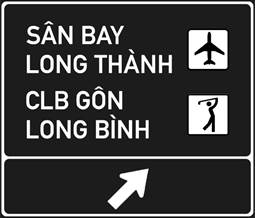
a) Sign No.IE.461a indicating distance b) Sign No. IE.461b indicating direction
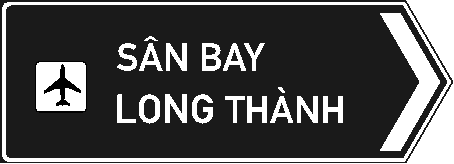
c) Sign No. IE.461c indicating direction to public service establishment

d) Sign No. IE.461d indicating direction to recreational area
Figure 20. Information sign for public service establishment and recreation area
51.13. Radio frequency
Sign No. IE.462 indicating radio frequency shall be installed in areas where weather changes regularly and affects vehicle operation or in areas with special travel conditions or other necessary positions on expressway (Figure 21). Information on weather and traffic situations on expressway shall be communicated via radio frequency depicted in the sign. Details of sign indicating radio frequency shall be elaborated under Appendix P (P.14) hereof.
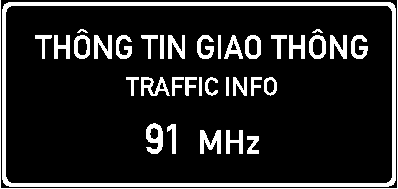
Figure 21. Sign No. IE.462 indicating radio frequency
51.14. Weigh station
Sign No. IE.463 indicating direction to weigh station (Figure 22) includes: sign No. IE.463a indicating distance to weigh station; sign No. IE.463b indicating direction to weigh station; sign No. IE.463c indicating entrance to weigh station. Sign No. IE.463c indicating entrance to weigh station shall be located at junction connecting expressway and access to weigh station. Details of sign indicating direction to weigh station shall be elaborated under Appendix P (P.15) hereof.
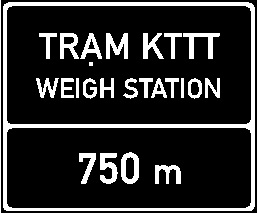
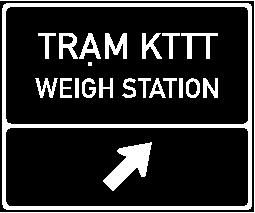
a) Sign No. IE.463a b) Sign No. IE.463b
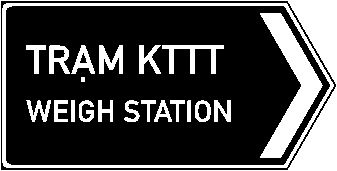
c) Sign No. IE.463c
Figure 22. Sign No. IE.463 indicating direction to weigh station
51.15. Location and direction
Sign No. IE.464 indicating location and direction consists of name of location and arrow indicating lane leading to said location (Figure 23). Arrows used in this type of sign include: 1) arrow pointing downwards to indicate lane; 2) arrow pointing diagonally upwards to indicate lane leading to a location. Sign indicating location and direction shall be mounted on gantries before exit. Sign No. IE.464b shall be located at exit junction or close to junction on the outer curve of expressway exit. Details of sign indicating location and direction shall be elaborated under Appendix P (P.16) hereof.
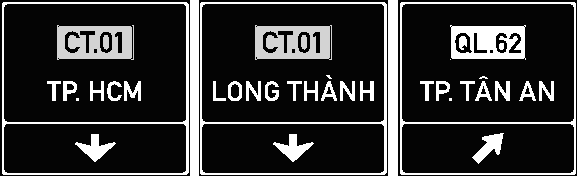
a) Sign No. IE.464a indicating one-way exit
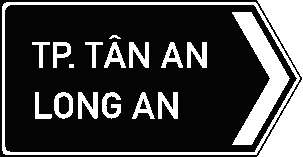
b) Sign No. IE.464b indicating exit direction
Figure 23. Sign No. IE.464 indicating location and direction
51.16. Location and distance
Sign No. IE.465 indicating location and distance consists of two or three lines indicating locations and distance to said locations in kilometer (Figure 24). The first line (topmost line) defines distance to the nearest junction. The second line (if any) defines distance to tourist area, recreational area, or major transportation hub. The third line (bottom line) defines distance to major city (of the highest administrative level) which the road travels through. This sign shall be located on road shoulder immediately after entering expressway and repeated every 10 km or higher in length. Details of sign indicating location and distance shall be located under Appendix P (P.17) hereof.
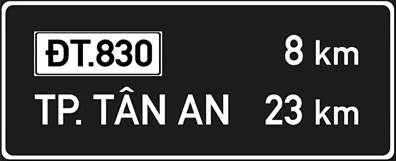
a) Sign depicting two locations
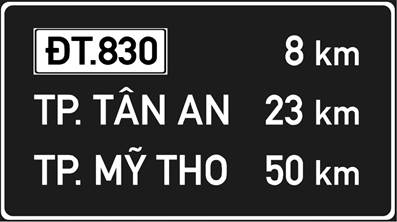
b) Sign depicting three locations
Figure 24. Sign No. IE.465 indicating location and distance
51.17. Layout of one-way exit
Sign No. IE.466 indicating layout of one-way exit at all junctions on expressway shall be mounted on gantries (Figure 25). Details of sign indicating one-way exit shall be elaborated under Appendix P (P.18) hereof.
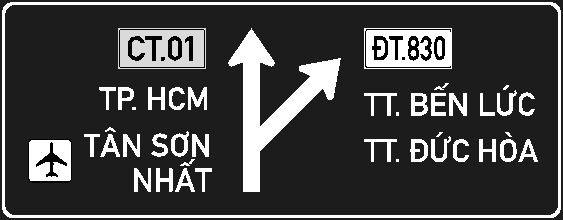
Figure 25. Sign No. IE.466 indicating one-way exit
51.18. Merging
Sign No. IE.467a indicates merging position at junctions with high traffic volume. Sign No. IE.467b informs road users about merging position ahead. This sign shall be located on road shoulder close to junction. Details of sign indicating lane merging shall be elaborated under Appendix P (P.19) hereof. Where sign No. IE.467 is not installed, signs No. W.207g and W.238 shall be used.
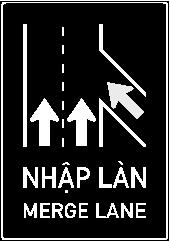
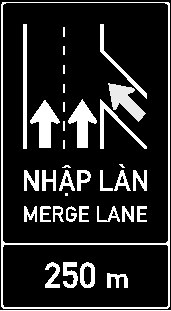
a) Sign No. IE.467a b) Sign No. IE.467b
Figure 26. Sign No. IE.467 indicating merging position
51.19. Obstacle ahead
Sign No. IE.468 warns about obstruction to normal traffic ahead (on roadway or close to roadway) and provides instruction to avoid the obstruction. Sign No. IE.468a directs vehicles to move on the left; sign No. IE.468b directs vehicles to move on either side; sign No. IE.468c directs vehicles to move on the right (Figure 27). Sign indicating obstacles ahead consists of black diagonal lines against neon yellow background. Details of sign indicating obstacles shall be elaborated under Appendix P (P.20) hereof.

a) Sign No.IE.468a b) Sign No. IE.468b c) Sign No. IE.468c
Figure 27. Sign No. IE.468 indicating obstacle ahead
51.20. Reflective marker
Sign No. IE.469 (reflective marker) for indicating turn direction informs vehicle operators about change in direction upon entering dangerous bends with small curve radius (Figure 28). This sign shall be located on outer curve and 0,5 m away from road shoulder or on central dividers in respect of roads with physically separated directions of travel. Details of sign indicating curve direction shall be elaborated under Appendix P (P.21) hereof. Intervals at which signs No. 469 are installed depends on curve radius and speed of vehicles on side road branching off from expressway and is specified under Schedule 7.


a) Right turn b) Left turn
Figure 28. Sign No. IE.469 indicating turn direction
Schedule 7. Installation interval of sign No. IE.469
|
Speed (km/h) |
Curve radius (m) |
Interval (m) |
|
< 30 |
< 60 |
12 |
|
30 - 50 |
60 - 120 |
24 |
|
50 - 70 |
120 - 220 |
36 |
|
70 - 100 |
220 - 380 |
48 |
51.21. Emergency phone number
Sign No. IE.470 uses white text against green background, provides emergency phone number in case of emergencies or accidents (Figure 29), and shall be installed on road shoulder. Details of sign indicating emergency phone number shall be elaborated under Appendix P (P.22) hereof.

Figure 29. Sign No. IE.470 indicating emergency phone number
51.22. Safe stopping distance
Sign No. IE.471 uses black text against neon yellow background and black outline (Figure 30). This sign informs vehicle operators about safe stopping distance while driving on expressway. Detail provisions pertaining to sign indicating safe stopping distance shall be elaborated under Appendix P (P.23) hereof.
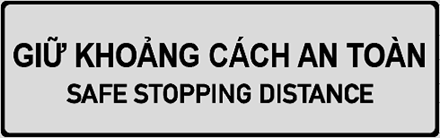
Figure 30. Sign No. IE.471 indicating safe stopping distance
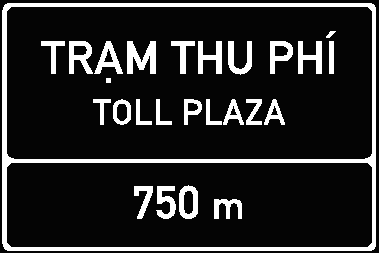
a) Sign No. IE.472a
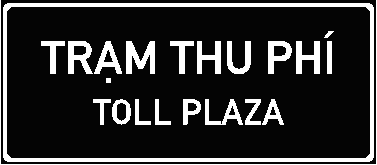
b) Sign No. IE.472b
Figure 31. Sign No. IE.472 indicating distance to toll plaza
51.23. Toll plaza
Sign No. IE.472 uses white text against green background and shall be mounted on road shoulder or gantries at a set distance away from toll plaza to inform vehicle operators about toll plaza (Figure 31). Details of sign indicating toll plaza and other signs related to toll plaza shall be elaborated under Appendix P (P.24) hereof.
51.24. Slow down
Sign No. IE.473 requests vehicle operators to be careful and slow down in areas prone to traffic safety risks (Figure 32). This sign uses black text against neon yellow background and shall be located at positions where deceleration is required such as dangerous bends or approach to toll plaza, weigh station, rest area, area prone to fog, etc. This sign is usually installed on road shoulder at visible position or gantries. Details of slow down sign shall be elaborated under Appendix P (P.25) hereof.
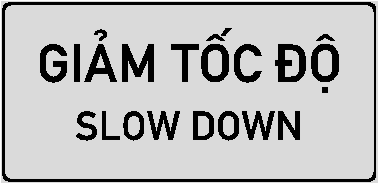
Figure 32. Sign No. IE.473 indicating slow down
51.25. Expressway exit
Sign No. IE.474 uses white text against green background, indicates exit from expressway, and shall be installed on road shoulder or gantries before expressway exit (Figure 33). Details of sign indicating expressway exit shall be elaborated under Appendix P (P.26) hereof.
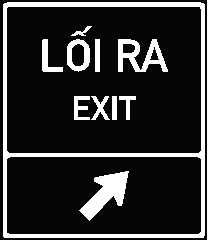
Figure 33. Sign No. IE.474 indicating exit
CHAPTER 10
ROAD MARKINGS
Article 52. General provisions for road markings
52.1. Road markings are a form of signal for traffic guidance and control that serves to improve traffic safety and capacity.
52.2. Road markings can be used as stand-alone signals or in combination with traffic signs or traffic lights.
52.3. Road markings include markers, text, and illustrations on roadway, sidewalk, traffic structures, and other parts of road to dictate traffic order, dimensional limits of traffic structures, and lane direction.
52.4. Road markings shall allow vehicles to operate smoothly, maintain traction between tires and road surface, prevent slip, and not be higher than 6 mm from road surface.
52.5. Where applicable, road markings shall be determined in a manner that conforms to traffic arrangement on the road, width of roadway, traffic speed, traffic volume, vehicles and pedestrians involved.
52.6. In respect of expressway, road with design speed ≥ 60 km/h, and road with V85 of at least 80 km/h, road markings shall be of reflective materials. In respect of other road types, whether or not reflective materials will be used shall be determined on the basis of financial capabilities and other requirements.
Article 53. Road marking classification
53.1. Road markings shall be divided into 2 types based on where the markings are applied: surface markings (including markings on road surface: longitudinal markings, transverse markings, and other types of markings) and vertical markings.
53.1.1. White markings shall be adopted to distinguish different sections of the road unless otherwise specified under Appendix G where yellow markings are adopted. In some cases, other colors can be adopted to increase level of traffic warning.
53.1.2. Vertical markings shall be implemented on the side of sidewalk, traffic structures, and other elements of the road. This type of markings combine yellow markings and black markings or white markings and red markings.
53.2. Road markings shall be divided into 3 types based on marking pattern:
53.2.1. Longitudinal markings are markings that are placed along the direction of travel;
53.2.2. Transverse markings are markings that are placed across the road or form an angle with the direction of travel;
53.2.3. Other markings are markings that utilize words or other formats.
53.3. Road markings shall be divided into 4 types based on functions and interpretations: regulatory markings, warning markings, guidance markings, deceleration markings.
53.4. Road markings shall be divided into 2 types based on marking shape:
53.4.1. Markers on road surface, kerb, or lane dividers consist of solid lines and broken lines;
53.4.2. Words and symbols consist of letters, numerals, or illustrations on road surface.
Article 54. Interpretations and dimensions of road markings
Interpretations and dimensions of common road markings shall be elaboration under Appendix G.
Article 55. Priority of road markings
Road users shall adhere to stand-alone road markings. Where road markings are to be used in combination with traffic lights and traffic signs, road users shall comply with orders of road markings, traffic signs, and traffic lights in the order of priority specified under Article 4 hereof.
Chapter 11
TRAFFIC CONES, REFLECTIVE MARKERS, PROTECTIVE WALLS, AND BARRIERS
Article 56. Functions of traffic cones and barricades
Traffic cones or barricades shall be located on the shoulder of dangerous roads to inform road users about safe roadway and direction of travel.
Barricades also prevent vehicles from moving out of roadway. Barricades also act as guidance for drivers at night via vertical markings or reflective markers.
Article 57. Shape and dimension of traffic cones
Traffic cones shall have square cross section with minimum side length of 12 cm or circular cross section with equivalent minimum cross section. Height of traffic cones from road surface to the highest point of traffic cones shall be 70 cm and can be adjusted from 40 cm to 70 cm on curve roads where height of traffic cones from both ends to the apex gradually increases from 40 cm to 70 cm. Aboveground section of cones shall be painted white; the topmost 10 cm section shall be painted red and of reflective or luminescent materials. In some cases, traffic cones of other colors can be adopted as long as reflective markers are installed on traffic cones in accordance with Article 61.
Article 58. Installation of traffic cones
58.1. Traffic cones shall be installed:
58.1.1. From one end to the other end of outer horizontal curve. Where transition curves are available, traffic cones shall be located from the beginning of a transition curve to the end of the other transition curve;
58.1.2. On road sections where road base is strictened;
58.1.3. On road sections where height of fill slope is at least 2 m;
58.1.4. On road sections that move along rivers, lakes, ponds, streams;
58.1.5. Where roads intersect railway at level crossings;
58.1.6. On both sides of roads that are frequently or seasonally inundated and on both sides of fords;
58.1.7. On road sections that cross sand dunes, grassy hills where distinction between roadway and roadside strips of land is not clear.
58.2. Traffic cones shall not be required at curve roads if roadway is clearly defined by kerbs, sidewalks, or adjacent structures or if arrow-shaped reflective markers have been installed.
Article 59. Traffic cone installation
59.1. In respect of new or renovated roads, traffic cones shall be adjacent to road shoulder in a manner where edge of all traffic cones are at least 0,5 m away from roadway and shall curve with the edge of roadway unless roadway is occupied by obstacles.
59.2. In respect of existing roads and/or roads where road shoulder is not wide enough, traffic cones shall be adjacent to the road shoulder.
59.3. Where trees are planted on road shoulder, traffic cones can be adjacent to the trees as long as the cones are clearly visible without encroaching upon the center of the road to an extent that usable area of the road is reduced.
59.4. Where barricades or barriers taller than 0,4 m have been installed, traffic cones shall not be required.
59.5. Road shoulder adjacent to traffic cones shall be even and durable, not pose risks to vehicles operating adjacent to the traffic cones, and not contain obstacles that obscure the traffic cones.
59.6. In respect of existing roads, where road base or road slope does not meet principles under 59.1 of this Article, traffic cones can be installed on road shoulder next to road margin.
59.7. Traffic cones shall form a straight line on straight sections and gradually curve on curved sections where spacing between traffic cones is:
59.7.1. Spacing (S) between 2 traffic cones on a regular straight section shall be 10 m in case of regular highway and 30 m in case of expressway;
59.7.2. Spacing between 2 traffic cones on a horizontal curve:
a) Where radius (R) of the horizontal curve is between 10 m and 30 m, S shall be 3 m;
b) Where radius (R) of the horizontal curve is 30 m < R ≤ 100 m, S shall be 5 m;
c) Where radius (R) of the horizontal curve is greater than 100 m, S shall be 10 m;
d) Spacing between 2 traffic cones at starting points and ending points of the horizontal curve shall equal the spacing between 2 traffic cones in the horizontal curve plus 3 m.
59.7.3. Spacing between 2 traffic cones on a sloped road:
a) Where slope gradient is greater than or equal to 3%, spacing between the traffic cones shall be 5 m;
b) Where slope gradient is lower than 3%, spacing between the traffic cones shall be 10 m (not applicable to bridge approaches and culvert approaches);
c) Spacing between 2 traffic cones on a sloped horizontal curve shall be determined in accordance with 59.7.2 of this Article. Spacing between traffic cones located after the horizontal curve shall be determined in accordance with Points a and b above.
59.7.4. Each line of traffic cones shall contain at least 6 traffic cones.
Article 60. Trees replacing traffic cones
Trees meeting requirements below can be used as substitute for traffic cones:
60.1. Each tree shall be 10 m away from one another and of relatively similar size (minimum diameter of 0,15 m);
60.2. Trees are planted on road shoulder or slope of road base and curve with edge of roadway;
60.3. White lime is applied to tree trunk from elevation of road shoulder to a height of 1,5 m.
Article 61. Reflective markers
61.1. General provisions for reflective markers
61.1.1. Reflective markers are guiding devices outfitted with reflective attachments to provide guidance during nighttime or in case of fog limited visibility. Reflective markers shall be installed where misunderstanding or confusion pertaining to direction may occur.
61.1.2. Reflective attachments of reflective markers shall be visible during nighttime when they are illuminated by standard motor vehicle headlamp 300 m away under normal weather conditions.
61.1.3. Reflective attachments can be reflective plastic sheets, reflective materials affixed to metal blocks, reflective film attached to metal plates, etc. Reflective attachments can be in circular, rectangular, triangular, or polygonal in shape and attached to crash barriers, barricades, or onto road surface. Reflective attachments also include reflective bands that wrap around reflective cones.
61.1.4. Yellow reflective cones shall be used as central dividers, on the sides of one-way roads, or on the right side of two-way roads. Red reflective cones shall be installed to indicate oncoming direction of travel on two-way roads (in order to warn road users about inappropriate direction of travel) and to indicate runaway ramps.
61.1.5. Reflective markers include: reflective cones installed on the road or dividers, reflective arrows, and reflective studs (cat’s eyes) on the road.
61.2. Reflective markers on the road or on dividers
61.2.1. Scope of reflective markers installed on the road or on dividers:
a) On expressway:
+ On both sides of the road. In this case, where crash barriers are less than 2,4 m away from the edge of roadway, reflective markers shall be installed on crash barriers. In other cases, reflective markers shall be installed on the side of the road in form of pillars;
+ On at least one side of each side road in complete grade-separated junctions.
b) On other roads: reflective markers should be installed on road sections where roadway area is reduced and crash barriers are not installed, windy mountainside roads with limited visibility, runaway ramp, and railway crossing. In respect of roads with frequent fog, reflective markers shall be attached to solid objects adjacent to roadway such as traffic islands, kerb, etc. if these features are hardly visible during nighttime.
61.2.2. Reflective markers shall not be installed on roadside and on dividers if:
a) Reflective studs have been installed on road surface into continuous strips;
b) Reflective arrow markers have been installed on curve sections;
c) Streetlamps have been installed to provide continuous illumination during nighttime;
d) Lanes expand gradually in the direction of travel.
61.2.3. Location and spacing of reflective markers on the side of the road and on dividers:
a) Spacing between reflective markers and the outermost edge of roadway shall be 0,6 m - 2,4 m; spacing between reflective markers and edge of road surface shall be consistent and conform to edge of roadway;
b) Spacing between reflective markers on straight roads shall not be lower than 10 m and not greater than 100 m;
c) Spacing between reflective markers within the vicinity of horizontal curve shall not be lower than 6 m and not greater than 100 m depending on curve radius;
d) 3 reflective markers shall be installed where straight sections meet starting points or end points of curved sections. Spacing between the first reflective marker and starting/end points shall be 1S; spacing between the second reflective marker and the first reflective marker shall be 3S; spacing between the third reflective marker and the second reflective marker shall be 6S up to 100 m (where S is spacing between reflective markers on horizontal curve).
61.3. Reflective arrow markers
61.3.1. Reflective arrow markers consist of a sign depicting a black directional arrow on yellow background affixed to the top of posts (see Figure 34a). Reflective arrow markers consisting of a white arrow indicating oncoming direction of travel (on the left side) on red background are usually installed on two-way roads that lack central dividers (Figure 34b).

Figure 34a. Reflective arrow markers

Figure 34b. Reflective arrow markers (on the left side) for two-way road
61.3.2. Dimensions of reflective arrow markers:
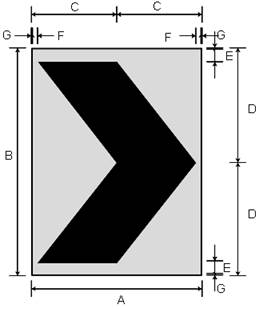
|
Dimensions (mm) |
A |
B |
C |
D |
E |
F |
|
Road with design speed < 60 km/h |
220 |
400 |
110 |
200 |
10 |
10 |
|
Road with design speed 60 - 80 km/h |
300 |
500 |
150 |
250 |
15 |
15 |
|
Road with design speed > 80 km/h |
600 |
800 |
300 |
400 |
20 |
20 |
* Where necessary along mountainside roads or foggy roads, the dimensions above can be increased by 1 grade to improve traffic safety.
61.3.3. Reflective arrow markers shall be used within vicinity of horizontal curves:
a) On expressway where radius of horizontal curve equals the lowest minimum radius depending on road grade;
b) On indirect left turn of complete grade-separated junctions;
c) On curved sections with limited visibility or curved sections prone to traffic accidents; curved sections where sign No. 201 “Chỗ ngoặt nguy hiểm” (Dangerous bend) are installed and where outer curve is adjacent to steep cliffs without crash barriers; areas with multiple hairpin curves.
61.3.4. Reflective arrow markers shall be located on outer curve of horizontal curves and from starting points to end points of the curved sections. Spacing between reflective arrow markers shall not be lower than 12 m and not greater than 60 m.
61.4. Reflective studs
61.4.1. Longitudinal reflective studs shall be installed:
a) On expressway:
+ On channelizing lines at the beginning of road gores. In this case, reflective studs shall be installed between physical gores and theoretical gore where maximum spacing between reflective studs is 6 m.
+ Reflective studs can be installed on road markings separating primary roadway and emergency lanes.
b) In respect of roads with more than two lanes per direction of travel and without permanent dividers, it is possible to install a line of reflective studs at the center of the road between road markings separating directions of travel or separating lanes, edge of road.
c) In respect of roads with two lanes and especially roads in mountainous regions, winding mountainside roads, foggy roads, and roads with limited visibility, road studs shall be installed along the center of the road in combination with road markings separating directions of travel. If necessary, reflective studs can be installed along the edge of roadway.
61.4.2. It is possible to install yellow reflective studs across the road where road surface sinks or swells unexpectedly and on stop line at non-channelized pedestrian crossing.
61.4.3. Reflective studs shall not protrude from road surface by more than 2,5 cm.
62.1. Barricades can be used as substitute for traffic cones. Barricades replacing traffic cones shall be outfitted with reflective markers or coated with reflective paint in accordance with regulations on placement of reflective markers and (vertical) road markings hereunder.
62.2. Barricades shall be at least 0,2 m - 0,3 m in thickness and at least 0,5 m tall from road shoulder.
Article 63. Permanent barriers
63.1. Permanent barriers shall be located at positions where cross section are of road base is reduced, bridge approaches, culvert approaches, restricted road sections, dead ends, areas with restricted vehicle and pedestrian access.
63.2. In respect of bridge approaches of bridges whose width is lower than width of road base, barriers shall be fashioned into crash barriers and outfitted with reflective markers or coated with reflective paint to provide guidance in the same manner as traffic cones.
63.3. In respect of culvert approaches of culvert whose length is lower than width of road base, barriers shall be fashioned into crash barriers or barricades shall be employed. In this case, barricades and crash barriers shall be outfitted with reflective markers to function as traffic cones.
63.4. Elements of barriers (posts, bars) shall be outfitted with reflective markers or coated with reflective paint in accordance with regulations on placement of reflective markers and (vertical) road markings hereunder.
64.1. Mobile barriers are barriers that can be relocated at request or opened and closed.
64.2. Mobile barriers shall be installed at positions where movement and traffic control is required.
64.3. Mobile barriers shall be 0,85 m in height and shall remain for the entire length of the restricted road sections.
64.4. Elements of barriers (posts, bars) shall be outfitted with reflective markers or coated with reflective paint in accordance with regulations on placement of reflective markers and (vertical) road markings hereunder.
CHAPTER 12
MILESTONE KILOMETER MARKER, H MARKER
Article 65. Functions of milestone kilometer marker
Milestone kilometer markers are used to display kilometer points for the purpose of road management and inform road users about distances on their direction of travel.
Article 66. Classification of milestone kilometer marker
66.1. There are 3 types of milestone kilometer markers:
66.1.1. Short milestone kilometer marker (Figure I.1 - Appendix I);
66.1.2. Post-mounted milestone kilometer marker (Figure I.2 - Appendix I);
66.1.3. Rectangular kilometer sign (Figure I.3 - Appendix I).
66.2. In respect of two-lane roads without central dividers, a short milestone kilometer marker located on road shoulder or a post-mounted milestone kilometer marker located outside of crash barriers shall be employed. Milestone kilometer markers shall be installed to the right of direction of travel from the starting point of a road to the end point of a road. Where installation of milestone kilometer markers to the right of direction of travel is not feasible, milestone kilometer markers shall be installed to the left of direction of travel.
66.3. In respect of regular highways with more than two lanes and without central dividers, two short milestone kilometer markers shall be installed on the sides of the road. Where crash barriers are installed, post-mounted milestone kilometer markers on the outside of the crash barriers shall be employed.
66.4. In respect of regular highways with central dividers of at most 4 m in width, post-mounted milestone kilometer markers in the middle of central dividers shall be employed.
Where width of central dividers is not sufficient to accommodate post-mounted milestone kilometer markers, rectangular kilometer sign (black text against white background) shall be installed on central dividers while post-mounted milestone kilometer markers shall be installed on the right side of each direction of travel.
66.5. In respect of regular highways with central dividers of more than 4 m in width, post-mounted milestone kilometer markers shall be installed to the left side of each direction of travel.
66.6. In respect of expressway with central dividers of at most 4 m in width, post-mounted milestone kilometer markers shall be installed in the middle of central dividers while rectangular kilometer signs shall be installed on road shoulder of each direction of travel.
66.6. In respect of expressway with central dividers of more than 4 m in width, post-mounted milestone kilometer markers shall be installed on the side of central dividers while rectangular kilometer signs shall be installed on road shoulder of each direction of travel.
Article 67. Milestone kilometer marker specifications
67.1. Shape, color, dimensions, and text on milestone kilometer markers shall be elaborated under Appendix I.
67.2. In respect of roads with at least 60 km/h in design speed, milestone kilometer markers shall be reflective so as to be visible during nighttime. Reflective milestone kilometer markers are recommended for other road types.
67.3. In respect of post-mounted milestone kilometer markers installed in the middle of central dividers, the lowest point of the markers to road surface shall be at least 1.200 m; the markers shall be at least 500 mm away from the edge of roadway.
67.4. In respect of rectangular kilometer signs installed on road shoulder or on central dividers, the lowest point of the signs shall be at least 1.200 mm away from road surface. Kilometer signs shall be at least 0,5 m away from the edge of roadway horizontally.
Article 68. Location of milestone kilometer markers relative to road cross section
Placement of short and post-mounted milestone kilometer markers relative to cross section of the road shall conform to 59.1 and 59.2 under Article 59. In respect of residential roads where sidewalk is taller than roadway, milestone kilometer markers shall be installed on the sidewalk in a manner that distance from the center of the markers to the edge of roadway is at least 0,75 m.
Article 69. Location of milestone kilometer markers relative to road longitudinal section
69.1. Location of milestone kilometer markers relative to longitudinal section of the road shall be at every 1.000 m of centerline of the road from starting point of the road. Starting point of a road is referred to as kilometer zero or “km 0”.
69.2. Location of starting point, localized adjustment to direction of road, local length of road shall be decided by competent authority governing the respective road system.
69.3. Where starting point of road or direction of road is changed in accordance with decision of competent authority under 69.2 above, milestone kilometer markers shall be reset. Maintenance contractors are not allowed to relocate milestone kilometer markers without permission.
69.4. Where a milestone kilometer marker cannot be installed at accurate kilometric point, the marker can be located anywhere within 50 m from the intended kilometric point along the road.
Article 70. Name of location and distance on milestone kilometric markers
70.1. Presentation of proper nouns on short and post-mounted milestone kilometer markers shall be elaborated under Appendix I hereof.
70.2. Distance accompanying a location refers to the distance from the respective milestone kilometer markers to the center of that location rounded to the closes kilometer.
Article 71. Scope of milestone kilometric markers
Milestone kilometer markers shall only be installed on national highways, provincial roads, district roads, and specialized roads but not urban roads, commune roads.
Article 72. H marker (100 m milestone marker)
72.1. H markers installed on roads shall be milestone markers indicating distances of 100 m located in-between two adjacent milestone kilometer markers. An H marker shall be installed at every 100 m between two adjacent milestone kilometer markers. Every 1 km consists of 9 H markers from H1 through H9. Installation of H markers shall be similar to that of right-of-way markers or signs attached to dividers or crash barriers.
72.2. Where intended location of H markers is occupied by crash barriers, barricades, or other permanent solid objects, H markers can then be presented or affixed to aforementioned structures or mounted on aforementioned structures in form of signs. Information presented on H markers shall be elaborated under Appendix I hereof.
72.3. Dimensions, shape, and color of H markers shall be elaborated under Appendix I hereof.
CHAPTER 13
RIGHT-OF-WAY MARKER
Article 73. Functions of right-of-way markers
Right-of-way markers are a form of road signal defining width of land used as road (including land for road and road margin) in accordance with the Law on Road Traffic.
Article 74. Design of right-of-way markers
74.1. Right-of-way markers shall be of concrete without steel rebar and of dimensions (20 cm x 20 cm x 100 cm). The top of each side shall be rounded by 10o; underground sections right-of-way markers shall be 50 cm in length; right-of-way markers shall be supported by concrete plates. Unique design is allowed in special cases as long as sufficient width for text is available.
74.2. The face of marker that faces the road shall contain a phrase that reads “MỐC LỘ GIỚI” (RIGHT-OF-WAY) that is red, carved into the marker by 3 mm - 5mm deep, 6 cm in text height, and 1 cm in text width.
74.3. Body of the marker shall be painted white. The topmost 10 cm section from the top of the marker shall be painted red;
74.4. Details of right-of-way markers shall be elaborated under Appendix I hereof.
Article 75. Installation of right-of-way markers
75.1. In respect of roads crossing residential areas, hamlets, villages: a right-of-way marker shall be installed on the side of the road every 100 m in road length.
75.2. In respect of roads crossing paddy fields, low hills, or outside of residential areas: a right-of-way marker shall be installed every 200 m to 500 m.
75.3. In respect of mountainous regions, right-of-way markers shall be installed in representative locations for the purpose of aiding road margin management.
76.1. Road authorities are responsible for installing right-of-way markers and delegating management responsibility to commune People’s Committees as per the law. In respect of roads under new construction projects, project developers shall direct construction entities to install right-of-way markers, record the installation in writing and shall transfer as-built dossiers containing records of right-of-way marker installation for the purpose of establishing road margin upon completion to road authority and commune People’s Committees;
76.2. Right-of-way markers shall depicted on straightened contour maps at a scale of 1/10.000.
CHAPTER 14
TRAVEL RESTRICTION SIGNAL
Article 77. Travel restriction classification
There are 3 types of restriction:
77.1. Restriction on specific vehicle type;
77.2. Restriction on direction of travel;
77.3. Total restriction on travel, in which reasons for the restriction are also divided into:
77.3.1 Travel restriction due to congested roads, bridges;
77.3.2 Travel restriction due to other special reasons.
Article 78. Restriction on specific vehicle type
78.1. For the purpose of restricting vehicle type or vehicle types, prohibitory signs under B.3 through B.20 under Appendix B hereof shall be installed (signs No. P.103 through P.120 except sign No. P.112 indicating pedestrian restriction).
78.2. These signs shall be installed in accordance with Article 30.
Article 79. Restriction on direction of travel
79.1. If one direction of travel is restricted, sign No. P.102 “Cấm đi ngược chiều” (Wrong way) shall be installed in accordance with Section B.2 Appendix B; sign No. I.407a “Đường một chiều” (One-way road) shall be installed in accordance with Section E.7 Appendix E hereof on oncoming direction of travel; or sign No. R302a or sign No. R302b shall be installed at the beginning of dividers.
79.2. These signs shall be installed in accordance with Article 30.
Article 80. Total travel restriction
80.1. Travel restriction due to bridge, road issues:
80.1.1. In respect of road sections where travel of vehicles and pedestrians is not possible, barriers and sign No. P.101 “Đường cấm” (Road closed) in accordance with Section B.1 Appendix B hereof shall be installed on the road sections.
80.1.2. Barriers shall be installed where side roads or detours on which vehicles can move are located. In addition to barriers and sign No. P.101, signs providing direction (signs No. I.416, I.417 (a,b,c)) under Section E.16 and E.17 Appendix E hereof shall also be installed.
80.1.3. If travel between channelized positions to areas of congestion is still allowed, barriers shall not be installed but instead signs below shall be installed:
a) In respect of main roads, directional sign appropriate to types of vehicle (signs No. I.416, I.417 (a,b,c)) shall be installed 100 m before locations of channelization;
b) “Đường cụt” (Dead end) sign (sign No. I.405c) in accordance with Section E.5 Appendix E hereof shall be installed 30 m after directional signs;
c) “Đường cụt” (Dead end) sign (sign No. I.405c) shall be repeated every 300 m to 500 m in the direction that leads to congested areas from locations of channelization;
d) Where vehicle movement is no longer possible at junctions with congested areas, barriers and sign No. P.101 “Đường cấm” (Road closed) in accordance with Section B.1 Appendix B hereof shall be installed.
80.1.4. In respect of congested roads where channelization is not possible and where vehicles have to wait for a while before they can move, barriers and sign No. P.101 “Đường cấm” (Road closed) in accordance with Section B.1 Appendix B hereof shall be installed.
80.1.5. Barriers indicating road closed shall be located where vehicles can turn around or be close to residential areas to allow road users to wait in which case information panels indicating traffic conditions and day, time until traffic is resumed shall be installed.
80.2. Travel restriction due to other reasons:
80.2.1. Where travel restriction is imposed for extended period of time due to special reasons, barriers and sign No. P.101 in accordance with Section B.1 Appendix B hereof shall be installed.
80.2.2. Where travel restriction is only imposed for a short period of time due to irregular situations, traffic enforcers may be stationed throughout duration of restriction in addition to barriers and road signs.
Article 81. Traffic control stations
81.1. Where travel restriction is imposed suddenly or channelization is implemented in areas with complicated traffic situations, traffic control stations shall be required in addition to signaling system under Article 77 through Article 80 hereof.
81.2. Traffic control stations shall, when necessary, be stationed by personnel around-the-clock for the purpose of traffic coordination.
81.3. Traffic control stations shall be adequately outfitted with barriers, signs, lights, and flags to control flow of traffic.
81.4. Where traffic control stations must be implemented due to bridge or road issues, road authority shall be responsible for implementation of the stations.
81.5. Where traffic control stations must be implemented due to construction or repair of bridges and road or other structures which affects traffic, construction contractors shall incur expenditure on implementing the stations while road authority shall be responsible for implementing the stations.
81.6. Where traffic control stations must be implemented for a short period of time due to reasons other than those specified under 81.4 and 81.5 of this Article, police authority shall take charge or cooperate with road authority in implementation depending on specificities of the work.
81.7. Prior to station implementation under 81.6 of this Article, police authority shall consult road authority for cooperation and support.
Article 82. Road restriction signaling in case of emergencies
Where road restriction must be imposed in case of emergency and signaling systems have not been installed in a timely manner, the following signals shall be used to indicate road restriction: transverse barriers to which red flags or red piece of fabric is attached or red light is mounted on during nighttime. Traffic enforcers shall stand in the middle of the road and stretch their arms to shoulder’s height to give orders while facing oncoming traffic.
Article 83. Signaling partial restriction of road surface, road shoulder, sidewalk
83.1. Where elements or parts of road such as sidewalk, road shoulder, footpaths on bridges, lanes in parts or entirety are damaged or being repaired, they must be physically isolated by barriers to prevent people and vehicles from entering these areas.
83.2. Barriers shall be sturdy.
83.3. Sign No. P.101 “Đường cấm” (Road closed) or other appropriate signs shall be installed in the middle of the barriers In case of active construction, sign No. P.101 or other appropriate signs shall be installed in combination with sign No. W.227 “Công trường” (Construction).
When necessary, other warning devices shall also be installed to inform road users.
83.4. Fences of frequently relocated construction works can be so designed to be portable. In this case, height of fence posts shall only be 0,6 m to 1,2 m from the ground (fences can be individual iron fences painted in white and red, mounted on wheels or heels wrapped in plastic or rubber, etc.).
83.5. Where road restriction is imposed on an entire lane on two-lane roads which means the other lane must accommodate both directions of travel, remove warning measures shall be implemented in addition to signs under 83.3 of this Article.
CHAPTER 15
CONVEX MIRRORS, DIVIDERS, AND CRASH BARRIERS
84.1. Convex mirrors serve to improve visibility of road users in areas with small curve radius or obscured field of view. Vehicle operators are able to observe oncoming traffic via convex mirrors to adjust their speed accordingly.
84.2. Location of convex mirrors
84.2.1. Convex mirrors used in areas with small curve radius or areas with obscured field of view shall be primarily installed on mountainside curves with limited visibility.
84.2.2. Convex mirrors shall be located on road shoulder on outer curve at the apex of the curve in a manner that the lowest point of the mirrors is 1,2 m above the road shoulder.
85.1. Dividers are parts of the road that do not accommodate vehicle operation and are used to separate directions of travel or to isolate lanes used by motorized and non-motorized vehicles or to isolate lanes used by other vehicle types per direction of travel.
85.2. Where dividers are located in the middle of the road to divide directions of travel, these dividers shall be referred to as central dividers; where dividers are used to separate main road from frontage road or to isolate lanes used by motorized and non-motorized vehicles or to isolate lanes used by other vehicle types, these dividers shall be referred to as lane dividers.
85.3. Dividers shall also be categorized into permanent dividers and mobile dividers.
85.3.1. Permanent dividers are dividers fixed on roadway. Permanent dividers include:
a) Dividers that are large enough to accommodate trees and can incorporate semi-rigid or flexible crash barriers;
b) Dividers that are stretches of land located in-between roadway, depressed or reliant on natural geography, and can incorporate semi-rigid or flexible crash barriers;
c) Dividers that incorporate rigid crash barriers that are approximately 0,3 m - 0,8 m in height or up to 1,27 m in height if light blocking properties are needed, are of a width determined by width of roadway, and are outfitted with reflective markers or reflective paint in accordance with regulations on installation of reflective markers and (vertical) road markings hereunder.
85.3.2. Mobile dividers are dividers that can be relocated on the road, are formed by concrete or plastic composite blocks filled with sand or water to 0,3 m - 0,8 m in height, stacked one next to another or linked by penetrating steel pipes of Æ40 - Æ50.
85.4. Conditions for installation of permanent and mobile dividers:
85.4.1. Permanent dividers shall be recommended for roads of at least four lanes in order to separate directions of travel.
85.4.2. Mobile dividers shall be recommended for roads with 2 or 3 lanes that must temporarily accommodate two directions of travel or must be temporarily divided into two separate lanes.
There are 3 types of crash barriers: rigid barriers, semi-rigid barriers, and flexible barriers.
86.1. Rigid barriers are of reinforced concrete or structures of similar rigidity to minimize or prevent vehicles from entering lanes of oncoming traffic. This type of barrier shall be adopted on high-speed roads where width of permanent barriers is limited and the roads accommodate high volume of trucks and buses.
86.2. Semi-rigid barriers are of up to 3 rows of corrugated steel plates parallel to the roads and secured to the roads by posts; the highest point of corrugated steel plates shall be taller than the highest point of the posts.
Rolling barriers or tire barriers are also allowed as impact attenuators.
86.3. Flexible barriers are cable barriers where cables are stretched and secured to posts which are planted on the road.
PART 3: MANAGEMENT REGULATIONS
Article 87. Management principles
87.1. Roads shall be outfitted with signals in accordance with this document prior to operation;
87.2. Roadmap for replacing, adjusting road signals:
87.2.1. Replacing and adjusted road signals shall conform to this document.
87.2.2. Signs whose contents and interpretations are not consistent with this document shall be immediately replaced or adjusted.
87.2.3. Road signals whose symbols, dimensions, color, or outline is not entirely compliant with this document but does not cause confusion or misinterpretation of the signals relative to intended interpretations under this document shall be gradually replaced by August 20 of 2025.
87.3. In respect of projects for road structures, unfinished road signaling system shall be adjusted to conform to this document. road signaling system must be finished prior to operation.
87.4. In addition to road signals under this document, Directorate for Roads of Vietnam shall propose and request Ministry of Transport to decide when necessary.
Article 88. Responsibilities and powers of road authority
88.1. Road authority are responsible for ensuring adequacy, consistency, and clarity of road signaling system in accordance with this document.
88.2. Organizations and individuals carrying out maintenance shall promptly detect damage and loss, prevent and take actions against violation of signaling system, and report to road authority.
Article 89. Responsibilities of road users
89.1. Road users shall adhere to this document upon participating in traffic.
89.2. Road users shall not relocate, appropriate, damage, or otherwise change effectiveness and functions of signs installed on the road;
89.3. Road users shall report any loss, damage, or existing details that are no longer suitable within road signaling system to road authority.
89.4. Road users shall compensate for damage caused by intentionally damaging or otherwise causing loss of road signals; be met with legal actions for modifying road signals.
PART 4. ORGANIZING IMPLEMENTATION
Article 90. Organizing implementation
90.1. Directorate for Roads of Vietnam shall be responsible for guiding and examining implementation of this document throughout road network; implementing this document on national highway network; develop sign moulds, providing guidelines on design and installation of road signaling system, and ensuring consistency and compliance with this document.
90.2. Departments of Transport shall be responsible for the implementation of this document on provincial road, district road, commune road, urban road, specialized road systems within the administrative boundaries of their provinces and cities.
90.3. Departments of Science and Technology shall take charge and cooperate with Directorate for Roads of Vietnam and relevant agencies in inspecting the implementation of this document.
90.4. Difficulties that arise during implementation of this document shall be reported to Ministry of Transport.
Appendix A
LIGHT SIGNAL
A.1 Types of light signals
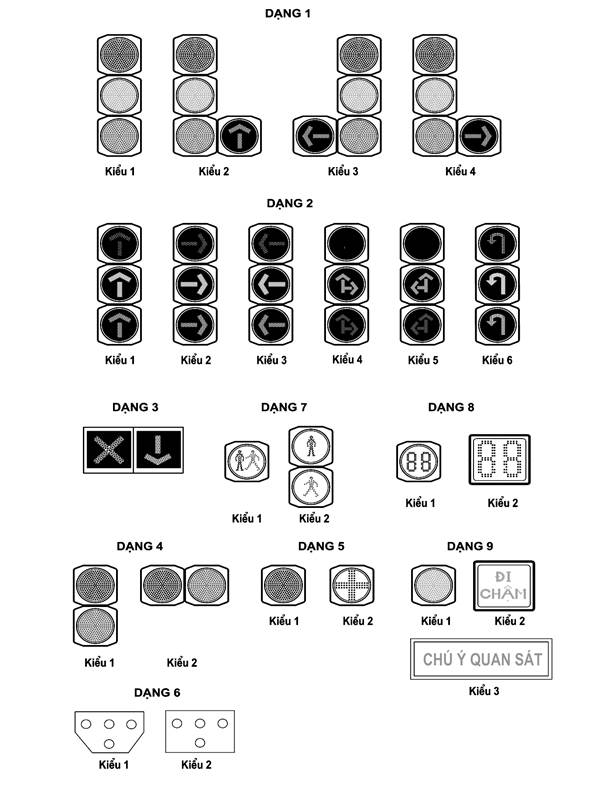
Figure A.1. Types of light signals
a) Type 1 model 1 light is a common type and consists of 3 signals, green - yellow - red. In addition, models 2, 3, and 4 indicate that vehicles may go straight ahead, turn left, turn right, and turn around.
b) Type 2 lights consist of models that have 3 light signals and arrows to coordinate vehicles in specific directions.
c) Type 3 light consists a red cross light on the left and a green arrow light on the right. Where red light is illuminated, all vehicles must stop; where green light is illuminated, all vehicles shall move in the direction indicated by the arrow.
d) Type 4 lights consist of 2 light signals of green and red. Model 1 light is vertically stacked where the red light is on top of the green light; model 2 light is horizontally stacked where the red light is on the left of the green light. Where red light is illuminated, all vehicles must stop; where green light is illuminated, all vehicles shall move.
e) Type 5 lights consist of a single red light. Model 1 light is circular light while model 2 light is cross light. The lights shall be located on the other side of the junction in direction of travel and shall restrict movement when they are illuminated.
i) Type 6 lights consist of 4 white lights of a diameter of 80 mm to 100 mm: accommodating light signals.
k) Type 7 lights coordinate foot traffic where standing human figure is red and walking human figure is green. Where red light is illuminated, pedestrians must stop; where green light is illuminated pedestrians may move within designated road section. Model 1: Red light is on the left of green light; model 2: red light is on top of green light
l) Type 8 light is a countdown timer to inform road users about remaining duration of light signal. Numerals on the countdown timer shall be available in both colors of green and red. Color of the light and color of numerals shall be always consistent. Model 1 is usually installed at low height; model 2 is usually installed at high position or on the other side of the junction.
m) Type 9 lights are adopted to warn about danger; circular or rectangular flashing lights containing warning about danger. The text can be changed depending on the danger to which warnings are issued. Flashing cycles of lights shall be appropriate to attract attention while allowing road users to read the warnings.
n) In addition to the aforementioned types, it is possible to use arrow lights and illustration of a vehicle type to coordinate movement of that vehicle type.
o) In respect of aforementioned light types, a light bulb may deliver multiple signals (green, yellow, red) as long as only one signal is clearly presented at any given time during the cycle.
p) Primary lights shall be 200 mm to 300 mm in dimensions. In respect of lights containing numerals, text, illustrations of vehicles, the aforementioned dimensions can be so adjusted to be seen by road users.
A.2 Regulations on using light signals
- Minimum duration of green light per direction of travel shall be 15 seconds;
- Minimum duration of pedestrian traffic lights shall be 7 seconds regardless of color. In respect of non-priority roads with low foot traffic volume and low road width and accommodating two lanes, duration of pedestrian traffic lights can be reduced to a minimum of 4 seconds. Note, pedestrian’s crossing speed is deemed to be 1,2 m/s. Where disabled crossing is implemented, crossing speed shall be lower than 1,2 m/s and light cycle will be determined via on-site inspection.
For the purpose of assisting pedestrians, especially people with visual or hearing impairments or people with disabilities crossing the street, sensors or call buttons may also be installed. Pedestrian call buttons consist of buttons and flashing lights on the same post located on sidewalk where pedestrians step off to cross the street. Pedestrian call buttons shall also be outfitted with audio-emitting devices that inform location of the buttons; audio is recognizable, played in a cycle of 0,15 seconds, repeated after 1 second, audible from a distance of 1,8 m to 3,7 m, played at a minimum volume of 5dB and maximum volume of 89 dB, and deactivated once flashing cycle of pedestrian traffic lights ends. Physical inspection of installation site shall be conducted for the purpose of installing pedestrian call buttons.
- Diameter of lights installed on roads with V85 of at least 60 km/h, areas with infrequent traffic, and areas with traffic consisting of mostly the elderly.
- Light signals shall be visible from a distance that is not lower than distances set under Schedule A.1:
Schedule A.1. Minimum distance at which light signals can be seen
|
V85 (km/h) |
Minimum distance (m) |
|
30 |
50 |
|
40 |
65 |
|
50 |
85 |
|
60 |
110 |
|
70 |
140 |
|
80 |
165 |
|
90 |
195 |
- Where natural lighting after light signals confuses vehicle operators, it is necessary to implement opaque background after the light signals to aid vehicle operators.
- As vehicle operators focus on areas in front of them while driving, effective field of view of light signals or other road signals installed on road shoulder or sidewalk shall be determined. Method for determining: expand driver’s line of sight to form a 40o angle on each side of the driver’s line of sight. The ability to see light signals of drivers of big vehicles or road users affected by sun glare must also be taken into account.
Appendix B
INTERPRETATION - USE OF PROHIBITORY SIGN
B.1 Sign No. P.101 “Đường cấm” (Road closed)
a) For the purpose of indicating vehicle restrictions from all directions other than priority vehicles as per the law, sign No. P.101 shall be installed.
b) Where road restriction is imposed due to congested roads and/or bridges, the prohibitory sign shall be installed in the middle of roadway together with fences in accordance with Article 82; priority vehicles are not allowed to enter in this case.
c) Where road restriction also applies to pedestrians, sign No. P.112 “Cấm người đi bộ” (No pedestrians) (in residential areas) shall be installed or fences blocking the road shall be extended to cover the entire road base (outside of residential areas).
d) Where road restriction is imposed due to other reasons while roads and bridges are serviceable, prohibitory sign shall be installed in the middle of the road without fences.
e) Where prohibitory sign installed in the middle of narrow roadway will prevent eligible vehicles from entering the restricted road, the sign shall instead be installed on the edge of roadway.

Figure B.1 - Sign No. P.101
B.2 Sign No. P.102 “Cấm đi ngược chiều” (Wrong way)
a) For the purpose of preventing vehicles (motorized and non-motorized) from entering from a specific direction except for priority vehicles, sign No. P.102 shall be installed. Pedestrians are still allowed to walk on sidewalk or road shoulder.
b) The direction of travel that does not face sign No. P.102 is the intended direction of travel in which vehicles may go. In which case signs No. I.407a or R302a or R302b shall be installed at the beginning of dividers.

Figure B.2 - Sign No. P.102
B.3 Sign No. P.103a “Cấm xe ô tô” (No motor vehicles), Sign No. P.103b “Cấm xe ô tô rẽ phải” (No right turn for motor vehicles) and P.103c “Cấm xe ô tô rẽ trái” (No left turn for motor vehicles)
a) For the purpose of indicating restriction imposed on motorized vehicles including three-wheeled motorbikes with trunks other than two-wheeled motorbikes and mopeds and priority vehicles, sign No. P.103 shall be installed.
Where road restriction is imposed due to poor bridge or road condition, fences or obstacles can be located on roadway.
b) For the purpose of restricting motorized vehicles including three-wheeled motorbikes with trunks from turning right or left except for two-wheeled motorbikes, mopeds, and priority vehicles, sign No. P.103b or sign No. P.103c shall be installed.
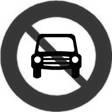
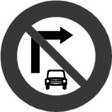
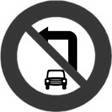
a) Sign No. P.103a b) Sign No. P.103b c) Sign No. P.103c
Figure B.3 - Sign No. P.103
B.4 Sign No. P.104 “Cấm xe máy” (No motorbikes)
For the purpose of indicating restriction on motorbikes of all types except for priority vehicles, sign No. P.104 shall be installed. This sign does not apply to people walking their motorbikes.
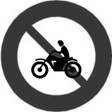
Figure B.4 - Sign No. P.104
B.5 Sign No. P.105 “Cấm xe ô tô và xe máy” (No motor vehicles and motorcycles)
For the purpose of indicating restriction on motorized vehicles and motorbikes other than priority vehicles, sign No. P.105 shall be installed.
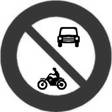
Figure B.5 - Sign No. P.105
B.6 Sign No. P.106 (a,b) “Cấm xe ô tô tải” (No trucks) and sign No. P.106c “Cấm các xe chở hàng nguy hiểm” (No hazardous goods vehicles)
a) For the purpose of indicating restriction on trucks other than priority vehicles, sign No. P.106a shall be installed. Sign No. P.106a also applies to tractors and specialized vehicles.
b) For the purpose of indicating restriction on trucks with cargo weight (according to Certificate of technical safety and environmental protection inspection for motorized road vehicles) exceeding a specific value, sign No. P.106b shall be installed. The sign restricts trucks with cargo weight (according to Certificate of technical safety and environmental protection inspection for motorized road vehicles) greater than the value specified in the sign (tonnage value in white on top of vehicle illustration). Sign No. P.106b also applies to tractors and specialized vehicles.
c) For the purpose of indicating restriction on hazardous goods vehicles, sign No. P.106c shall be installed.
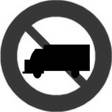
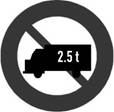

a) Sign No. P.106a b) Sign No. P.106b c) Sign No. P.106c
Figure B.6 - Sign No. P.106
B.7 Sign No. P.107 “Cấm xe ô tô khách và xe ô tô tải” (No passenger coaches and cargo trucks)
For the purpose of indicating restriction on passenger coaches and cargo trucks including tractors and specialized vehicles except for priority vehicles, sign No. P.107 shall be installed.
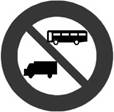
Figure B.7 - Sign No. P.107
B.7a Sign No. P.107a: “No passenger coaches”
a) For the purpose of indicating restriction on passenger coaches other than priority vehicles, sign No. P.107a shall be installed. This sign does not apply to buses.
b) Where restriction on passenger coaches is imposed on the basis of seating capacity, supplementary signs indicating seating capacity limit shall be installed or seating capacity limit in white shall be included in vehicle illustration.
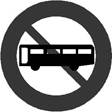
Figure B.7a - Sign No. P.107a
B.7b Sign No. P.107b “Cấm xe ô tô taxi” (No taxis)
For the purpose of indicating restriction on taxis, sign No. P.107P shall be installed. Where taxi restriction is imposed on an hourly-based basis, supplementary signs indicating restriction hours.

Figure B.7b - Sign No. P.107b
B.8 Sign No. P.108 “Cấm xe kéo rơ-moóc” (No trailer trucks)
For the purpose of indicating restriction on trailer trucks including motorbikes, tractors, passenger coaches towing trailers except for semi-trailer motor vehicles and priority vehicles (that tow trailers), sign No. P.108.
.
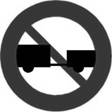
Figure B.8 - Sign No. P.108
B.8a Sign No. P.108a “Cấm xe sơ-mi rơ-moóc” (No semi-trailer trucks)
For the purpose of indicating restriction on semi-trailer trucks and vehicles towing trailers except for priority vehicles (in form of semi-trailer trucks or vehicles towing trailers), sign No. P.108a shall be installed.
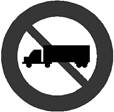
Figure B.8a - Sign No. P.108a
B.9 Sign No. P.109 “Cấm máy kéo” (No tractors)
For the purpose of indicating restriction on tractors including tyred tractors and tracked tractors, sign No. P.109 shall be installed.

Figure B.9 - Sign No. P.109
B.10 Sign No. P.110a “Cấm xe đạp” (No bicycles) and sign No. P.110b “Cấm xe đạp thồ” (No cargo bicycles)
a) For the purpose of indicating restriction on bicycles, sign No. P.110a shall be installed. This sign does not apply to people walking their bicycles.
b) For the purpose of indicating restriction on cargo bicycles, sign No. P.110b shall be installed. This sign does not apply to people walking their cargo bicycles.


a) Sign No. P.110a b) Sign No. P.110b
Figure B.10 - Sign No. P.110
B.11 Sign No. P.111a “Cấm xe gắn máy” (No mopeds), sign No. P.111 (b,c) “Cấm xe ba bánh loại có động cơ” (No three-wheeled motorized vehicles) and sign No. P.111d "No three-wheeled non-motorized vehicles”
a) For the purpose of indicating restriction on mopeds, sign No. P.111a shall be installed. This sign does not apply to bicycles.
b) For the purpose of indicating restriction on three-wheeled motorized vehicles such as motorized rickshaws, etc., sign No. P.111b or sign No. P.111c shall be installed.
c) For the purpose of indicating restriction on three-wheeled non-motorized vehicles such as pedal rickshaws, etc., sign No. P.111d shall be installed.

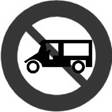
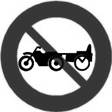

a) Sign No. P.111a b) Sign No. P.111b c) Sign No.P.111c d) Sign No. P.111d
Figure B.11 - Sign No. P.111
B.12 Sign No. P.112 “Cấm người đi bộ” (No pedestrians)
For the purpose of indicating restriction on pedestrian crossing, sign No. P.112 shall be installed
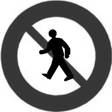
Figure B.12 - Sign No. P.112
B.13 Sign No. P.113 “Cấm xe người kéo, đẩy” (No human-powered vehicles)
For the purpose of indicating restriction of non-motorized vehicles powered by humans, sign No. P.113 shall be installed. This sign does not apply to children strollers and mobility devices of people with disabilities.

Figure B.13 - Sign No. P.113
B.14 Sign No. P.114 “Cấm xe súc vật kéo” (No animal-powered vehicles)
For the purpose of indicating restriction on animal-powered cargo or passenger vehicles, sign No. P.114 shall be installed.
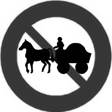
Figure B.14 - Sign No. P.114
B.15 Sign No. P.115 “Hạn chế tải trọng toàn bộ xe” (Gross weight limits)
For the purpose of indicating restriction on vehicles (motorized and non-motorized) including priority vehicles whose gross weight (kerb weight plus passenger, cargo, and goods weight) exceeds a defined value, sign No. P.115 shall be installed.

Figure B.15 - Sign No. P.115
B.16 Sign No. P.116 “Hạn chế tải trọng trên trục xe” (Axle load limit)
For the purpose of indicating restriction on vehicles (motorized and non-motorized) including priority vehicles whose axle load exceeds a defined value, sign No. P.116 shall be installed.
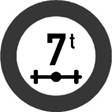
Figure B.16 - Sign No. P.116
B.17 Sign No. P.117 “Hạn chế chiều cao” (Height limits)
a) For the purpose of indicating height restriction of vehicles, sign No. P.117 shall be installed.
b) Sign No. P.117 prohibits vehicles (motorized and non-motorized) whose height exceeds the defined value, including priority vehicles (where vehicle height is determined from road, bridge surface to the highest point of vehicles or cargo thereon).
c) Height value dictated on the sign is the distance from the highest point on road surface to the lowest point of obstacles on the road (clear height) less 0,5 m. This height value shall be rounded up to the nearest 0,1 m (for example: actual height is 4,65 m; height value specified on the sign shall be: 4,65 - 0,5 = 4,15 which is rounded up to = 4,2 m).
d) Signs No. P.117 and No. W.239b shall be installed all points along the road where clear height is not lower than 4,75 m. Only sign No. W.239b shall be required to warn about areas where clear height is between 4,75 m to 5,5 m and where clear height is limited on local roads (culverts, tunnels, etc.). In respect of areas where clear height is greater than 5,5 m, signage shall not be required.

Figure B.17 - Sign No. P.117
B.18 Sign No. P.118 “Hạn chế chiều ngang xe” (Width limits)
a) For the purpose of indicating width restriction of vehicles, sign No. P.118 shall be installed.
b) Sign No. P.118 prohibits vehicles (motorized and non-motorized) including priority vehicles whose total width exceeds the width dictated on the sign.
c) Width value specified on the sign shall be measured at an immobile state of obstacles on the road less 0,4 m.
d) Sign No. P.118 shall be installed to indicate areas on the road occupied by obstacles whose width is less than 3,2 m.

Figure B.18 - Sign No. P.118
B.19 Sign No. P.119 “hạn chế chiều dài xe” (Length limits)
a) For the purpose of indicating restriction on vehicles (motorized and non-motorized) including priority vehicles whose total length is greater than a defined value, sign No. P.119 shall be installed.
b) Length value dictated on the sign shall be the maximum length of which a vehicle can move without causing traffic congestion.
c) The sign shall be installed in road sections with small horizontal curve radius, winding curves, or road sections frequented by vehicles of great lengths and prone to danger.
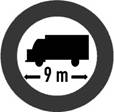
Figure B.19 - Sign No. P.119
B.20 Sign No. P.120 “Hạn chế chiều dài xe cơ giới kéo theo rơ-moóc hoặc sơ-mi rơ-moóc” (Length limits of motorized vehicles towing trailers or semi-trailers)
a) For the purpose of indicating restriction on motorized vehicles towing trailers and including semi-trailer trucks and priority vehicles towing trailers where combined length is greater than a defined value, sign No. P.120 shall be installed.
b) Length value dictated on the sign indicates the maximum length, in meter, of the entire vehicle including cargo.
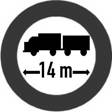
Figure B.20 - Sign No. P.120
B.21 Sign No. P.121 “Cự ly tối thiểu giữa hai xe” (Minimum safe following distance)
a) For the purpose of indicating minimum distance between motor vehicles, sign No. P.121 shall be installed.
b) Distance value on the sign indicates minimum distance in meter. The sign prohibits all motor vehicles, including priority vehicles, from disobeying the minimum distance on the sign.
c) Length of the road to which sign No. P.121 applies shall be indicated using sign No. S.501 “Phạm vi tác dụng của biển” (Applicable area of the sign) which is located below the primary signs (or by sign No. P.135 if other prohibitory signs also expire simultaneously).
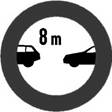
Figure B.21 - Sign No. P.121
B.23 Sign No. P.123a “Cấm rẽ trái” (No left turns) and sign No. P.123b “Cấm rẽ phải” (No right turns)
a) For the purpose of indicating restriction on left turn or right turn at junctions, sign No. P.123a or sign No. P.123a shall be installed respectively. These signs do not allow u-turn.
b) These signs prohibit vehicles (motorized and non-motorized) except for priority vehicles from turning left or right.
c) Appropriate directional signs may be installed before no turning signs.


a) Sign No. P.123a b) Sign No. P.123b
Figure B.23 - Sign No. P.123
B.24 Sign No. P.124 (a,b) “Cấm quay đầu xe” (No u-turn), sign No. P.124c “Cấm rẽ trái và quay đầu xe” (No left turns and u-turn), sign No. P.124d “Cấm rẽ phải và quay đầu xe” (No right turn and u-turns, sign No. P.124e “Cấm ô tô rẽ trái và quay đầu xe” (No left turns and u-turn for motor vehicles), and sign No. P.124f “Cấm ô tô rẽ phải và quay đầu xe” (No right turns and u-turn for motor vehicles)
a) For the purpose of indicating restriction on u-turn, sign No. P.124a shall be installed. Direction of the arrow indicates direction of u-turn that is restricted.
b) For the purpose of indicating restriction on motor vehicle making u-turn, sign No. P.124b shall be imposed. Direction of the arrow indicates direction of u-turn that motor vehicles are not allowed to make.
c) For the purpose of indicating restriction on left turns and u-turn, sign No. P.124c shall be installed.
d) For the purpose of indicating restriction on right turns and u-turn, sign No. P.124d shall be installed.
e) For the purpose of indicating restriction on left turns and u-turn of motor vehicles, sign No. P.124e shall be installed.
f) For the purpose of indicating restriction on right turns and u-turn of motor vehicles, sign No. P.124f shall be installed.
g) Sign No. P.124a prohibits vehicles (motorized and non-motorized); sign No. P.124b prohibits motor vehicles and side cars from making u-turn other than priority vehicles.
The signs do not allow turning left to go in other directions.
h) Where “No u-turns” or “No u-turns for motor vehicles” sign is installed at road sections other than a junction, sign No. S.503d shall be installed below the primary sign to indicate starting point of the restriction.
 or
or 
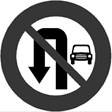 or
or 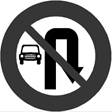
a) Sign No. P.124a b) Sign No. P.124b


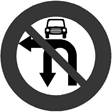
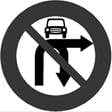
c) Sign No.P.124c d) Sign No. P.124d e) Sign No. P.124e f) Sign No. P.124f
Figure B.24 - Sign No. P.124
B.25 Sign No. P.125 “Cấm vượt” (No overtaking)
a) For the purpose of indicating restriction on overtaking by motorized vehicles, sign No. P.125 shall be installed.
b) The signs prohibits all motorized vehicles from overtaking each other (including priority vehicles) while allowing motorized vehicles to overtake two-wheeled motorbikes, mopeds.
c) The sign expires where sign No. P.133 or sign No. P.135 is installed or where other prohibitory signs expire simultaneously.
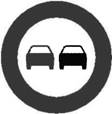
Figure B.25 - Sign No. P.125
B.26 Sign No. P.126 “Cấm xe ô tô tải vượt” (No overtaking for trucks)
a) For the purpose of restricting trucks from overtaking other motorized vehicles, sign No. P.126 shall be installed.
b) The sign restricts trucks having transport capacity (according to Certificate of technical safety and environmental protection inspection for motorized road vehicles) greater than 3.500 kg including priority vehicles from overtaking other motorized vehicles. These vehicles are allowed to overtake two-wheeled motorbikes and mopeds.
c) The sign does not restrict other motorized vehicles from overtaking each other and overtaking trucks.
c) The sign expires where sign No. DP.133 or sign No. DP.135 is installed or where other prohibitory signs expire simultaneously.
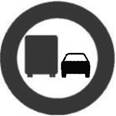
Figure B.26 - Sign No. P.126
B.27 Sign No. P.127 “Tốc độ tối đa cho phép” (Speed limits)
a) For the purpose of indicating maximum speed limit for motorized vehicles, sign No. P.127 shall be installed;
b) The sign prohibits motorized vehicles from exceeding the maximum speed limit prescribed on the sign except for priority vehicles as per the law. Vehicle operators shall rely on operating conditions such as climate, road conditions, traffic conditions, vehicles, health conditions to operate at appropriate and safe speed that does not exceed the maximum speed limit;
c) Speed limit specified on the sign shall be presented in km/h and determined in accordance wit technical regulations and actual operating conditions. Where specific study is not available, it is possible to consult Figure B.27a to determine maximum speed limit for each direction;
d) Maximum speed limit shall not be lower than 80 km/h and shall not be greater than 120 km/h. Sign No. P.127 shall not be installed haphazardly without specific study;
e) Where direction of travel moves from areas with higher maximum speed limit to areas with lower maximum speed limit and the difference between said maximum speed limit is significant, intermediate speed limit shall be imposed. The transition section shall not be shorter than 250 m when acting as transition from 120 km/h to 100 km/h; 200 m when acting as transition from 100 km/h to 80 km/h; 150 m when acting as transition from 80 km/h to 60 km/h; 180 m when acting as transition from 90 km/h to 60 km/h or from 80 km/h to 50 km/h;
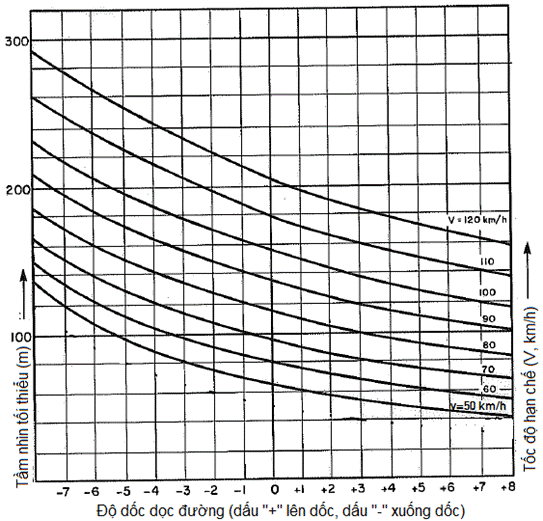
Figure B.27a - Correlation between maximum speed limit, sight distance, and longitudinal gradient (for reference)
g) Speed limit of road sections that cross temporary bridges, weak bridges, pontoon bridges, ferry approaches, traffic inspection stations, tunnels, toll plazas, weigh stations shall be determined depending on technical requirements.
h) Speed limit of road sections that cross ongoing construction sites shall be imposed via construction site warning signs or supplementary speed limit signs. End of construction sites shall be signified by end of prohibition signs. Where construction works are completed or suspended, temporary prohibitory signs shall be removed as soon as normal traffic is restored;
i) Where sign No. P.127 is installed at entrances and exits of highways, for the purpose of indicating effectiveness of signs that allow vehicles to merge and exit at these positions, sign No. S.509 shall also be installed.
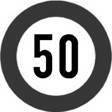
Figure B.27b - Sign No. P.127
B.27a Sign No. P.127a “Tốc độ tối đa cho phép về ban đêm” (Nighttime speed limits)
a) Where nighttime speed limit must be imposed, sign No. P.127a shall be installed.
Sign No. P.127a shall be installed on residential roads to improve operating speed at night. The sign only applies within the time period specified on the sign and from where the sign is installed to where sign No. R.421 is installed. The sign shall be installed after sign No R.420 “Đoạn đường qua khu đông dân cư” (Residential areas).
b) Nighttime speed limit specified on the sign shall be presented in km/h and shall not be greater than 80 km/h. Road users operating at night shall not exceed the speed limit specified on the sign except for priority cases as per the law. Where sign No. P.127a and sign No. P.127 both apply to a road section, sign No. P.127 shall prevail.
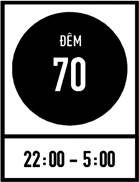
Figure B.27a - Sign No. P.127a
B.27b Combined sign No. P.127b “Biển ghép tốc độ tối đa cho phép trên từng làn đường” (Differentiated per-lane speed limits)
a) Where per-lane speed limit is implemented, sign No. P.127b shall be installed on the side of the road or on cantilever posts or gantries. Vehicles operating on a lane shall adhere to maximum speed limit imposed on that lane.
b) Sign No. P.127b shall be rectangular sign with blue background depicting maximum speed limit of respective lanes. The sign shall be installed on the side of the road or on gantries or cantilever posts.
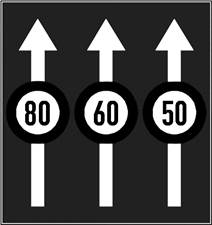
Figure B.27b - Sign No. P.127b
B.27c Combined sign No. P.127c “Biển ghép tốc độ tối đa cho phép theo phương tiện, trên từng làn đường” (Per-lane and per-vehicle speed limits)
a) Where maximum speed limit is imposed per vehicle and/or per lane, sign No. P.127c. Vehicles shall stay within designated lanes and comply with maximum speed limit applicable to said lanes.
b) Sign No. P.127b shall be rectangular sign with blue background depicting maximum speed limit of respective lanes. The sign shall be installed on the side of the road or on gantries or cantilever posts. Symbols on the sign may change depending on use conditions.
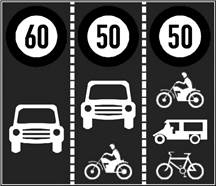
Figure B.27c - Sign No. P.127c
B.27d Sign No. DP.127 “Biển hết tốc độ tối đa cho phép theo biển ghép” (End of speed limits on combined sign)
a) Where maximum speed limit imposed by sign No. P.127b, sign No. P.127c expires, sign No. DP.127 shall be installed corresponding to traffic arrangement solutions. Sign No. DP.135 shall be installed to indicate end of all restrictions.
b) The sign informs road users that sign No. DP.127d expires. After clearing this sign, vehicles may operate at maximum speed defined under the Law on Road Traffic.
|
Sign No. DP.127a |
Sign No. DP.127b |
|
Sign No. DP.127c |
|
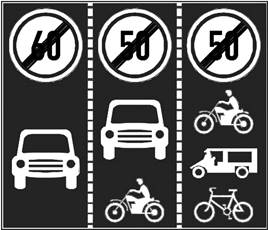
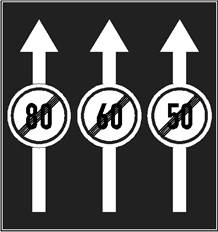
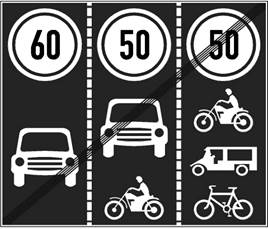
Figure B.27d - Sign No. DP.127
B.28 Sign No. P.128 “Cấm sử dụng còi” (No horns)
a) For the purpose of restricting the use of horn, sign No. P.128 shall be installed.
b) The length of road affected by the sign shall be signified by sign No. S.501 located below the primary sign (or from where the sign is installed to where sign No. DP.135 is installed if other prohibitory signs expire simultaneously).

Figure B.28 - Sign No. P.128
B.29 Sign No. P.129 “Kiểm tra” (Inspection)
For the purpose of notifying location of inspection stations where vehicles must pull over for inspection and examination, sign No. P.129 shall be installed.
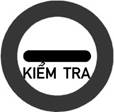
Figure B.29 - Sign No. P.129
B.30 Sign No. P.130 “Cấm dừng xe và đỗ xe” (No stopping and no parking)
a) For the purpose of indicating restriction on stopping and parking, sign No. P.130 shall be installed.
The sign prohibits motorized vehicles from stopping and parking on roads where the sign is installed except for priority vehicles as per the law. In respect of buses operating on pre-determined route, appropriate bus stops shall be located.
b) Restriction imposed by the sign applies from where the sign is installed to junctions or to where parking, stopping is allowed (or to where sign No. P.135 is installed if other prohibitory signs also expire simultaneously). Where special indication is required, starting point of the restriction shall be signified by sign No. S.503f and ending point of the restriction shall be signified by sign No. S.503d located below the primary sign.
c) Where stopping and parking restriction only applies in specific hours, sign No. S.508(a,b) shall be installed.
d) Where divider is open and allows u-turn within the area affected by the sign, sign No. P.130 shall be repeated.

Figure B.30 - Sign No. P.130
B.31 Sign No. P.131 (a,b,c) “Cấm đỗ xe” (No parking)
a) For the purpose of indicating parking restriction except for priority vehicles, sign No. P.131 (a,b,c) shall be installed.
Sign No. P.131a prohibits motorized vehicles from parking on roads on which the sign is installed.
Sign No. P.131b and sign No. P.131c prohibit motorized vehicles from parking on roads on which the signs are installed on odd days and on even days respectively.
b) Subjects and duration of parking restriction shall conform to Points c, d section B.30 in case of sign No. P.130.
c) Where divider is open and allows u-turn within the area affected by the signs, the signs shall be repeated.

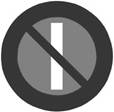

a) Sign No. P.131a b) Sign No. P.131b c) Sign No. P.131c
Figure B.31 - Sign No. P.131
B.32 Sign No. P.132 “Nhường đường cho xe cơ giới đi ngược chiều qua đường hẹp” (Yielding to oncoming motorized vehicle in narrow roads)
a) For the purpose of requiring all vehicles (motorized and non-motorized) including priority vehicles to yield to oncoming motorized vehicles on narrow roads or narrow bridges, sign No. P.132 shall be installed.
b) The sign applies to motorized vehicles, non-motorized vehicles, and priority vehicles entering narrow roads where sign No. P.132 is installed and motorized vehicles are traveling in the opposite direction.

Figure B.32 - Sign No. P.132
B.33 Sign No. DP.133 “Hết cấm vượt” (End of no overtaking)
For the purpose of indicating end of overtaking restriction, sign No. DP.133 shall be installed (or sign No. DP.135 shall be installed if other prohibitory signs also expire simultaneously).
The sign informs road users that signs No. P.125 and No. P.126 expire. Motorized vehicles may overtake while adhering to overtaking conditions.
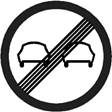
Figure B.33 - Sign No. DP.133
B.34 Sign No. DP.134 “Hết tốc độ tối đa cho phép” (End of speed limits)
a) For the purpose of indicating end of maximum speed limit, sign No. DP.134 shall be installed (or sign No. DP.135 shall be installed if other prohibitory signs also expire simultaneously).
b) The sign informs road users that sign No. P.127 expires. After clearing this sign, vehicles may operate at maximum speed defined under the Law on Road Traffic.

Figure B.34 - Sign No. DP.134
B.35 Sign No. DP.135 “Hết tất cả các lệnh cấm” (End of all restrictions)
a) For the purpose of indicating simultaneous expiry of multiple prohibitory signs, sign No. DP.135 shall be installed.
b) The sign informs road users about expiry of sign No. P.121 and other prohibitory signs from sign No. P.125 through sign No. P.131 (a,b,c) before it.

Figure B.35 - Sign No. DP.135
B.36 Sign No. P.136 “Cấm đi thẳng” (No straight ahead)
For the purpose of restricting all vehicles (other than priority vehicles) from going straight ahead, sign No. P.136 shall be installed. The sign shall be installed before junctions leading to roads where the restriction is imposed. Where restriction applies to specific vehicles and in specific hours, respective supplementary signs shall be installed.

Figure B.36 - Sign No. P.136
B.37 Sign No. P.137 “Cấm rẽ trái, rẽ phải” (No left turns, no right turns)
For the purpose of restricting all vehicles (other than priority vehicles) from turning left or right, sign No. P.137 shall be installed. The sign shall be installed before junctions where the restriction is imposed. Where restriction applies to specific vehicles and in specific hours, respective supplementary signs shall be installed.
- Red diagonal line is on top of black arrows

Figure B.37 - Sign No. P.137
B.38 Sign No. P.138 “Cấm đi thẳng, rẽ trái” (No straight ahead, no left turns)
For the purpose of restricting all vehicles (other than priority vehicles) from going straight ahead or turning left at junctions, sign No. P.138 shall be installed before the junctions. Where restriction applies to specific vehicles and in specific hours, respective supplementary signs shall be installed.

Figure B.38 - Sign No. P.138
B.39 Sign No. P.139 “Cấm đi thẳng, rẽ phải” (No straight ahead, no right turns)
For the purpose of restricting all vehicles (other than priority vehicles) from going straight ahead or turning right at junctions, sign No. P.139 shall be installed before the junctions. Where restriction applies to specific vehicles and in specific hours, respective supplementary signs shall be installed.

Figure B.39 - Sign No. P.139
B.40 Sign No. P.140 “Cấm xe công nông và các loại xe tương tự” (No agricultural vehicles and similar vehicle type)
For the purpose of indicating restriction on agricultural vehicles, sign No. P.140 shall be installed.
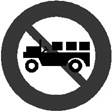
Figure B.40 - Sign No. P.140
Appendix C
INTERPRETATION - USE OF WARNING SIGN
C.1 Sign No. W.201 (a,b) “Chỗ ngoặt nguy hiểm” (Dangerous bends)
a) For the purpose of warning about dangerous bends, sign No. W.201 (a,b);
- Sign No. W.201a warns about dangerous left curves;
- Sign No. W.201b warns about dangerous right turns.
b) Dangerous bends are curves where:
- Transition angle is greater than or equal to 45o or curve radius is lower than or equal to 100 m in plain areas.
- Transition angle is greater than or equal to 45o or curve radius is lower than or equal to 40 m in mountainous areas.
c) Curves in areas where sight distance of road users is obstructed such as areas with dense vegetation or foggy areas shall be considered dangerous bends regardless of transition angle or curve radius.
d) The first curves after each straight section of at least 1 km in length shall be considered dangerous bends regardless of transition angle or curve radius.
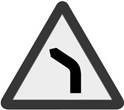
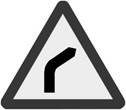
a) Sign No. W.201a b) Sign No. W.201b
Figure C.1 - Sign No. W.201 (a,b)
C.1a Sign No. W.201 (c,d) “Chỗ ngoặt nguy hiểm có nguy cơ lật xe” (Dangerous bends with risk of rollover)
For the purpose of warning about oncoming curves with risk of rollover for vehicles with high center of gravity and great mass such as trucks, sleeper buses, loose cargo trucks, etc., sign No. W.201 (c,d) shall be installed:
- Sign No. W.201c warns about dangerous left bends with risk of rollover to the right;
- Sign No. W.201d warns about dangerous right bends with risk of rollover to the left.
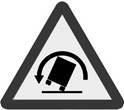
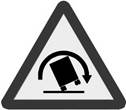
a) Sign No. W.201c b) Sign No. W.201d
Figure C.1a - Sign No. W.201 (c,d)
C.2 Sign No. W.202(a,b) “Nhiều chỗ ngoặt nguy hiểm liên tiếp” (Consecutive dangerous bends)
a) For the purpose of warning about two bends of opposite direction, sign No. W.202 (a,b) shall be installed:
- Sign No. W.202a warns about at least 2 bends near one another, at least one of which is a dangerous bend and the first of which turns to the left;
- Sign No. W.202b is similar to sign No. W.202a where the first of the bends turns to the right.
b) Two bends are considered nearby if a straight section at the end of the previous bend is less than 160 m away from the beginning of the next bend.
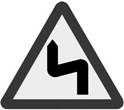
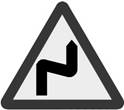
a) Sign No. W.202a b) Sign No. W.202b
Figure C.2 - Sign No. W.202 (a,b)
C.3 Sign No. W.203 (a,b,c) “Đường bị thu hẹp” (Narrow roads)
a) For the purpose of warning about sudden road constriction, sign No. W.203 (a,b,c) shall be installed:
- Sign No. W.203a indicates roads constricted on both sides;
- Sign No. W.203b or No. W.203c indicates roads constricted on either left or right side.
b) Narrow roads mean sections of roadway that are constricted causing opposing traffic to be difficult, dangerous, reducing traffic capacity relative to nearby road sections.
c) Following installation of sign No. W.203 (a,b,c), where road sections are constricted beyond traffic capacity for both directions of travel, sign determining which direction of travel has priority over the other direction shall be installed before constricted sections (sign No. P.132 and sign No. I.406).
d) Road users approaching constricted road sections shall beware of oncoming traffic. Vehicles operating on constricted side of the road shall yield to oncoming vehicles.
e) Where sign No. P.132 is installed before constricted road sections, vehicles operating on that direction of travel shall yield to oncoming traffic; where sign No. I.406 is installed before constricted road sections, vehicles operating on that direction of travel shall have priority while oncoming traffic must yield.
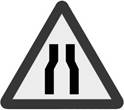
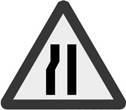
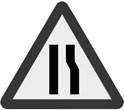
a) Sign No. W.203a b) Sign No. W.203b c) Sign No. W.203c
Figure C.3 - Sign No. W.203 (a,b,c)
C.4 Sign No. W.204 “Đường hai chiều” (Two-way roads)
a) For the purpose of indicating that both directions of travel on road sections ahead must be accommodated on one side of the road due to construction works or road obstacles or that dual-carriageway is temporarily arranged or that road sections accommodate both directions of travel, sign No. W.204 shall be installed.
b) For the purpose of indicating transition from road sections with central dividers to undivided two-way roads or indicating end of one-way roads, sign No. W.204 shall be installed.
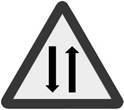
Figure B.4 - Sign No. W.204
C.5 Sign No. W.205 (a,b,c,d,e) “Đường giao nhau” (Junctions)
For the purpose of indicating at-grade junctions of roads of equal priority, sign No. W.205 (a,b,c,d,e) shall be installed. The sign shall be primarily be installed at junctions outside of city area. This sign is not required within city area.
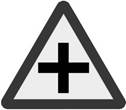
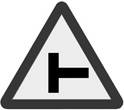
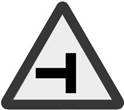
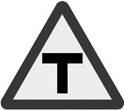
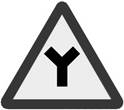
Sign No. W.205a Sign No. W.205b Sign No. W.205c Sign No. W.205d Sign No. W.205e
Figure B.5 - Sign No. W.205
C.6 Sign No. W.206 “Giao nhau chạy theo vòng xuyến” (Roundabout)
For the purpose of indicating junctions within traffic island in the middle where vehicles entering the junctions must navigate the junctions in the direction indicated by the arrows, sign No. W.206 shall be installed. This sign is not required within city area.

Figure C.6 - Sign No. W.206
C.7 Sign No. W.207 (a,b,c,d,e,f,g,h,i,k,l) “Giao nhau với đường không ưu tiên (đường nhánh) (Junction with non-priority road (side roads))
a) For the purpose of indicating junction with non-priority roads, sign No. W.207 (a,b,c,d,e,f,g,h,i,k,l) shall be installed on priority roads. Depending on geometry of the junctions and whether roads in the junctions are priority or not, type of sign and illustration shall be determined accordingly. Sign No. W.207 may be installed at junctions with alleys, small paths, or similar structures when necessary.
b) Sign No. W.207 (a,b,c,d,e,f,g,h,i,k,l) must be installed before junctions outside of city area (may be installed before junctions inside city area depending on actual conditions). Vehicles operating on roads on which this sign is installed shall have right of way over the junctions and shall only yield to priority vehicles as per the law.
d) Sign No. W.208 shall be installed on all side roads connected to priority roads at junctions (road sections located between sign No. I.401 and sign No. I.402).
e) Sign No. W.207d or sign No. W.207e shall be installed in combination with supplementary signs to indicate affected area of the sign where priority roads meet multiple non-priority roads in succession with high traffic density (area of junctions with non-priority roads). Other sign No. W.207 shall not be required within areas affected by sign No. W.207d and sign No. W.207e.

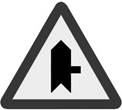
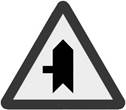
a) Sign No.W.207a b) Sign No. W.207b c) Sign No. W.207c
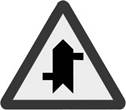

d) Sign No. W.207d d) Sign No. W.207e
Figure C.7 - Sign No. W.207 (a,b,c,d,e)
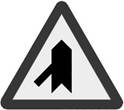
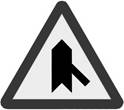
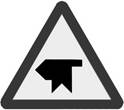
a) Sign No. W.207f b) Sign No. W.207g c) Sign No. W.207h
Figure C.8 - Sign No. W.207 (f,g,h)
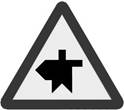
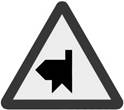
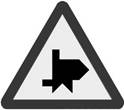
a) Sign No. W.207i b) Sign No. W.207k c) Sign No. W.207l
Figure C.9 - Sign No. W.207 (i,k,l)
C.8 Sign No. W.208 “Giao nhau với đường ưu tiên” (Junction with priority road (main road))
a) For the purpose of indicating junctions with priority roads, sign No. W.208 shall be installed on non-priority roads. This sign is not required within city area.
b) Vehicles operating on roads on which sign No. W.208 is installed shall yield to vehicles on priority road at junctions (except for priority vehicles).
c) Sign No. S.506b can be installed below sign No. W.208 where direction changes at junctions with priority roads.
d) Where sign No. W.208 is installed in residential areas, the sign shall be installed before junctions with priority roads. Sign No. S.502 may be installed if sign No. W.208 is located outside of residential areas.

Figure C.10 - Sign No. W.208
C.9 Sign No. W.209 “Giao nhau có tín hiệu đèn” (Signalized junctions)
a) For the purpose of indicating signalized junctions in case road users have difficulty observe traffic lights and react accordingly, sign No. W.209 shall be installed. Where traffic lights are clearly visible, sign No. W.209 shall not be recommended.
b) Sign No. W.209 may be used in combination with or as replacement for signs No. W.205, No. W.206, No. W.207, No. W.208.
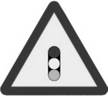
Figure C.11 - Sign No. W.209
C.10 Sign No. W.210 “Giao nhau với đường sắt có rào chắn” (Railway crossing with barrier)
For the purpose of indicating junction between roads and railways with solid barrier or semi-solid barrier and railway crossing guards, sign No. W.210 shall be installed.
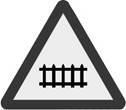
Figure C.12 - Sign No. W.210
C.11 Sign No. W.211a “Giao nhau với đường sắt không có rào chắn” (Railway crossing without barrier) and sign No. W.211b “Giao nhau với đường tàu điện” (Tramway crossing)
a) For the purpose of indicating junction between road and railway without barriers and without railway crossing guards, sign No. W.211a shall be installed.
b) Where road and railway are parallel and located on the same structures such as bridges, sign No. W.210 or sign No. W.211a shall be installed depending on whether barriers are present.
c) Where sign No. W.211a is installed ,sign No. W.242 (a,b) shall also be installed 10 m away from the outermost rail.
d) For the purpose of indicating at-grade junction between road and tramway, sign No. W.211b shall be installed. This sign shall only be required if the tramway is clearly visible.
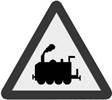
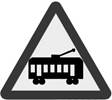
a) Sign No. W.211a b) Sign No. W.211b
Figure C.13 - Sign No. W.211
C.12 Sign No. W.212 “Cầu hẹp” (Narrow bridges)
For the purpose of indicating that roadway on narrow bridges is equal to or lower than 4,5 m, sign No. W.212 shall be installed. Upon crossing these bridges, vehicle operators shall slow down, observe, yield to each other, and wait on both sides of the bridges.
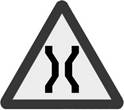
Figure C.14 - Sign No. W.212
C.13 Sign No. W.213 “Cầu tạm” (Temporary bridges)
a) For the purpose of warning about temporary bridges accommodating vehicle traffic, sign No. W.213 shall be installed.
b) Where bridge load capacity and horizontal clearance is low, sign No. P.115 and sign No. P.118 or other necessary signs shall also be installed. Road users shall, upon encountering sign indicating temporary bridges, beware and refrain from crossing the bridge during flood.
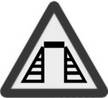
Figure C.15 - Sign No. W.213
C.14 Sign No. W.214 “Cầu quay - cầu cất” (Draw bridges)
For the purpose of indicating draw bridges ahead, sign No. W.214 shall be installed. Road vehicles must stop and wait.
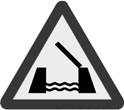
Figure C.16 - Sign No. W.214
C.15 Sign No. W.215a “Kè, vực sâu phía trước” (Quayside or riverbank ahead), sign No. W.215b “Kè, vực sâu bên đường phía bên phải” (Quayside or riverbank on the right) and sign No. W.215c “Kè, vực sâu bên đường phía bên trái” (Quayside or riverbank on the left)
For the purpose of indicating quayside or riverbank ahead or on either side of the road, sign No. W.215a, sign No. W.215b, or sign No. W.215c shall be installed. Where barricades or crash barriers have been installed, this is shall not be required.
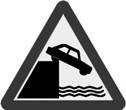
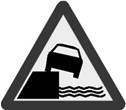
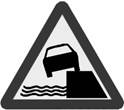
a) Sign No. W.215a b) Sign No. W.215b c) Sign No. W.215c
Figure C.17 - Sign No. W.215
C.16 Sign No. W.216a “Đường ngầm” (Ford) and sign No. W.216b “Đường ngầm có nguy cơ lũ quét” (Ford susceptible to flash flooding)
b) For the purpose of warning about ford, sign No. W.216a shall be installed. For the purpose of warning about ford susceptible to flash flood, sign No. W.216b shall be installed. A text that reads “LŨ” (FLOOD) shall be attached to the bottom of these signs when necessary.
b) Fords are road sections that cross rivers, streams, or shallow gaps over which water can flow frequently or in case of flood.
c) Water gauges shall be installed on both sides of fords.
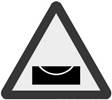

a) Sign No. W.216a b) Sign No. W.216b
Figure C.18 - Sign No. W.216
C.17 Sign No. W.217 “Bến phà” (Ferry station)
For the purpose of signifying ferry station ahead, sign No. W.217 shall be installed. Road users shall adhere to regulations of ferry stations.
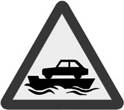
Figure C.19 - Sign No. W.217
C.18 Sign No. W.218 “Cửa chui” (Underpass)
For the purpose of signifying arches or underpasses, etc. that affect traffic, sign No. W.218 shall be installed.
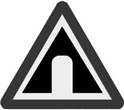
Figure C.20 - Sign No. W.218
C.19 Sign No. W.219 “Dốc xuống nguy hiểm” (Steep descent)
a) For the purpose of signifying steep descent, sign No. W.219 shall be installed.
b) Number depicted in the sign indicates actual slope gradient in % rounded to exclude decimal fraction
Length of the slope shall be presented in sign No. S.501 attached below the primary sign.
c) Dangerous descent is defined as:
- Gradient is 6% or more and length is more than 600 m;
- Gradient is 10% or more and length is more than 140 m;
Vehicle operators must choose appropriate driving methods to descend safely, and conveniently.
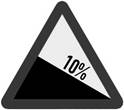
Figure C.21 - Sign No. 219
C.20 Sign No. W.220 “Dốc lên nguy hiểm” (Steep ascent)
a) For the purpose of signifying steep ascent, sign No. W.220 shall be installed.
b) Number depicted in the sign indicates actual slope gradient in % rounded to the nearest %.
Length of the slop shall be presented in sign No. S.501 attached below the primary sign.
c) Dangerous ascent is defined as:
- Gradient is 6% or more and length is more than 600 m;
- Gradient is 10% or more and length is more than 140 m;
Vehicle operators must choose appropriate driving methods to ascend safely, and conveniently.
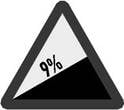
Figure C.22 - Sign No. W.220
C.21 Sign No. W.221(a,b) “Đường không bằng phẳng” (Uneven road)
a) For the purpose of signifying rough road surface that is dangerous to vehicles approaching at high speed, sign No. W.221 (a,b) shall be installed:
- Sign No. W.221a “Uneven road” signifies short bouts of potholes, grooves, depressions on otherwise smooth roads;
- Where maximum speed limit of road sections is 50 km/h or where slow down markings are installed, sign No. W.221a shall not be required.
- Length of uneven road sections shall be presented by sign No. S.501 attached below the primary sign.
- Sign No. W.221b “Speed bumps” warns vehicles about speed bumps ahead or depressed, swollen approaches of bridges and culverts;
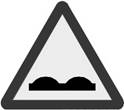
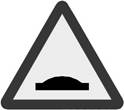
a) Sign No. W.221a b) Sign No. W.221b
Figure C.23 - Sign No. W.221
C.22 Sign No. W.222a “Đường trơn” (Slippery road) and Sign No. W.222b “Lề đường nguy hiểm” (Dangerous road shoulders)
a) For the purpose of warning about slippery road ahead especially in bad weather, sign No. W.222a shall be installed. Vehicle operators shall slow down accordingly and beware upon encountering this sign.
b) For the purpose of warning about unstable road shoulders that cause loose materials or wheelspin, sign No. W.222b shall be installed.
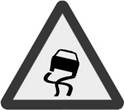
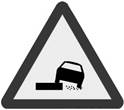
a) Sign No. W.222a b) Sign No. W.222b
Figure C.24 - Sign No. 222
C.23 Sign No. W.223 (a,b) “Vách núi nguy hiểm” (Dangerous cliff)
For the purpose of warning about cliffside roads, sign No. W.223 (a,b) shall be installed. The sign warns road users about potential danger. The sign shall be installed at approaches to cliffside roads that are narrow and visually obscured. Whether sign No. W.223a or sign No. W.223b is installed shall be determined depending on whether the cliff is on the right or left side of the road.
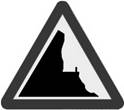
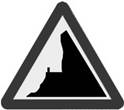
a) Sign No. W.223a b) Sign No. W.223b
Figure C.25 - Sign No. W.223
C.24 Sign No. W.224 “Đường người đi bộ cắt ngang” (Pedestrian crossing)
a) For the purpose of warning about pedestrian crossing ahead, sign No. W.224 shall be installed. Vehicle operators shall slow down, yield to pedestrians, and only move when pedestrians are not at risk.
b) Road sections reserved for pedestrians at junctions, in city areas that are frequented by pedestrians shall have pedestrian crossing markings.
c) This sign shall not be required in residential roads if road users can easily see pedestrian crossing where maximum speed limit is below 50 km/h or traffic lights are present.
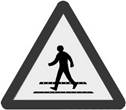
Figure C.26 - Sign No. W.224
C.25 Sign No. W.225 “Trẻ em” (Children)
a) For the purpose of warning about road sections frequented by children such as in vicinity of kindergartens, schools, or clubs, sign No. W.225 shall be installed.
b) Length of these road sections shall be presented by sign No. S.501 attached below the primary sign.
c) Road users shall slow down and beware of children on the road.
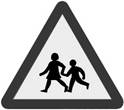
Figure C.27 - Sign No. W.225
C.26 Sign No. W.226 “Đường người đi xe đạp cắt ngang” (Bicycle crossing)
For the purpose of warning about cyclists crossing the road from nearby alleys or merging onto highways from bicycle-only lanes, sign No. W.226 shall be installed.
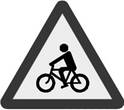
Figure C.28 - Sign No. W.226
C.27 Sign No. W.227 “Công trường” (Construction)
For the purpose of warning about ongoing repair, renovation, upgrade construction and personnel and machinery working on the road, sign No. W.227 shall be installed. Road users shall slow down to not cause danger to working personnel and machinery.
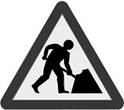
Figure C.29 - Sign No. W.227
C.28 Sign No. W.228 (a,b) “Đá lở” Falling rocks and sign No. W.228c “Sỏi đá bắn lên” (Loose road surface) and sign No. W.228d “Nền đường yếu” (Weak road)
a) For the purpose of warning about falling rocks from cut slope that endanger road users and vehicles, especially in mountainous regions, sign No. W.228 (a,b) shall be installed. Length of dangerous road sections shall be presented using sign No. S.501 attached below the primary sign. Whether sign No. W.228a or sign No. W.228b is installed depends on practical conditions.
Road users shall beware and, during poor weather conditions or limited visibility, not park or stop in areas prone to falling rocks during or after heavy rain.
b) For the purpose of warning about loose road surface that endangers road users and vehicles, sign No. W.228c shall be installed.
c) For the purpose of warning about weak road or road under monitoring for depression where vehicle operation at high speed may cause harm, sign No. W.228d shall be installed. Vehicle operators shall slow down reasonably.
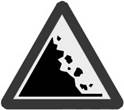
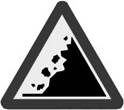
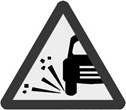
a) Sign No. W.228a b) Sign No. W.228b c) Sign No. W.228c

d) Sign No. W.228d
Figure C.30 - Sign No. W.228
C.29 Sign No. W.229 “Dải máy bay lên xuống” (Low-flying aircraft)
For the purpose of warning about low-flying aircrafts, sign No. W.229 shall be installed. Where necessary, traffic shall be signalized using flags or red lights or hand gestures of traffic enforcers.
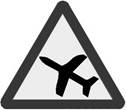
Figure C.31 - Sign No. W.229
C.30 Sign No. W.230 “Gia súc” (Cattle or livestock)
For the purpose of warning about free cattle or livestock or herded cattle or livestock, sign No. W.230 shall be installed. Road users shall slow down, observe, and yield to cattle and livestock.
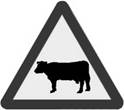
Figure C.32 - Sign No. W.230
C.31 Sign No. W.231 “Thú rừng vượt qua đường” (Wild animal crossing)
For the purpose of warning about wild animal crossing or nature reserve or no-poaching sites, sign No. W.231 shall be installed. The length of these road sections shall be presented by sign No. S.501 attached below primary sign. Road users shall slow down, observe, and beware of accidents.
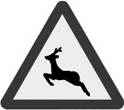
Figure C.33 - Sign No. W.231
C.32 Sign No. W.232 “Gió ngang” (Crosswinds)
a) For the purpose of warning about strong crosswinds, sign No. W.232 shall be installed. Road users must drive at appropriate speed lest strong crosswinds cause rollover.
b) this sign shall be located outside of city area and residential area. Anemometers shall be installed at dangerous locations to inform road users about wind direction and speed.
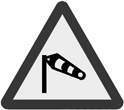
Figure C.34 - Sign No. W.232
C.33 Sign No. W.233 “Nguy hiểm khác” (Other dangers)
For the purpose of warning about dangers on the road that cannot be presented by sign No. W.201a through sign No. W.232 in accordance with C.1 through C.32 hereof, sign No. W.233 shall be installed.

Figure C.35 - Sign No. W.233
C.34 Sign No. W.234 “Giao nhau với đường hai chiều” (Two-way traffic crossing)
For the purpose of warning about junctions with two-way roads, sign No. W.234 shall be installed on the one-way roads leading to the junctions. This sign is not required within city area.
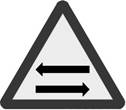
Figure C.36 - Sign No. W.234
C.35 Sign No. W.235 “Đường đôi” (Dual-carriageways)
For the purpose of warning about oncoming roads on which both directions of travel are separated by solid dividers, sign No. W.235 shall be installed. This sign is not required within city area.
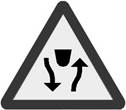
Figure C.37 - Sign No. W.235
C.36 Sign No. W.236 “Kết thúc đường đôi” (End of dual-carriageway)
For the purpose of warning about end of roads on which both directions of travel are separated by solid dividers, sign No. W.236 shall be installed. This sign is not required for two-way roads divided by road markings. This sign is not required within city area.
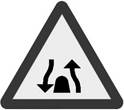
Figure C.38 - Sign No. W.236
C.37 Sign No. W.237 “Cầu vồng” (Hump bridges)
This sign reminds vehicle operators to be cautious. The sign shall be installed on roads leading to bridges with significant curvature that affects visibility.
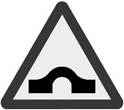
Figure C.39 - Sign No. W.237
C.38 Sign No. W.238 “Đường cao tốc phía trước” (Expressway)
Sign No. W.238 shall be installed on side roads merging to expressway to inform vehicle operators.
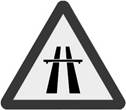
Figure C.40 - Sign No. W.238
C.39 Sign No. W.239a “Đường cáp điện ở phía trên” (Overhead electric cables); Sign No. W.239b “Chiều cao tĩnh không thực tế” (Actual vertical clearance)
a) For the purpose of warning about overhead electric cables, sign No. W.239 and sign No. S.509a shall be installed. For the purpose of indicating actual vertical clearance at areas where distance from the highest point of road surface to the lowest point of overhead obstacles, sign No. W.239b shall be installed.
b) The sign shall be installed to the right side of each direction of travel.
c) Where vertical clearance is greater than 5,5 m, sign No. W.239 (a,b) shall not be required unless special operational conditions are present.
Safe vertical clearance: means the distance from the lowest point to the highest point of structures less safe electrical distance depending on electrical safety level.
Actual vertical clearance: means the distance from the highest point of the road to the lowest point of obstacles.
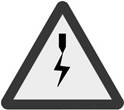
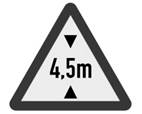
a) Sign No. W.239a b) Sign No. W.239b
Figure C.41 - Sign No. W.239
C.40 Sign No. W.240 “Đường hầm” (Tunnels)
For the purpose of warning vehicle operators about tunnels ahead, sign No. W.240 shall be installed.
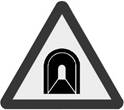
Figure C.42 - Sign No. W.240
C.41 Sign No. W.241 “Ùn tắc giao thông” (Traffic congestion)
For the purpose of warning about areas prone to traffic congestion, sign No. W.241 shall be installed.
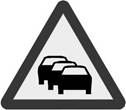
Figure C.43 - Sign No. 241
C.42 Sign No. W.242 (a,b) “Nơi đường sắt giao vuông góc với đường bộ” (Perpendicular railway crossing)
For the purpose of supplementing sign No. W.211, sign No W.242 shall be installed to indicate railway crossing. The sign shall be 10 m away from the nearest rail.
Where only a pair of rails intersects road at railway crossing, sign No. W.242a shall be installed.
Where at least two pairs of rails intersect road at railway crossing, sign No. W.242b shall be installed.


a) Sign No. W.242a b) Sign No. W.242b
Figure C.44 - Sign No. W.242
C.43 Sign No. W.243 (a,b,c) “Nơi đường sắt giao không vuông góc với đường bộ” (Non-perpendicular railway crossing)
For the purpose of warning about non-perpendicular at-grade junction between road and railway without guards and without barriers, sign No. W.243 shall be installed. The sign shall be attached below sign No. W.211. Signs indicating non-perpendicular railway crossing consist of 3 signs: sign No. W.243a, sign No. W.243b, and sign No. W.243c that are 50 m, 100 m, and 150 m respectively away from the nearest rail at the crossing.



a) Sign No. W.243a b) Sign No. W.243b c) Sign No. W.243c
Figure C.45 - Sign No. W.243
C.44 Sign No. W.244 “Đoạn đường hay xảy ra tai nạn” (Accident-prone area)
For the purpose of warning about road sections prone to accidents, sign No. W.244 shall be installed. The sign shall be installed at appropriate locations leading to road sections prone to accidents.
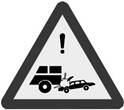
Figure C.46 - Sign No. W.244
C.45 Sign No. W.245 (a,b) “Đi chậm” (Slow down)
For the purpose of reminding drivers to slow down, sign No. W.245 (a,b) shall be installed. The sign shall be installed at appropriate locations leading to road section to which the sign applies.
In respect of international roads, sign No. W.245b shall be adopted.
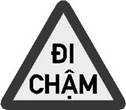
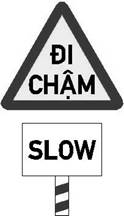
a) Sign No. W.245a b) Sign No. W.245b
Figure C.47 - Sign No. W.245
C.46 Sign No. W.246 (a,b,c) “Chú ý chướng ngại vật” (Obstacles ahead)
For the purpose of warning drivers about obstacles ahead and that drivers must slow down and comply with instructions on the signs, sign No. W.246a, sign No. W.246b, and sign No. W.246c shall be installed. This sign shall be installed at appropriate locations leading to road sections with obstacles.

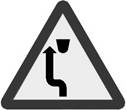
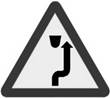
a) Sign No. W.246a b) Sign No. W.246b c) Sign No. W.246c
Figure C.48 - Sign No. W.246
C.47 Sign No. W.247 “Chú ý xe đỗ” (Watch out for parking vehicles)
a) For the purpose of warning about motor vehicles, tractors, trailers or semi-trailers towed by motor vehicles or hauling units, specialized vehicles parking on roadway, sign No. W.247 shall be placed on the road 5 m in front of and behind the vehicles;
b) In respect of one-way roads, the sign shall be placed only behind parking vehicles.
c) If multiple vehicles are parked simultaneously, this sign shall be placed in front of the first vehicle and behind the last vehicle on two-lane roads.
d) The sign shall be placed directly on the road.
Figure C.49 - Sign No. W.247
Appendix D
INTERPRETATION - USE OF SIGNS GIVING ORDERS
D.1 Sign No. R.122 “Dừng lại” (Stop)
a) For the purpose of requesting vehicles (motorized and non-motorized) to stop, sign No. R.122 shall be installed. This is a special form of sign giving orders.
b) The sign compels motorized and non-motorized vehicles including priority vehicles to stop before the sign or at stop line and only move where go signal is given (by traffic enforcers or lights or flags). Where flags or lights are not available or functional or where traffic enforcers are not present, road users shall only move if risks to traffic safety are no longer present.
c) For the purpose of ensuring turning priority at junctions for road users on priority roads, sign No. R.122 accompanied by sign No. S.506b below shall be installed on non priority road. The sign compels road users on non-priority roads to yield (except for priority vehicles) to vehicles on priority road at junctions.
d) Where visibility at junctions is not guaranteed, sign No. R.122 accompanied by supplementary sign that reads “Dừng lại quan sát” (Stop and watch) and speed hump markings shall be installed on non-priority roads.

Figure D.1 - Sign No. R.122
D.1a Sign No. R.301 (a,b,c,d,e,f,g,h) “Hướng đi phải theo” (Directions)
a) For the purpose of compelling vehicles (motorized and non-motorized) to move in specific directions, sign No. R.301 (a,b,c,d,e,f,g,h) shall be installed. Specific sign design shall be determined based on directions.
b) The sign compels vehicles to move in the direction indicated by the arrow (except priority vehicles):
- Sign No. R.301a: vehicles can only go straight;
- Sign No. R.301b: vehicles can only turn right;
- Sign No. R.301c: vehicles can only turn left;
- Sign No. R.301d: vehicles can only turn right;
- Sign No. R.301e: vehicles can only turn left;
- Sign No. R.301f: vehicles can only move straight or turn right;
- Sign No. R.301g: vehicles can only move straight or turn left;
- Sign No. R.301h: vehicles can only turn left or turn right.
c) Where sign No. R.301a is installed before junctions, the sign applies to junctions immediately after the sign and prohibits vehicles from turning left and right. Where the sign is installed after junctions, the sign applies to road sections from sign location to junctions. In this case, the sign prohibits left-turn and u-turn and only allows turning into houses or alleys between the sign location and the next junction.
- Sign No. R.301 (b,c) installed after junctions provides direction for vehicles entering the junctions and prevents vehicles moving in the wrong direction on one-way roads. The sign compels road users to only turn left or right at junctions before the sign.
- Sign No. R.301 (d,e) shall be installed before junctions. The sign compels road users to only turn left or right at junctions after the sign.
- Sign No. R.301f shall be installed before junctions. The sign compels road users to only go straight or turn right at junctions after the sign.
- Sign No. R.301g shall be installed before junctions and compels road users to only go straight or turn left or make a u-turn.
- Sign No. R.301h shall be installed after junctions to prevent road users from moving in the wrong direction on one-way roads. The sign compels road users to only turn left, make a u-turn, or turn right at junctions before the sign.

a) Sign No. R.301a b) Sign No. R.301b c) Sign No. R.301c d) Sign No. R.301d
Figure D.2 - Sign No. R.301 (a,b,c,d)

e) Sign No. R.301e f) Sign No. R.301f g) Sign No. R.301g h) Sign No. R.301h
Figure D.3 - Sign No. R.301 (e, f, g, h)
D.2 Sign No. R.302 (a,b,c) “Hướng phải đi vòng chướng ngại vật” (Detour)
a) For the purpose of requesting vehicles (motorized and non-motorized vehicles) to take detour around obstacles, sign No. R.302 (a,b,c) shall be installed. Sign No. R.302 (a,b) shall also be adopted in combination with sign No. P.102 at dividers to inform road users about direction of one-way road section.
b) The sign shall be installed before obstacles and indicate direction of detour: stay to the right; stay to the left; stay to either left or right.
c) The sign compels vehicles to take detour in the direction provided by the arrows.


a) Sign No. R.302a b) Sign No. R.302b

c) Sign No. R.302c
Figure D.4 - Sign No. R.302
D.3 Sign No. R.303 “Giao nhau chạy theo vòng xuyến” (Roundabout)
a) For the purpose of informing vehicles (motorized and non-motorized) about roundabout, sign No. R.303 shall be installed.
b) The signs compels all vehicles entering the junctions to clear the roundabout in the direction provided by the arrows.

Figure D.5 - Sign No. R.303
D.4 Sign No. R.304 “Đường dành cho xe thô sơ” (Non-motorized vehicles only)
a) For the purpose of indicating roads for non-motorized vehicles only (including vehicles operated by people with disabilities) and pedestrians, sign No. R.304 shall be installed.
b) The sign allows non-motorized vehicles (including vehicles operated by people with disabilities) and pedestrians to use this lane, prohibits motorized vehicles, including mopeds, and priority vehicles from entering this lane while allowing motorized vehicles, including mopeds, and priority vehicles to cross this lane without harming non-motorized vehicles and pedestrians.
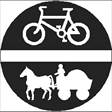
Figure D.6 - Sign No. R.304
D.5 Sign No. R.305 “Đường dành cho người đi bộ” (Foot traffic only)
a) For the purpose of indicating foot traffic only lanes, sign No. R.305 shall be installed.
b) Motorized and non-motorized vehicles (other than bicycles and wheelchairs of people with disabilities) and priority vehicles are not allowed to enter roads on which this sign has been installed, are allowed to cross these roads without harming pedestrians.

Figure D.7 - Sign No. R.305
D.6 Sign No. R.306 “Tốc độ tối thiểu cho phép” (Minimum speed limit)
a) For the purpose of indicating minimum speed limit for motorized vehicles, sign No. R.306 shall be installed;
b) The sign requires all motorized vehicles to operate at a speed not lower than the speed depicted on the sign in normal traffic conditions. Vehicles whose maximum speed defined by manufacturers does not meet the minimum speed limit shall be prohibited from entering this road.
c) The minimum speed limit shall be presented in km/h and determined in accordance with technical standards of bridges and roads and traffic arrangement and shall not be greater than safety speed limit.
d) This sign shall only be adopted on roads where accessibility must be improved, outside of residential areas, and where vehicles operate at high speed.

Figure D.8 - Sign No. R.306
D.7 Sign No. R.307 “Hết tốc độ tối thiểu” (End of minimum speed limit)
a) For the purpose of indicating end of minimum speed limit, sign No. R.307 shall be installed (or sign No. DP.135 shall be installed if other prohibitory signs also expire simultaneously).
b) The sign informs road users about expiry of sign No. R.306 and that road users may operate at a speed slower than the previous minimum speed limit as long as they do not obstruct other vehicles.

Figure D.9 - Sign No. R.307
D.8 Sign No. R.308 (a,b) “Tuyến đường cầu vượt cắt qua” (Overpass)
For the purpose of indicating overpass ahead where vehicles can go straight ahead or follow instructions to make a left (or right) turn, sign No. R.308 (a,b) shall be installed. The sign shall be installed before overpass to provide directions.


a) Sign No. R.308a b) Sign No. R.308b
Figure D.10 - Sign No. R.308
D.9 Sign No. R.309 “Ấn còi” (Honking)
This sign compels vehicle operators to honk upon reaching the sign. The sign shall be installed before sudden curves or slopes of a gradient greater than 10% with limited visibility.

Figure D.11 - Sign No. R.309
D.10 Sign No. R.310 (a,b,c) “Hướng đi phải theo cho các xe chở hàng nguy hiểm” (Directions to follow by vehicles transporting hazardous goods)
For the purpose of requiring vehicles transporting hazardous goods to go in a specified direction, sign No. R.310 (a,b,c) shall be installed). Specific sign design shall be determined based on directions.
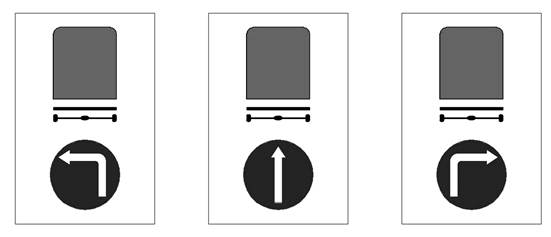
a) Sign No. R.310a b) Sign No. R.310b c) Sign No. R.310c
Figure D.12 - Sign No. R.310
D.11 Sign No. R.403a “Đường dành cho xe ô tô” (Motor vehicle road), Sign No. R.403b “Đường dành cho xe ô tô, xe máy” (Motor vehicle and motorbike road), biển số R.403c “Đường dành cho xe buýt” (Bus road), Sign No. R.403d “Đường dành cho xe ô tô con” (Car road), Sign No. R.403e “Đường dành cho xe máy” (Motorbike road), Sign No. R.403f “Đường dành cho xe máy và xe đạp” (Motorbike and bicycle road)
a) For the purpose of indicating the start of motor vehicle roads, sign No. R.403a shall be installed.
b) For the purpose of indicating the start of motor vehicles and motorbike roads, sign No. R.403b shall be installed.
c) For the purpose of indicating the start of bus roads, sign No. R.403c shall be installed.
d) For the purpose of indicating the start of car roads, sign No. R.403d shall be installed.
e) For the purpose of indicating the start of motorbike roads, sign No. R.403e shall be installed.
g) For the purpose of indicating the start of motorbike (including mopeds) by bicycle (including non-motorized vehicles) roads, sign No. R.403f shall be installed.
h) Vehicles other than those listed on signs No. R.403a, R.403b, R.403c, R.403d, R.403e, R.403f shall not enter road sections on which the signs are installed.
i) The type of sign and vehicle illustration thereon shall be determined in accordance with types of vehicles allowed.
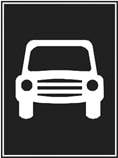
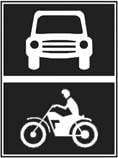
a) Sign No. R.403a b) Sign No. R.403b
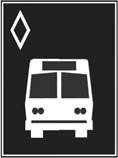
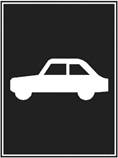
c) Sign No. R.403c d) Sign No. R.403d
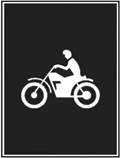
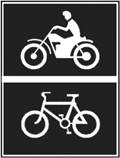
e) Sign No. R.403e f) Sign No. R.403f
Figure D.13 - Sign No. R.403
D.12 Sign No. R.404a “Hết đoạn đường dành cho xe ô tô” (End of motor vehicle roads), sign No. R.404b “Hết đoạn đường dành cho xe ôtô, xe máy” (End of motor vehicle, motorbike roads), sign No. R.404c “Hết đoạn đường dành cho xe buýt” (End of bus roads), sign No. R.404d “Hết đoạn đường dành cho xe ôtô con” (End of car roads), sign No. R.404e “Hết đoạn đường dành cho xe máy” (End of motorbike roads), sign No. R.404f “Hết đoạn đường dành cho xe máy và xe đạp” (End of motorbike and bicycle roads)
a) For the purpose of indicating the end of motor vehicle roads, sign No. R.404a shall be installed.
b) For the purpose of indicating the end of motor vehicles and motorbike roads, sign No. R.404b shall be installed.
c) For the purpose of indicating the end of bus roads, sign No. R.404c shall be installed.
d) For the purpose of indicating the end of car roads, sign No. R.404d shall be installed.
e) For the purpose of indicating the end of motorbike roads, sign No. R.404e shall be installed.
f) For the purpose of indicating the end of motorbike and bicycle, including moped, roads, sign No. R.404f shall be installed.
h) Dimensions and colors of illustrations on the signs:
- These signs shall be similar to sign No. R.404 and accompanied by red diagonal lines from the top right corner to the bottom left corner.
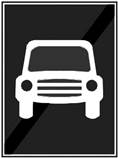
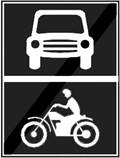
a) Sign No. R.404a b) Sign No. R.404b
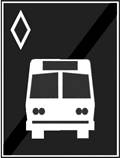
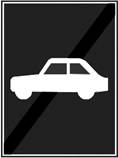
c) Sign No. R.404c d) Sign No. R.404d
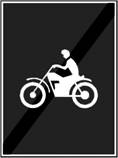
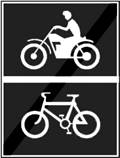
e) Sign No. R.404e f) Sign No. R.404f
Figure D.14 - Sign No. R.404
D.13 Sign No. R.411 “Hướng đi trên mỗi làn đường phải theo” (Direction on each lane)
a) For the purpose of informing road users about number of lanes and direction of each lane, sign No. R.411 shall be installed. The signs shall be used in combination with road markings (marking type 9.3: directional arrow markings on the road). Depending on practical situations regarding number of lanes, and direction of each lane, appropriate symbols shall be presented. The sign compels road users to stay within lanes appropriate to their destination.
Note: number of lanes and arrow directions shall be illustrated in accordance with actual instructions. Illustration on sign No. R.411 is an example.
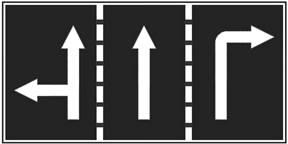
Figure D.15 - Sign No. R.411
D.14 Sign No. R.412 (a,b,c,d,e,f,g,h) “Làn đường dành riêng cho từng loại xe hoặc nhóm xe” (Per-vehicle lane)
a) For the purpose of road users about lanes reserved specifically for a type or types of vehicles, sign No. R.412 shall be installed. The sign shall be installed above each lane and at the beginning of direction of travel. The type of sign and vehicle illustration thereon shall be determined in accordance with types of vehicles allowed. Other vehicle types shall not be allowed to enter lanes on which these signs are installed (other than priority vehicles). In respect of sign No. R.412 e, where road markings dividing bus-only lanes are broken lines, other vehicles are allowed to enter these lanes as long as they must yield to buses or change to other lanes so as to not affect bus operation; where road markings dividing bus-only lanes are solid lines, other vehicles are not allowed to enter these lanes.
- Sign No. R.412a indicates lanes reserved only for passenger coaches (including buses). Where passenger coach-only lanes are further divided on the basis of seating capacity, seating capacity of passenger coaches shall be displayed on vehicle illustration of the sign (for example: “< 16c”). For the purpose of indicating rapid bus-only lanes, the word “BRT” shall be added to sign No. R.412a.
- Sign No. R.412b indicates lanes reserved only for cars.
- Sign No. R.412c indicates lanes reserved only for trucks. Where truck-only lanes are further divided on the basis of cargo weight, permissible cargo weight of trucks shall be displayed on vehicle illustration (for example: “<3,5t“).
- Sign No. R.412d indicates lanes reserved only for motorbikes and mopeds.
- Sign No. R.412e indicates lanes reserved only for buses;
- Sign No. R.412f indicates lanes reserved only for motor vehicles.
- Sign No. R.412g indicates lanes reserved only for motorbikes and bicycles, including mopeds and other non-motorized vehicles.
- Sign No. R.412h indicates lanes reserved only for bicycles, including other non-motorized vehicles.
b) Upon approaching junctions, vehicles may change lane depending on desired destination. Lane change shall conform to regulations of the law.
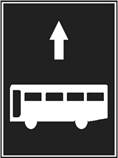
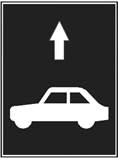
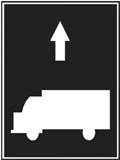
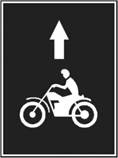
a) Sign No. R.412a b) Sign No. R.412b c) Sign No. R.412c d) Sign No. R.412d
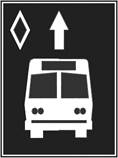
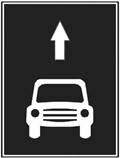
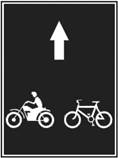
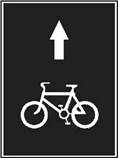
e) Sign No. R.412e f) Sign No. R.412f g) Sign No. R.412g h) Sign No. R.412h
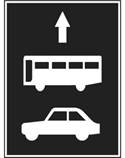
(example: passenger coach and car-only lane)
Figure D.16 - Sign No. R.412
D.15 Sign No. R.412 (i,j,k,l,m,n,o,p) “Kết thúc làn đường dành riêng cho từng loại xe hoặc nhóm xe” (End of per-vehicle lane)
a) For the purpose of indicating the end of passenger coach-only lanes, sign No. R.413i shall be installed.
b) For the purpose of indicating the end of car-only lanes, sign No. R.413j shall be installed.
c) For the purpose of indicating the end of truck-only lanes, sign No. R.413k shall be installed.
d) For the purpose of indicating the end of motorized vehicle-only lanes, sign No. R.413l shall be installed.
e) For the purpose of indicating the end of bus-only lanes, sign No. R.413m shall be installed.
g) For the purpose of indicating the end of truck-only lanes, sign No. R.413k shall be installed.
h) For the purpose of indicating the end of motorbike and bicycle-only lanes, sign No. R.413o shall be installed.
i) For the purpose of indicating the end of bicycle-only lanes, sign No. R.413p shall be installed.
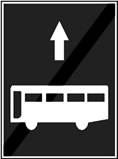
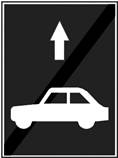
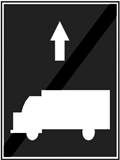
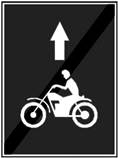
a) Sign No. R.412i b) Sign No. R.412j c) Sign No. R.412k d) Sign No. R.412l
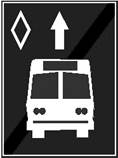
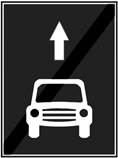
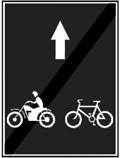
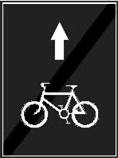
e) Sign No. R.412m f) Sign No. R.412n g) Sign No. R.412o h) Sign No. R.413p
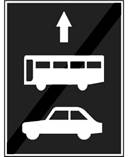
(example: end of passenger coach and car-only lane)
Figure D.17 - Sign No. R.413
D.16 Sign No. R.415 “Biển gộp làn đường theo phương tiện” (Combined per-vehicle lane) and “Kết thúc làn đường theo phương tiện” (End of per-vehicle lane)
a) For the purpose of informing road users about number of lanes and vehicles allowed per lane, sign No. R.415a shall be installed. Symbols depicted on each lane shall be selected on the basis of practical situations pertaining to number of lanes and traffic arrangement. Illustrations on sign No. R.415a is only a specific case. The sign does not apply to vehicles changing lanes to enter, exit, stop, or park on the side of the road. Depending on road markings, vehicles shall change lane in an appropriate manner.
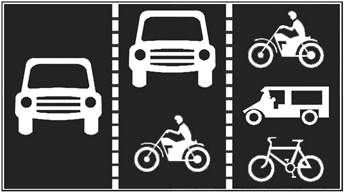
a) Figure D.18 - Sign No. R.415a
For the purpose of indicating end of per-vehicle lane, sign No. R.415b shall be installed (Figure D.18b).
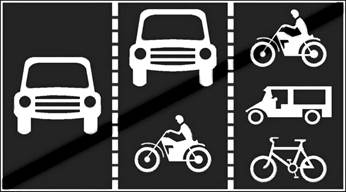
b) Figure D.18 - Sign No. R.415b
Figure No. D.18 “Biển gộp làn đường theo phương tiện” (Combined per-vehicle lane) and “Kết thúc làn đường theo phương tiện” (End of per-vehicle lane)
b) Upon approaching junctions, vehicles may change lane depending on desired destination. Lane change shall conform to regulations of the law.
c) Sign No. R.415 is blue rectangular sign depicting types of vehicles allowed on each lane. The sign shall be installed on the side of the road or on gantries or cantilever posts.
d) This sign only applies to road sections with 2 to 4 lanes per direction of travel.
D.17 Sign No. R.420 “Bắt đầu khu đông dân cư” (Start of residential zone)
a) For the purpose of indicating the start of residential roads, sign No. R.420 shall be installed.
b) The sign informs road users about scope of regulations applicable in residential zones.
c) Road sections that cross residential zones shall be identified by sign No. R.420 and sign No. R.421.
In respect of residential zones: Depending on the level of urbanization and population density, location of sign No. R.420 and sign No. R.421 shall be determined appropriately (the signs shall not be installed in accordance with administrative division boundaries if urbanization has not been performed or if population density is low); location of sign No. R.420 signifies the start of residential zones for all roads in said residential zones until location of sign No. R.421.
In respect of road sections outside of residential areas: A road section is considered residential road if it is at least 500 m in length, at most 6 m in distance from houses to the edge of roadway, and less than 10 m in distance between house entrances; in addition in special cases such as junctions, speed limit shall be imposed intermittently or throughout junctions in residential areas.
d) Within the area affected by sign No. R.420, where road users encounter maximum speed limit sign (sign No. P.127), road users shall comply with sign No. P.127.

Figure D.19 - Sign No. R.420
D.18 Sign No.R.421 “Hết khu đông dân cư” (End of residential zone)
For the purpose of indicating the end of residential roads, sign No. R.421 shall be installed. The sign informs road users about expiry of scope of regulations applicable in residential zones.

Figure D.20 - Sign No. R.421
D.19 Sign giving per-zone orders
For the purpose of indicating restrictions, limitations, or instructions applicable to all roads in a zone, signs that read “Bắt đầu vào khu vực” shall be installed (for example: sign No. R.E,9a; R.E,9b; R.E,9c; R.E,9d; etc.). The word ZONE shall be displayed at the top of restricted, limited, instructed details. Type of signs shall be determined on the basis of restrictions, limitations, and instructions, for example:
- For the purpose of restricting parking in the area, sign No. R.E,9a shall be installed;
- For the purpose of restricting parking by the hours in the area, sign No. R.E,9b shall be installed;
- For the purpose of defining parking area, sign No. R.E,9c shall be installed;
- For the purpose of defining maximum speed limit in the area, sign No. R.E,9d shall be installed.
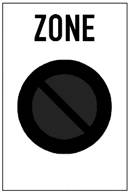
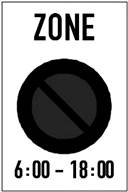

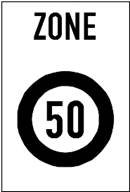
a) Sign No. R.E,9a b) Sign No. R.E,9b c) Sign No. R.E,9c d) Sign No. R.E,9d
Figure D.21 - Sign “Entering zone”
D.20 Sign indicating end of zone
For the purpose of providing direction to exit zones under restriction, limitation, or instruction, respective signs that read “Ra khỏi khu vực” (End of zone) shall be installed (For example: sign No. R.E,10a; R.E,10b; R.E,10c; R.E,10d; ...). Type of signs shall be determined on the basis of restrictions, limitations, and instructions, for example:
- For the purpose of indicating end of parking restriction in the area, sign No. R.E,10a shall be installed;
- For the purpose of indicating end of parking restriction by the hour in the area, sign No. R.E,10b shall be installed;
- For the purpose of defining parking area, sign No. R.E,10c shall be installed;
- For the purpose of indicating end of maximum speed limit in the area, sign No. R.E,10d shall be installed.

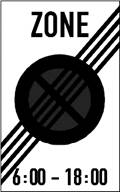

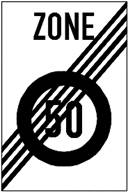
a) Sign No. R.E,10a b) Sign No. R.E,10b c) Sign No. R.E,10c d) Sign No. R.E,10d
Figure D.22 - Sign “End of zone”
D.21 Start of tunnel and end of tunnel (sign No. R.E,11a; R.E,11b according to GMS)
a) For the purpose of informing road users about tunnels with separate traffic rules applicable to them, sign No. R.E,11a shall be installed.
b) For the purpose of informing road users about end of tunnels with separate traffic rules applicable to them, sign No. R.E,11b shall be installed.
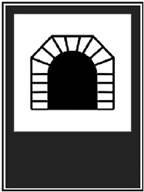
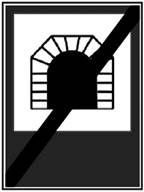
a) Sign No. R.E,11a b) Sign No. R.E,11b
Figure D.23 - Signs warning about tunnels
Appendix E
INTERPRETATION - USE OF INFORMATION SIGNS
E.1 Sign No. I.401 “Bắt đầu đường ưu tiên” (Start of priority road)
a) For the purpose of indicating priority road on which vehicles have right of way, sign No. I.401 shall be installed. The sign shall be installed at appropriate locations on side road leading to primary roads and require vehicles on side roads to yield to vehicles on primary roads.
Where sign No. W.207 has been installed on priority road and sign No. W.208 has been installed on side roads, sign No. I.401 shall not be required.
b) Vehicles on priority roads have the right to clear non-signalized junctions. Vehicles from other roads merging into or intersecting priority roads must yield (other than priority vehicles). In respect of signalized junctions, privileges of vehicles on priority roads shall no longer apply (other than priority vehicles).
c) Sign No. S.506a shall be installed below sign No. I.401 if priority road changes direction at junction.
d) Sign No. W.208 or sign No. R.122 accompanied by sign No. S.506b shall be installed on non-priority roads at junctions.

Figure E.1 - Sign No. I.401
E.2 Sign No. I.402 “Hết đoạn đường ưu tiên” (End of priority road)
For the purpose of indicating the end of priority road, sign No. I.402 shall be installed.

Figure E.2 - Sign No. I.402
E.5 Sign No. I.405 (a,b,c) “Đường cụt” (Dead end)
a) For the purpose of informing about dead ends, the following signs shall be installed:
- Sign No. I.405 (a,b) indicating entrance to dead ends. Type of signs shall be selected depending on the type of entrance. These signs shall be installed on primary roads before junctions where entrance to dead end is located.
- Sign No. I.405c indicating dead end ahead. This sign shall be installed 300 m to 500 m before the dead end and repeated every 100 m.
- Dead ends are roads in which vehicles can no longer move further. Dead ends can be dead-end alleys (in residential zones); roads or bridges interrupted by natural disasters, external forces, or temporary bypass where means of stream crossing are not available at appropriate location; approaches of damaged bridges, etc.
b) In respect of dead ends inaccessible by vehicles or unused, dead end sign shall not be installed but instead sign No. P.101 shall be installed.



a) Sign No. I.405a b) Sign No. I.405b c) Sign No. I.405c
Figure E.5 - Sign No. I.405
E.6 Sign No. I.406 “Được ưu tiên qua đường hẹp” (Priority in narrow road)
a) For the purpose of informing road users that they have right of way at narrow roads, sign No. I.406 shall be installed.
b) Where oncoming vehicles (motorized or non-motorized) have entered narrow roads, vehicles on priority roads shall yield in this case.
c) Where sign No. I.406 has been installed on one direction of travel, sign No. P.132 shall be installed on the other direction of travel.
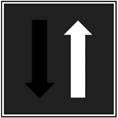
Figure E.6 - Sign No. I.406
E.7 Sign No. I.407 (a,b,c) “Đường một chiều” (One-way road)
a) For the purpose of indicating one-way roads, sign No. I.407 (a,b,c) shall be installed. Sign No. I.407a shall be installed after junction; where sign No. R.302 has been installed at the beginning of dividers, sign No. I.407a shall not be required. Sign No. I.407b,c shall be installed before junction and on roads leading to one-way roads.
b) Sign No. I.407 (a,b,c) shall only allow vehicles to move in the direction indicated by the arrows and shall prohibit vehicles from making u-turn (except for priority vehicles as per the law).
c) For the purpose of indicating the end of one-way road sections, sign No. I.204 shall be installed. Sign No. I.204 informs two-way traffic.
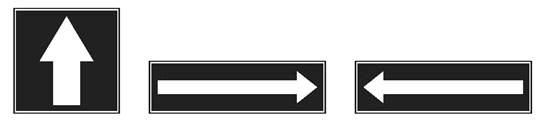
a) Sign No. I.407a b) Sign No. I.407b c) Sign No. I.407c
Figure E.7 - Sign No. I.407
E.8 Sign No. I.408 “Nơi đỗ xe” (Parking)
a) For the purpose of indicating parking areas, parking lots, coach stations, etc., sign No. I.408 shall be installed.
b) Length of parking spaces can be determined and limited by road markings or physical structural elements. Defined area for parking ceases to apply at 10 m before the next junction.

Figure E.8 - Sign No. I.408
E.8a Sign No. 408a “Nơi đỗ xe một phần trên hè phố” (Partial parking on sidewalk)
a) For the purpose of indicating parking area on parts of wide sidewalks, sign No. I.408a shall be installed. Vehicles shall park in a way that all wheels not on the driver’s side shall rest on the sidewalk.
b) The sign shall face direction of travel or be parallel to direction of travel and take effect from location of the sign. Length of parking areas can be defined by road markings. When necessary, supplementary signs indicating effective area of parking area shall be installed.
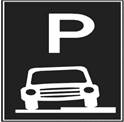
Figure E.8a - Sign No. I.408a
E.9 Sign No. I.409 “Chỗ quay xe” (U-turn)
a) For the purpose of indicating u-turn, sign No. I.409 shall be installed.
b) Sign No. S.502 can be attached to the bottom of sign No. I.409.

Figure E.9 - Sign No. I.409
E.10 Sign No. I.410 “Khu vực quay xe” (U-turn area)
a) For the purpose of indicating u-turn area, sign No. I.410 shall be installed. The sign describes u-turn procedures.
b) Sign No. I.502 can be attached to the bottom of sign No. I.410.

Figure E.10 - Sign No. I.410
E.13 Sign No. I.413a “Đường phía trước có làn đường dành cho ô tô khách” (Oncoming passenger coach-only lane ahead) and sign No. I.413 (b,c) “Rẽ ra đường có làn đường dành cho ô tô khách” (Turning to passenger coach-only lane)
a) For the purpose of informing road users about oncoming passenger coach-only lane, sign No. I.413a shall be installed. The sign shall be installed at junctions leading to one-way roads where the oncoming traffic direction accommodates passenger coaches.
b) For the purpose of informing road users about passenger coach-only lane at right turn or left turn at junction, sign No. I.413b or sign No. I.413c shall be installed. Depending on turn direction, appropriate sign design shall be determined.
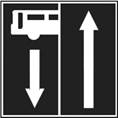
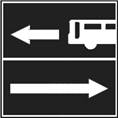
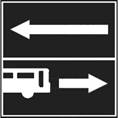
a) Sign No. I.413a b) Sign No. I.413b c) Sign No. I.413c
Figure E.13 - Sign No. I.413
E.14 Sign No. I.414 (a, b, c, d) "Chỉ hướng đường"
For the purpose of providing direction at junctions, sign No. I.414 (a,b,c,d) shall be installed. Direction instruction shall provide code (name) of roads and distance (rounded to the nearest kilometer or to the nearest 100 m if the distance is less than 1 km):
- Sign No. I.414 (a,b) shall be installed at junctions leading to a location and a residential zone.
- Sign No. I.414 (c,d) shall be installed at junctions leading to at least two locations and residential zones. Locations that are further away shall be displayed at the bottom.
- Illustration of directions on the sign shall be synonymous with actual directions. Texts and numerals shall be adjusted by sign dimensions while ensuring clarity and aesthetics. Larger font size is recommended.
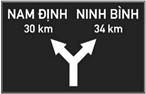
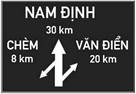
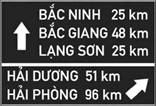
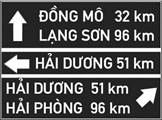
a) Sign No. I.414a b) Sign No. I.414b c) Sign No. I.414c d) Sign No. I.414d
Figure E.14 - Sign No. I.414
E.15 Sign No. I.415 “Mũi tên chỉ hướng đi” (Direction to location)
For the purpose of providing direction and distance to adjacent location from a residential zone or junction, sign No. I.415 shall be installed. Where distance to a location too insignificant, the distance is not required to be presented.

Figure E.15 - Sign No. I.415
E.16 Sign No. I.416 “Đường tránh” (Bypass)
a) For the purpose of providing direction for bypass due to road, bridge congestion or construction, sign No. I.416 shall be installed.
b) Prohibitory signs attached to these signs shall be signs No. P.101 through P.120 depending on the situations. When necessary, road names shall also be presented on the sign for better clarity.
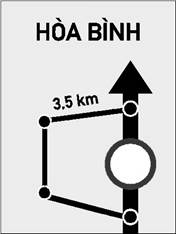
Figure E.16 - Sign No. I.416
E.17 Sign No. I.417 (a,b,c) “Chỉ hướng đường phải đi cho từng loại xe” (Direction for each vehicle type)
a) For the purpose of providing alternate routes for vehicles restricted or limited from entering specific roads to reach the next residential zones, sign No. I.417 (a,b,c) shall be installed.
b) Sign design and texts shall be selected on the basis of vehicle types, residential zones, and direction on the sign.
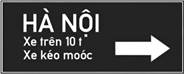
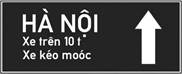
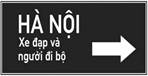
a) Sign No. I.417a b) Sign No. I.417b c) Sign No. I.417c
Figure E.17 - Sign No. I.417
E.18 Sign No. I.418 “Lối đi ở những vị trí cấm rẽ” (Alternate route for no-turning location)
a) For the purpose of providing direction at junctions where turning is restricted, sign No. I.418 shall be installed. The sign shall be installed before junctions where turning is restricted.
b) Illustrations shall be designed in accordance with practical situations.

Figure E.18 - Sign No. I.418
E.19 Sign No. I.419 “Chỉ dẫn địa giới” (Boundary sign)
a) For the purpose of indicating administrative boundaries between cities, provinces, and districts, sign No. I.419 (a,b) shall be installed.
Sign No. I.419b applies to international roads and roads frequented by foreigners. Sign No. I.419a applies to other cases.
b) The sign, when installed on national highway, shall be located on administrative boundaries between two central-affiliated cities or two provinces or a central-affiliated city and a province. The sign, when installed on provincial roads, shall be located on administrative boundaries in the same manner as when it is installed on national highway and administrative boundaries between a province-affiliated city with adjacent district or districts. The sign shall not be required on district roads, commune roads, urban roads, and specialized roads.
c) Kilometric points presented on sign No. I.419 (a,b) shall be rounded to the nearest meter.
d) Depending on geometry, the sign can be located on the left side or the right side of direction of travel.
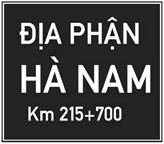
Figure E.19a - Sign No. I.419a
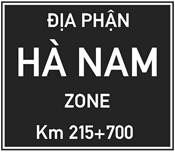
Figure E.19b - Sign No. I.419b
E.22 Sign No. I.422 “Di tích lịch sử” (Historical site)
For the purpose of providing direction to historical site, scenic site, etc., sign No I.422 (a,b) shall be installed.
Sign No. I.422b applies to international roads and roads frequented by foreigners. Sign No. I.422a applies to other cases.
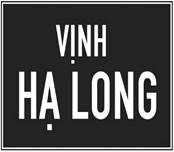
Figure E.22a - Sign No. I.422a
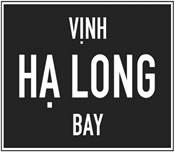
Figure E.22b - Sign No. I.422b
E.23a Sign No. I.423 (a,b) “Vị trí người đi bộ sang ngang” (Pedestrian crossing)
a) For the purpose of informing pedestrians and road users about pedestrian crossing, sign No. I.423 (a,b) shall be installed.
b) This sign can be used as stand-alone sign at crossing location, non-signalized roads or in combination with road markings. Road users shall slow down, observe, and yield to pedestrians. Pedestrian depicted on the sign shall be directed towards the road.
Where pedestrian crossing markings are available or sign No. W.224 or sign No. R.305 has been installed before location of pedestrian crossing, sign No. I.423 (a,b) shall not required.
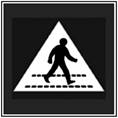
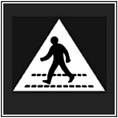
a) Sign No. I.423a b) Sign No. I.423b
Figure E.23a - Sign No. I.423
E.23b Sign No. I.423c “Điểm bắt đầu đường đi bộ” (Start of footpath) (sign No. F,9 under the GMS)
For the purpose of informing drivers and pedestrians about start of footpath, sign No. I.423c shall be installed. This sign shall not be installed at pedestrian crossing.

Figure E.23b - Sign No. I.423c
E.24 Sign No. I.424 (a,b) “Cầu vượt qua đường cho người đi bộ” (Pedestrian overpass)
For the purpose of informing road users about pedestrian overpass, sign No. I.424 (a,b) shall be installed. Depending on direction of pedestrians crossing the road, sign No. I.424a or sign No. I.424b shall be installed.
Where pedestrian overpass is obvious to pedestrians, sign No. I.424 (a,b) shall not be required.
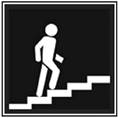
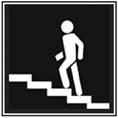
a) Sign No. I.424a b) Sign No. I.424b
Figure E.24 - Sign No. I.424
E.25 Sign No. I.424 (c,d) “Hầm chui qua đường cho người đi bộ” (Pedestrian underpass)
For the purpose of informing pedestrians about pedestrian underpass, sign No. I.424 (c,d) shall be installed. Depending on direction of pedestrians crossing the road, sign No. I.424a or sign No. I.424b shall be installed.
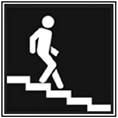
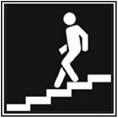
a) Sign No. I.424c b) Sign No. I.424d
Figure E.25 - Sign No. I.424
E.26 Sign No. I.425 “Bệnh viện” (Hospital)
a) For the purpose of informing about treatment establishment near roads such as hospitals, infirmaries, medical stations, etc., sign No. I.425 shall be installed.
b) Road users shall slow down, observe, and shall not honk.

Figure E.26 - Sign No. I.425
E.27 Sign No. I.426 “Trạm cấp cứu” (First aid)
For the purpose of informing about first aid facilities near roads, sign No. I.426 shall be installed.
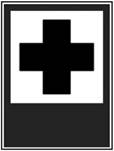
Figure E.27 - Sign No. I.426
E.28 Sign No. I.427a “Trạm sửa chữa” (Repair shop)
For the purpose of informing about repair shops serving motor vehicles and motorbikes, sign No. I.427a shall be installed.
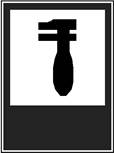
Figure E.28 - Sign No. I.427a
E.29 Sign No. I.427b “Trạm kiểm tra tải trọng xe” (Weigh station)
For the purpose of informing about weigh station, sign No. I.427b shall be installed.
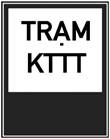
Figure E.29 - Sign No. I.427b
E.30 Sign No. I.428 “Cửa hàng xăng dầu” (Petrol station)
For the purpose of informing about petrol station or recharge station serving vehicles on the road, sign No. I.428 shall be installed.
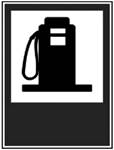
Figure E.30 - Sign No. I.428
E.31 Sign No. I.429 “Nơi rửa xe” (Car wash)
For the purpose of informing about car wash, sign No. I.429 shall be installed.
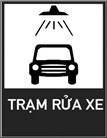
Figure E.31 - Sign No. I.429
E.32 Sign No. I.430 “Điện thoại” (Telephone)
For the purpose of indicating location of public telephone, sign No. I.430 shall be installed.

Figure E.32 - Sign No. I.430
E.33 Sign No. I.431 “Trạm dừng nghỉ” (Rest area)
For the purpose of indicating rest areas (for accommodation, meals, fuel supply, etc.), sign No. I.431 shall be installed. Depending on services available in each rest area, appropriate illustration shall be included on the sign.
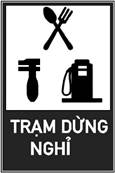
Figure E.33 - Sign No. I.431
E.34 Sign No. I.432 “Khách sạn” (Hotel)
For the purpose of indicating hotels, sign No. I.432 shall be installed.
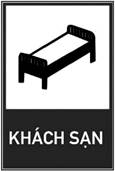
Figure E.34 - Sign No. I.432
E.35a Sign No. I.433a “Nơi nghỉ mát” (Lounging area)
For the purpose of indicating lounging areas, sign No. I.433a shall be installed.
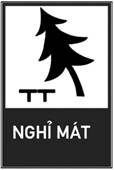
Figure E.35a - Sign No. I.433a
E.35b Sign No. I.433 (b,c,d) “Báo hiệu nơi cắm trại, nhà nghỉ lưu động” (Camping site, recreational vehicle parking site)
For the purpose of indicating camping sites and recreational vehicle parking sites on international roads and roads frequented by foreigners, sign No. I.33b, sign No. I.433c, or sign No. I.433d shall be installed.
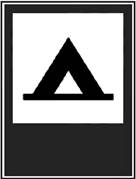
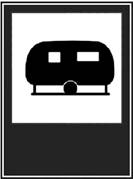
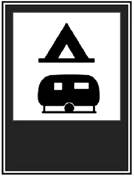
a) Sign No. I.433b b) Sign No. I.433c c) Sign No. I.433d
Figure E.35b - Camping site, recreational vehicle parking site
E.35c Sign No. I.433e - “Báo hiệu nhà trọ” (Youth hostel)
For the purpose of indicating youth hostels on international roads and roads frequented by foreigners, sign No. I.433e shall be installed.

Figure E.35c - Sign No. I.433e
E.36 Sign No. I.434a “Bến xe buýt” (Bus stop)
For the purpose of indicating stopping places for buses to pick up and drop off passengers, sign No. I.434a shall be installed. Sign No. I.434a shall be installed in combination with supplementary sign to provide information on route code, route name, starting and end points of bus routes. Supplementary signs can be adjacent to sign No. I.434a or in passenger pick-up and drop-off areas.
Where bus stopping places are not bus stops according to applicable regulations, the phrase “Bến xe buýt” (Bus stop) shall be replaced by “Điểm dừng xe buýt” (Bus stopping place).
Where stopping places are used as passenger pick-up and drop-off areas for fixed routes, the phrase “Bến xe buýt” (Bus stop) shall be replaced with the phrase “Điểm đón trả khách tuyến cố định” (Fixed passenger pick-up and drop-off) and the phrase “BUS STOP” on the sign shall be removed.
For the purpose of indicating stopping places of other vehicle types, illustration of appropriate vehicle types and texts shall be presented (for example: “Điểm dừng xe taxi” (Taxi stand), etc.).
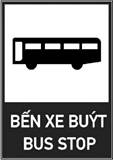
Figure E.36 - Sign No. I.434a
E.37 Sign No. I.434b “Bến xe tải” (Truck station)
For the purpose of indicating truck parking areas for goods loading and unloading, sign No. I.434b shall be installed.
Where truck parking areas are not truck stations in accordance with applicable regulations, replace the phrase “Bến xe tải” (Truck station) shall be replaced by the phrase “Điểm dừng xe tải” (Truck stopping place).
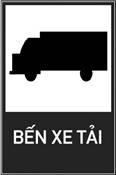
Figure E.37 - Sign No. I.434b
E.38 Sign No. I.435 “Bến xe điện” (Tramway station)
For the purpose of indicating stopping places for trams to pick up and drop off passengers, sign No. I.435 shall be installed.
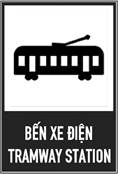
Figure E.38 - Sign No. I.435
E.39 Sign No. I.436 “Trạm cảnh sát giao thông” (Traffic police station)
For the purpose of indicating location of traffic police station, sign No. I.436 shall be installed. Vehicles shall slow down and shall not overtake in this area.
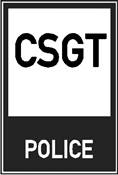
Figure E.39 - Sign No. I.436
E.40 Sign No. I.437 “Đường cao tốc” (Expressway)
For the purpose of indicating the start of expressway, sign No. I.437 shall be installed.
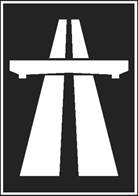
Figure E.40 - Sign No. I.437
E.42 Sign No. I.439 “Tên cầu” (Bridge name)
a) For the purpose of displaying information of a bridge, sign No. I.439 shall be installed. Sign No. I.439 shall only be installed where a bridge is greater than 30 m in length or the name is associated with geographical or historical locations. Bridge sign shall not be installed in respect of bridges with symbolic meaning and bridges in city area, except for bridges that are named after historical figures or historical sites in which case their signs shall be retained and their kilometric points are not required to be presented.
For the purpose of management, in addition to sign No. I.439, other information such as: name, kilometric point rounded to the nearest meter, name or code of road, design load, length, year of construction shall be attached to outermost piers of bridges (close to bridge inspection entrances and exits).
b) The sign shall be on the right relative to direction of travel and 10 m away from bridge abutments on both sides of the bridge.
c) The sign shall reads: Name of bridge, kilometric point, and name of road.
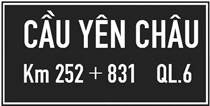
Figure E.42 - Sign No. I.439
E.43 Sign No. I.440 “Đường đang thi công” (Road under construction)
a) For the purpose of indicating roads under construction, repair, upgrade, or renovation, sign No. I.440 shall be installed.
Kilometric point shall be rounded to the nearest meter.
b) Sign No. I.440 shall be installed on both ends of roads under construction, repair, upgrade, or renovation and after sign No. I.441 (a,b,c).
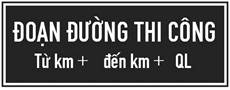
Figure E.43 - Sign No. I.440
E.44 Sign No. I.441 (a,b,c) “Báo hiệu phía trước có công trường thi công” (Construction ahead)
a) For the purpose of informing road users about construction ahead, sign No. I.441 (a,b,c) shall be installed.
b) Sign No. I.441 (a,b,c) shall be installed on both sides of construction sites and 500 m, 100 m, 50 m away from construction sites on both sides and before sign No. I.440. In case of one-way roads, the sign shall only be installed on one side that can be seen by oncoming traffic. Depending on traffic volume and speed, number of sign and warning distance can be adjusted accordingly.
c) Sign No. W.227 shall also be installed in combination with sign No. I.441 (a,b,c). When necessary, sign No. P.127 and sign No. P.134 shall be installed at the end of construction sites.
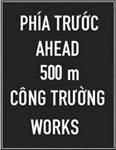
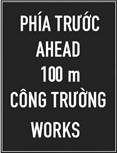
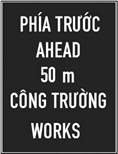
a) Sign No. I.441a b) Sign No. I.441b c) Sign No. I.441c
Figure E.44 - Sign No. I.441
E.45 Sign No. I.442 “Chợ” (Market)
For the purpose of indicating market area, sign No. I.442 shall be installed. motorized vehicles in this area shall observe and slow down.

Figure E.45 - Sign No. I.442
E.46 Sign No. I.443 “Xe kéo rơ-moóc” (Trailer truck)
a) For the purpose of warning about vehicles towing trailers or other vehicles, sign No. I.443 shall be installed.
b) Sign No. I.443 shall be installed on the top of the cabin of towing vehicles.
The sign shall be square in shape, have green background, and contain yellow equilateral triangles.

Figure E.46 - Sign No. I.443
E.47 Sign No. I.444 “Biển báo chỉ dẫn địa điểm” (Direction to location)
For the purpose of informing road users about direction to important locations, types of signs include:
- Sign No. I.444a indicating railway stations shall be installed before junctions leading to railway stations;
- Sign No. I.444b indicating airports shall be installed before junctions leading to airports.
- Sign No. I.444c indicating parking lots shall be installed before junctions leading to parking lots;
- Sign No. I.444d indicating passenger coach stations shall be installed before junctions leading to passenger coach stations;
- Sign No. I.444e indicating first aid facilities shall be installed at junctions leading to hospitals and first aid facilities;
- Sign No. I.444f indicating waterway stations shall be installed before junctions leading to waterway stations;
- Sign No. I.444g indicating scenic areas and tourist areas shall be installed before junctions leading to scenic areas and tourist areas;
- Sign No. I.444h indicating petrol stations shall be installed before junctions leading to petrol stations.
- Sign No. I.444i indicating car wash establishments shall be installed before junctions leading to car wash establishments;
- Sign No. I.444j indicating ferry stations shall be installed before junctions leading to ferry stations;
- Sign No. I.444k indicating metro stations shall be installed at junctions leading to metro stations;
- Sign No. I.444l indicating service establishments shall be installed before junctions leading to rest areas;
- Sign No. I.444m indicating repair stations shall be installed before junctions leading to repair stations in service establishments.



a) Sign No. I.444a b) Sign No. I.444b c) Sign No. I.444c
Figure E.47 - Sign No. I.444 (a,b,c)



a) Sign No. I.444d b) Sign No. I.444e c) Sign No. I.444f
Figure E.48 - Sign No. I.444 (d,e,f)



a) Sign No. I.444g b) Sign No. I.444h c) Sign No. I.444i
Figure E.49 - Sign No. I.444 (g, h, i)



a) Sign No. I.444j b) Sign No. I.444k c) Sign No. I.444l
Figure E.50 - Sign No. I.444 (j,k,l)

Figure E.51 - Sign No. I.444m
E.48 Sign No. I.445 “Biển báo kiểu mô tả tình trạng đường” (Road conditions)
For the purpose of allowing coherent and accident-free traffic on roads with poor conditions or traffic safety risks, sign No. I.445 indicating road conditions shall be installed at approaches to the aforementioned roads to inform drivers and consist of the following types:
- Sign No. I.445a informing slippery roads shall be installed at an appropriate distance before roads that are slippery during the rain or oil spill, etc.;
- Sign No. I.445b indicating sloped roads shall be installed at an appropriate distance before roads with high gradient and limited visibility;
- Sign No. I.445c indicating foggy roads, roads with limited visibility shall be installed before foggy roads;
- Sign No. I.445d indicating weak road base shall be installed at an appropriate distance before roads where road base experiences depression or unevenness;
- Sign No. I.445e compelling large or oversized vehicles to stay to the right shall be installed at appropriate locations leading to roads with at least two lanes to request drivers of large or oversized vehicles to slow down and yield to other vehicles;
- Sign No. I.445f warning about strong crosswinds shall be installed before large bridges or bridges crossing bays or mountain ridges where strong crosswinds are frequently present;
- Sign No. I.445g indicating accident-prone roads shall be installed at appropriate locations leading to accident-prone roads;
- Sing No. I.445h indicating continuous descent shall be installed at appropriate locations leading to continuous descent;
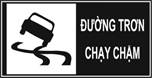
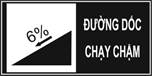
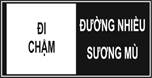
a) Sign No. I.445a b) Sign No. I.445b c) Sign No. I.445c
Figure E.52 - Sign No. I.445 (a,b,c)

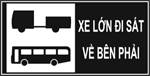
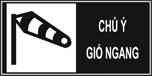
a) Sign No. I.445d b) Sign No. I.445e c) Sign No. I.445f
Figure E.53 - Sign No. I.445 (d, e, f)
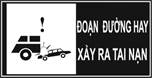
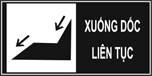
a) Sign No. I.445g b) Sign No. I.445h
Figure E.54 - Sign No. I.445 (g, h)
E.49 Sign No. I.446 “Nơi đỗ xe dành cho người khuyết tật” (Handicapped parking)
For the purpose of indicating parking areas for people with disabilities, sign No. I.446 shall be installed. The sign shall be installed at appropriate location and may be used in combination with sign No. P.131a and sign No. I.408.
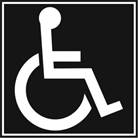
Figure E.55 - Sign No. I.446
E.50 Sign No. I.447 “Biển báo cầu vượt liên thông” (Complete overpass)
The sign shall be installed before overpasses allowing complete traffic between roads. Depending on the type of junction, sign No. I.447a, sign No. I.447b, sign No. I.447c, or sign No. I.447d shall be installed. Sign No. I.414c and sign No. I.414d shall be installed at junctions to provide directions.
Where illustrations of direction on signs No. I.447a, I.447b, I.445c, I.447d are not representative of actual traffic layout, the illustrations shall be adjusted accordingly.
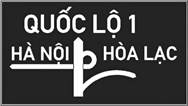
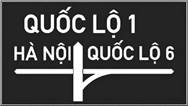
a) Sign No. I.447a b) Sign No. I.447b
Figure E.56 - Sign No. I.447 (a,b)
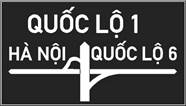
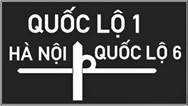
a) Sign No. I.447c b) Sign No. I.447b
Figure E.57 - Sign No. I.447 (c,d)
E.51 Sign No. I.448 “Làn đường cứu nạn hay làn thoát xe khẩn cấp” (Runaway ramps)
The sign consists of 4 pairs of signs at 2 km, 1 km, 300 m, and at junctions and informs road users about emergency lanes. Location of the signs shall allow the signs to be easily seen. Distances on the sign can be adjusted accordingly.
Where illustrations of runaway ramps on sign No. I448 are not representative of actual layout, distance, or shape of runaway ramps, the illustrations shall be adjusted accordingly. For the purpose of preventing confusion between main roads and runaway ramps, cantilever posts shall be installed at junctions between runaway ramps and main roads to provide clear direction.
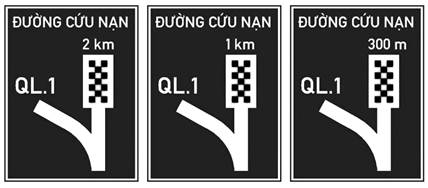
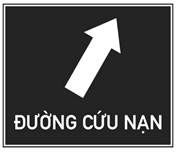
Figure E.58 - Sign No. I.448
E.52 Sign No. I.449 “Biển tên đường” (Road name)
For the purpose of indicating name of international roads, sign No. I.449 shall be installed.
Sign No. I.449 shall have dark blue background and white lettering.
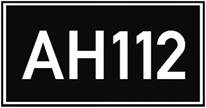
Figure E.59 - Sign No. I.449
INTERPRETATION - USE OF SUPPLEMENTARY SIGN
F.1 Sign No. S.501. “Phạm vi tác dụng của biển” (Applicable area)
a) Sign No. S.501 informs road users about the length of dangerous roads or the length of road prohibition or restriction and is installed below primary signs. The length of road prohibition and restriction shall be presented in meter and rounded to the nearest 10 meters.
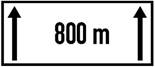
Figure F.1 - Sign No. S.501
F.2 Sign No. S.502 “Khoảng cách đến đối tượng báo hiệu” (Distance to signalized object)
a) Sign No. S.502 shall be installed below danger signs, prohibitory signs, signs giving orders, and information signs that are installed if location of these signs differs from general provisions to indicate actual distance from location of the signs to signalized objects head.
b) Distance on the sign shall be presented in meters and rounded to the nearest 10 meter.
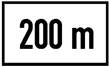
Figure F.2 - Sign No. S.502
F.3 Sign No. S.503 (a,b,c,d,e,f) “Hướng tác dụng của biển” (Applicable direction of sign)
a) Sign No. S.503 (a,b,c) installed below prohibitory signs and signs giving orders shall indicate that the signs apply to directions perpendicular to the current direction of travel.
b) Sign No. S.503b indicates that the sign applies to both directions of left and right.
c) Sign No. S.503 (d,e,f) installed below sign No. P.124 (a,b,c,d,e,f), sign No. P.130, and sign No. P.131 indicates that the signs apply to direction parallel to the direction of travel.
d) Sign No. S.503e indicates that repeated signs restricting parking and stopping apply to the front and the rear of the signs.
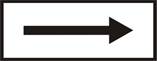
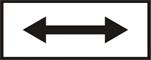

a) Sign No. S.503a b) Sign No. S.503b c) Sign No. S.503c
Figure E.3a - Sign No. S.503 (a,b,c)



a) Sign No. S.503d b) Sign No. S.503e c) Sign No. S.503f
Figure E.3b - Sign No. S.503 (d,e,f)
Supplementary signs No. S.H,3a; S.H,3c (sign No. H,3 (a,b,c) according to the GMS) may be installed on diplomatic roads and crowded roads.
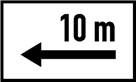
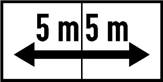
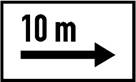
a) Sign No. S.H,3a b) Sign No. S.H,3b c) Sign No. S.H,3c
Figure F.3b - Sign No. S.H,3 (a,b,c)
F.4 Sign No. S.504 “Làn đường” (Lane)
Sign No. S.504 shall be installed on the sides of lanes and below prohibitory signs, signs giving orders or below traffic lights to indicate lanes regulated by the signs or traffic lights (where sign No. S.504 is incorporated onto prohibitory signs and signs giving orders, these signs shall be accompanied by arrows indicating applicable lanes).

Figure F.4 - Sign No. S.504
F.5 Sign No. S.505a “Loại xe” (Vehicle type)
Sign No. S.505a shall be installed below prohibitory signs, signs giving orders, and information signs to indicate types of vehicles to which prohibitory signs, signs giving orders, and information signs apply. Vehicle illustrations shall be determined on the basis of the type of vehicles regulated by the signs.
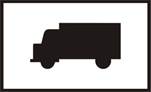
Figure F.5 - Sign No. S.505a
F.6 Sign No. S.505b “Loại xe hạn chế qua cầu” (Bridge weight limits)
Sign No. S.505b shall be installed below sign No. P.106a to indicate trucks regulated by traffic signs and permissible gross weight (including kerb weight and cargo weight) corresponding to each type of vehicle regardless of number of axles.
Sign No. S.505b shall be installed for each bridge. The sign shall be installed to the right of direction of travel and 10 m to 20 m away from bridge approaches and at a location that the sign can be easily seen.
In case of unexpected damage to bridges or bridges with low weight restrictions, in addition to sign No. S.505b, additional information panels shall be installed on both sides of the roads to inform road users about location of bridges with the lowest weight restrictions in the area.
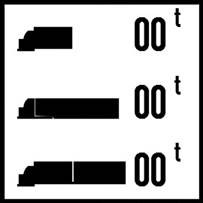
Figure F.6 - Sign No. S.505(b)
F.7 Sign No. S.505c “Tải trọng trục hạn chế qua cầu” (Bridge axle load limits)
a) Sign No. S.505c shall be installed below sign No. P.106a to specify types of trucks with maximum permissible load corresponding to each type of axle (single-axle, tandem axle, triaxle).
b) Sign No. S.505c shall be installed in combination with sign No. S.505b below sign No. P.106 and vehicles must meet requirements of both signs No. S.505b and S.505c in order to cross the bridge;
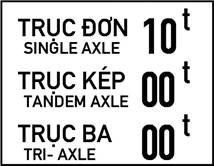
Figure F.7 - Sign No. S.505c
F.8 Sign No. S.506 (a,b) “Hướng đường ưu tiên” (Direction of priority road)
a) Sign No. S.506a shall be installed below sign No. I.401 on priority roads.
b) Sign No. S.506b shall be installed below sign No. W.208 and sign No. R.122 on non-priority roads.


a) Sign No. S.506a b) Sign No. S.506b
Figure F.8 - Sign No. S.506
F.9 Sign No. S.507 “Hướng rẽ” (Turn direction)
a) Sign No. S.507 shall be used as stand-along sign to inform road users about dangerous turns and direction of the turn.
b) The sign shall be installed if road users have difficulty recognizing direction of the turn. Two signs indicating opposite directions can be installed at 1,2 m to 1,5 m in height to indicate both left turn and right turn. For the purpose of guiding in curves, it is possible to use reflective markers.
c) This sign shall not be used as replacement for sign No. W.201 (a,b) and W.202 (a,b,c).

Figure F.9 - Sign No. S.507
F.10 Sign No. S.508 “Biểu thị thời gian” (Time)
Sign No. S.508 (a,b) shall be installed below prohibitory signs or signs giving orders in order to dictate effective period of these signs accordingly. Effective period can be a time of day (from time to time) or even days, odd days, weekdays, or specific periods of time (for example, “> 5 minutes”, etc.) and accompanied by English texts when necessary.
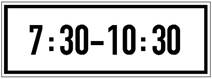
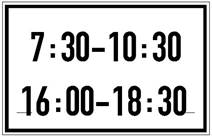
a) Sign No. 508a b) Sign No. S.508b
Figure F.10 - Sign No. S.508
F.11 Sign No. S.509 “Thuyết minh biển chính” (Explanation for primary sign)
a) For the purpose of providing explanation for sign No. W.239, sign No. S.509a can be installed below sign No. W.239 to dictate specify safe height for vehicle operation.
b) When necessary, it is possible to install sign No. S.509b below sign No. P.130 and sign No. P.131 (a,b,c) to clarify.
c) Application in other cases shall be decided on a case-by-case basis.
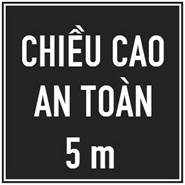

a) Sign No. S.509a b) Sign No. S.509b
Figure F.11 - Sign No. S.509
F.12. Sign No. S.510a “Chú ý đường trơn có băng tuyết” (Icy road warning) and sign No. S.510b “Chú ý đường sắt” (Railway)
For the purpose of warning about slippery or snowy roads, supplementary sign No. S.510a shall be installed. The sign is rectangular with red background and white text, white outline.

a) Figure F.12 - Sign No. S.510a
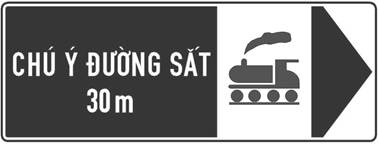
b) Figure F.12 - Sign No. S.510b
Figure F.12 - Icy road warning sign and railway warning sign.
F.13 Direction to camping site, youth hostel sign (sign G,7; G,8 under GMS)
For the purpose of providing direction to camping site or youth hostel, sign No. S.G,7 or S.G,8 shall be installed.
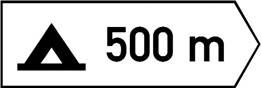
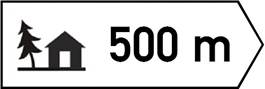
a) Sign No. S.G,7 b) Sign No. S.G,8
Figure F.13 - Direction to camping site, youth hostel sign
F.14 Direction to parking space for transition to public transportation (sign No. G,9b according to GMS)
For the purpose of providing direction to parking space for transition to public transportation, sign No. S.G,9b shall be installed.

Figure F.14 - Sign No. S.G,9b
F.15 Number of lanes and direction of each lane (sign No. S.G,11a; G,11c according to GMS)
For the purpose of informing vehicle operators about number of lane and direction of each lane, sign No. S.G,11a; S.G,11c shall be installed. The number of arrows on these signs must equal the number of lanes traveling in the same direction and direction ahead and inform road users about the number of lanes ahead.
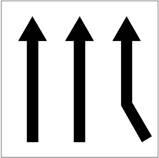

a) Sign No. S.G,11a b) Sign No. S.G,11c
Figure F.15 - Number of lanes and direction of each lane
F.16 Lane(s) not open to public traffic (sign No. G,12a; G,12b according to GMS)
For the purpose of informing drivers about lanes not open to public traffic, sign No. S.G,12a and S.G,12b shall be installed.
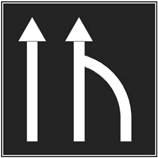
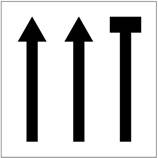
a) Sign No. S.G,12a b) Sign No. S.G,12b
Figure F.16 - Lanes not open to public sign
F.17 Exception sign (sign No. H,6 according to GMS)
For the purpose of exempting a vehicle type or vehicle types from prohibition or restriction, sign No. S.H,6 shall be installed to depict the exempted vehicle type or types with the phrase “Except - Ngoại lệ”.
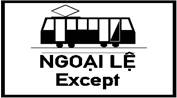
Figure F.17 - Sign No. S.H,6
Appendix G
INTERPRETATION - USE OF ROAD MARKINGS
G1. Longitudinal road markings
G1.1. Road markings dividing directions of travel
a. Marking 1.1: Road markings dividing directions of travel (central markings), as single broken lines
Interpretation: divides two directions of travel. Vehicles may cross over to lanes of oncoming traffic from either direction of traffic.
Illustration:
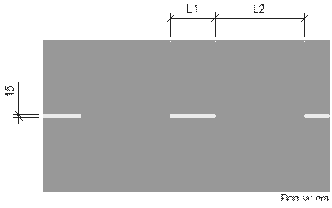
Figure G.1 - Marking 1.1
Design: Marking 1.1 is a single, broken, yellow line. Width of line b = 15 cm, length of each line segment L1 = 1 m - 3 m; length of gap between line segments (2 m - 6 m) at a ratio L1/L2 = 1:2. In case of narrow roads with insufficient space for 2 lanes for motorized vehicles and frequented by motorbikes in high quantity, this type of line can still be used in which case b = 10 cm and the ratio L1/L2 = 1:3 or 1:2.
As design speed increases, L1 and L2 shall also be increased accordingly. L1 and L2 shall be lowered for the purpose of guiding vehicles (for example in curves with small radius).
b. Marking 1.2: Road markings dividing directions of travel (central markings), as single solid lines
Interpretation: divides two directions of travel. Vehicles are not allowed to cross over the lines or operate on the lines.
Illustration:
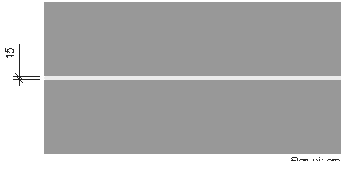
Figure G.2 - Marking 1.2
Design:
- Marking 1.2 is a single, solid, yellow line of 15 cm in width. This line is used in roads where overtaking sight distance is not guaranteed, risk of head-on collision is high, there are 2 or 3 lanes for motorized vehicles, and central dividers are not installed.
- Marking 1.2 shall only be used if width of lane is sufficient to accommodate large vehicles permitted to operate on the roads in question.
c. Marking 1.3: Road markings dividing directions of travel (central markings), as double solid lines
Interpretation: divides two directions of travel. Vehicles are not allowed to cross over the lines or operate on the lines.
Illustration:
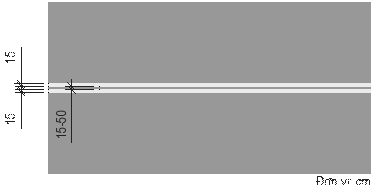
Figure G.3 - Marking 1.3
Design:
- Marking 1.3 is two solid, parallel, yellow lines with b = 15 cm; spacing between the lines is at least 15 cm and at most 50 cm. Where spacing between two lines is greater than 50 cm, diagonal yellow channelizing lines shall be used (marking 4.1).
- This line is commonly used to divide two directions of travel on roads with at least 4 lanes for motorized vehicles, roads without central dividers and inadequate overtaking sight distance, and roads with high risk of head-on collision and in other necessary areas.
- Marking 1.3 can be used on roads with 2 or 3 lanes for motorized vehicles and without central dividers in necessary positions to highlight dangers present and deter overtaking, operating on the lines. The function of marking 1.3 in this case is similar to that of marking 1.2.
* Where it is necessary to allow vehicles to cross over the lines, yellow dotted lines below shall be used:
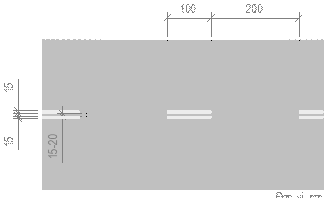
d. Marking 1.4: Road markings dividing directions of travel, as a solid line and a broken line
Interpretation: divides two directions of travel. Vehicles on the side of broken line may cross over and use the opposite lane when necessary; vehicles on the side of solid line must not cross over or operate on the line.
Illustration:
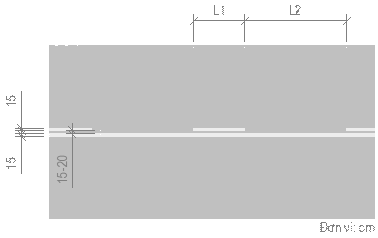
Figure G.4 - Marking 1.4
Design:
- Marking 1.4 consists of a solid line parallel with a broken line. Width of each line b = 15 cm; spacing between each line shall be 15 cm - 20 cm. In respect of broken line, L1 = (1 m - 3 m); L2 = (2 m - 6 m); the ratio of L1/L2 = 1:2.
As design speed increases, L1 and L2 shall also be increased accordingly. L1 and L2 shall be lowered for the purpose of guiding vehicles (for example in curves with small radius).
- This line shall be used on roads with at least two lanes, without central dividers where, at necessary sections, vehicles on a direction of travel are prohibited from entering lanes of oncoming traffic for safety reasons.
Where only one lane adjoins the solid line, the width of this lane shall be sufficient to accommodate large vehicles permitted to operate on the roads in question.
e. Marking 1.5: Reversible lane marking
Interpretation: defines reversible lanes. Direction of travel on a lane at any given time can be reversed by traffic enforcers, traffic lights, signs, or other appropriate traffic signals.
Illustration:
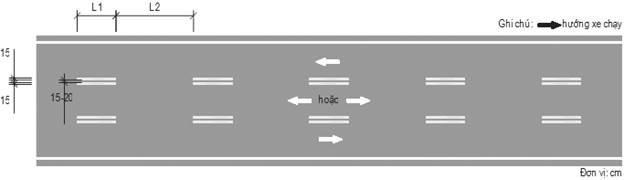
Figure G.5 - Marking 1.5
Design: Marking 1.5 is double broken yellow lines with width of each line b = 15 cm; spacing between the lines = 15 cm - 20 cm; length of each line segment L1 = (1 m - 2 m), length of gap between line segments L2 = (3 m - 6 m), ratio of L1:L2 = 1:3.
As design speed increases, L1 and L2 shall also be increased accordingly. L1 and L2 shall be lowered for the purpose of guiding vehicles (for example in curves with small radius).
g. Road markings dividing directions of travel in horizontal or vertical curves without adequate overtaking sight distance
For the purpose of painting central road markings on horizontal or vertical curves where overtaking restriction is imposed, no-overtaking zones shall be determined for each direction of travel. No-overtaking zone on a direction of travel means a zone whose actual length is shorter than the minimum overtaking sight distance. Types of road markings dividing directions of travel shall be determined on the basis of no-overtaking requirements. Marking 1.3 shall be adopted for no-overtaking zones on both directions; marking 1.4 shall be adopted for no-overtaking zones on one side of the curve (solid line in marking 1.4 shall be on the side where overtaking is prohibited); marking 1.1 shall be adopted where overtaking restriction is not imposed on both sides of the curve (see illustrations for types of road markings in Figure G.6 and Figure G.7).









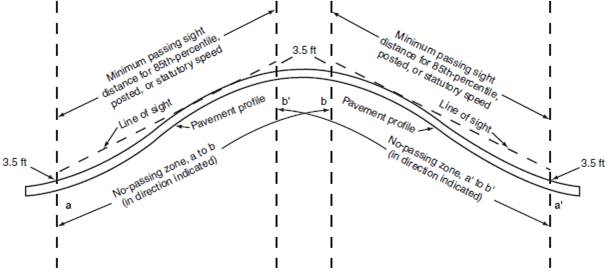
Note: No-overtaking zones on both sides may or may not overlap.
Figure
G.6 - Location of road markings dividing directions of travel
(central markings) in vertical curve
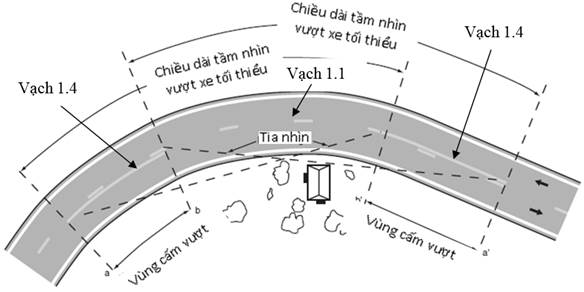
Note: No-overtaking zones on both sides may or may not overlap.
Figure
G.7 - Location of road markings dividing directions of travel
(central markings) in horizontal curve
Identification of no-overtaking zone:
+ Start of no-overtaking zones (a and a’ on Figure G.6 and Figure G.7) is points where actual sight distance of vehicles entering the curves is shorter than the minimum overtaking sight distance corresponding to the maximum speed limit or V85. V85 is the speed at or below which 85% of drivers operate. Minimum overtaking sight distance is specified under Schedule G.1 below.
Schedule
G.1 - Minimum overtaking sight distance
for determining no-overtaking zone
|
Maximum speed limit or V85 (km/h) |
Minimum overtaking sight distance (m) (only for determining no-overtaking zones) |
Maximum speed limit or V85 (km/h) |
Minimum overtaking sight distance (m) (only for determining no-overtaking zones) |
|
30 |
120 |
80 |
245 |
|
40 |
140 |
90 |
280 |
|
50 |
160 |
100 |
320 |
|
60 |
180 |
110 |
355 |
|
70 |
210 |
120 |
395 |
+ End of no-overtaking zones (b and b’ on Figure G.6 and Figure G.7) is points where actual sight distance is greater than minimum overtaking sight distance corresponding to V85 or design speed (after vehicles have passed sections with inadequate overtaking sight distance).
Regulations on length of line segments:
+ Where length of no-overtaking zone (length of section consisting of alternating solid line segment and broken line segment) per direction of travel is lower than 30 m, minimum length of no-overtaking zones shall be increased to 30 m.
+ Length of overtaking zones alternating no-overtaking zones per direction of travel shall not be lower than 100 m.
Road markings prohibiting overtaking shall only be used if width of the lane where overtaking is prohibited in the curve is sufficient to accommodate large vehicles permitted to operate on the roads in question.
g. Road markings dividing directions of travel on 2+1 roads
Figure G.8 and Figure G.9 illustrate the use of road markings dividing directions of travel on 2+1 roads:
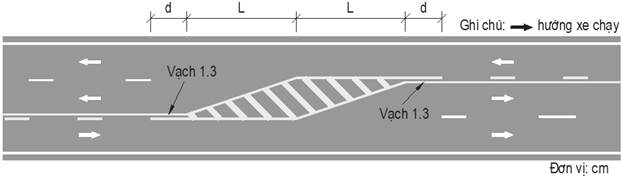
Note: d = 75 m, L ≥ 25 m.
Figure G.8 - Road markings on 2+1 roads where one lane transitions to two lanes
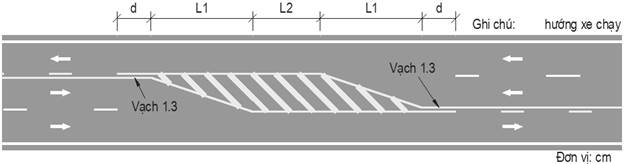
Note: d =75 m, L1 ≥ 100 m, L2 ≥ 100 m.
Figure G.8 - Road markings on 2+1 roads where two lanes transition to one lane
Note:
+ Each diagonal line shall be parallel with one another, 45 cm wide, 100 cm away from one another, creating a 135o angle relative to the direction of travel (marking 4.1).
+ Road markings defining area of parallel diagonal lines shall be single solid lines (see Figure G.8 and Figure G.9). These lines shall have width equal to that of single lines in marking 1.3 and be compliant with Figure G.8 and Figure G.9.
G1.2. Road markings dividing lanes traveling in the same direction
a. Marking 2.1: Road markings dividing lanes traveling in the same direction in form of single broken lines
Interpretation: divides lanes traveling in the same direction. In this case, vehicles may change lane by crossing over marking 2.1.
Illustration:
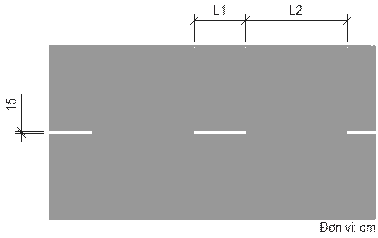
Figure G.10 - Marking 2.1
Design: Marking 2.1 is single broken white line. b = 15 cm, L1 = (1 m - 3 m); L2 = (3 m - 6 m); ratio of L1/L2 = 1:3.
As design speed increases, L1 and L2 shall also be increased accordingly. L1 and L2 shall be lowered for the purpose of guiding vehicles (for example in curves with small radius).
b. Marking 2.2: Road markings dividing lanes traveling in the same direction in form of single solid lines
Interpretation: divides lanes traveling in the same direction. In this case, vehicles are not allowed to change lanes, use other lanes, or operate on the lines.
Illustration:
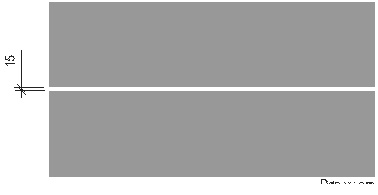
Figure G.11 - Marking 2.2
Design: Marking 2.2 is single solid white line of 15 cm in width.
c. Marking 2.3: Road markings defining per-vehicle lanes or priority lanes
Interpretation: Road markings define lane reserved for a specific type of motorized vehicle (solid line) where other vehicles are not allowed to enter except for emergencies as per the Law on Road Traffic.
Road markings define priority lane for a specific type of motorized vehicles (broken line) where other vehicles may use the lane and must yield to vehicles that have priority on the lane.
Vehicles on per-vehicle lanes or priority lanes may cross over the lines where these vehicles are not restricted from entering adjacent lane or roadway.
Illustration:
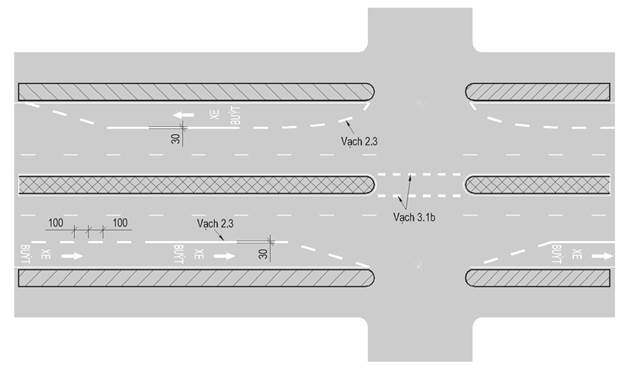
Figure G.12 - Illustration of road markings indicating bus-only lanes or priority lanes for buses
Design:
- Road markings indicating per-vehicle lanes or priority lanes shall be single white lines of 30 cm in width. Marking 2.3 can be a broken line or a solid line. In case of broken line, L1 = (1 m - 2 m), L2 = (1 m - 2 m), ratio L1/L2 = 1:1.
- Marking 2.3 in form of broken line is also used for defining the beginning and end of per-vehicle lanes or priority lanes as illustrated in Figure G.12.
- Road markings defining per-vehicle lanes or priority lanes shall contain words or symbols indicating the type of vehicles allowed to operate or having priority on the lanes.
- Road markings defining per-vehicle lanes or priority lanes shall be painted from starting points of the lanes; words indicating the type of vehicles allowed to operate or having priority on the lanes shall be repeated after each junction. Where distance between junctions is longer than 500 m, words indicating the type of vehicles allowed to operate or having priority on the lanes can be repeated in the middle of the lanes.
d. Marking 2.4: Road markings dividing lanes traveling in the same direction in form of double line (a solid line, a broken line)
Interpretation: Divides lanes traveling in the same direction, vehicles operating on a lane adjoining the broken line may cross over to the other lane when necessary; vehicles operating on a lane adjoining the solid line must not cross over to the other lane or operate on the line.
Illustration:
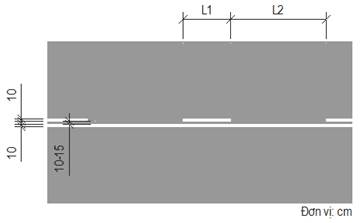
Figure G.13 - Marking 2.4
Design: Consists of marking 2.1 and marking 2.2 combined.
G1.3. Road markings limiting roadway
a. Marking 3.1: Road markings limiting roadway of separating motorized vehicle lanes and non-motorized vehicle lanes
Interpretation: limits roadway or separates motorized vehicle lanes and non-motorized vehicle lanes and allows vehicles to operate on the line when necessary as long as vehicles yield to non-motorized vehicles.
Design:
- Where marking 3.1 (a,b) is used to limit roadway (sections of reinforced road shoulder with similar structure to road surface are considered roadway), the outermost edge of the marking shall be 15 to 30 cm away from the outermost edge of roadway in case of regular roads and define emergency lanes on roadway of expressway. Road markings limiting roadway shall only be implemented on expressway, roads where width of roadway is at least 7 m, and in other necessary cases.
- Where marking 3.1 (a,b) is used to separate motorized vehicle lanes and non-motorized vehicle lanes, signs or painted word “XE ĐẠP” (BICYCLE) or painted symbol of bicycles shall be present on non-motorized vehicle lanes.
- Non-motorized vehicle-only lanes shall only be implemented if density of non-motorized vehicles on roads with at least 2 lanes for motorized vehicles is significant or in other necessary cases as long as width of non-motorized vehicle-only lanes is at least 1,5 m. Where non-motorized vehicle-only lanes are not implemented, marking 2.1 or marking 2.1 combined with marking 2.2 can be implemented.
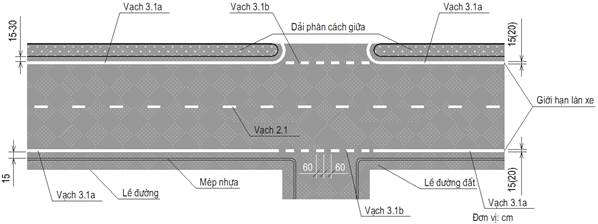
Figure
G.13a - Illustration of marking 3.1 limiting roadway 
Figure G.13b - Illustration of marking 3.1 separating motorized vehicle lanes and non-motorized vehicle lanes
Design: Marking 3.1a is a single solid line with b = 15 cm - 20 cm. Marking 3.1b is a single broken line with b = (15 cm - 20 cm); L1 = 0,6 m; L2 = 0,6 m; ratio of L1/L2 = 1:1.
b. Other markings defining roadway
- Marking 3.2 and marking 3.3: separate conventional lanes from acceleration/deceleration lanes, conventional lanes from supplementary lanes or act as separating, channelizing markings in merging and exit areas.
Marking 3.2: Is a solid white line with b = 45 cm in case of expressway and b = 30 cm in case of other roads. Vehicles are not allowed to cross over marking 3.2 except for emergencies under the Law on Road Traffic.
Marking 3.3: Is a broken white line with b = 45 cm in case of expressway and 30 cm in case of other roads; L1 = (100 cm - 300 cm); L2 = (100 cm = 300 cm); ratio of L1:L2 = 1:1. Vehicles are allowed to cross over the marking. In addition, marking 3.3 is also used as transition from marking 2.1 to marking 3.2. Length of the transition segment is between 50 m and 100 m.
- Marking 3.4: informs about marking 1.2 or marking 2.2 ahead; or serves as transition from marking 1.1 to marking 1.2; or serves as transition from marking 2.1 to marking 2.2. Width of marking 3.4 shall correspond to width of marking 1.2 or marking 2.2.
Marking 3.4: Is a broken white line with L1 = (3 m - 6 m); L2 = (1 m - 2 m); ratio of L1:L2 = 3:1. Length of marking 3.4 shall be between 50 m and 100 m.
c. Road markings in merging and exit areas
General principles:
- Chevron markings can be implemented on road surface contained by projections of sides of traffic islands at merging and exit areas.
- Each chevron marking (marking 4.2) shall be parallel to one another, approximately 45 cm in width, 100 cm away from one another, be oriented in a way that its tails point in the direction of travel and create a 45o angle with the direction of travel.
- Markings defining area of chevron markings shall be solid white line with b = 20 cm (marking 3.1).
- Markings separating conventional lanes from acceleration/deceleration lanes or serving to separate, channelize lanes in merging and exit areas can be solid white line with b = 45 cm (marking 3.2) or broken white line with b = 45 cm, L1 = 300 cm, L2 = 300 cm (marking 3.3).
- Vehicles shall not cross over the chevrons except for emergencies under the Law on Road Traffic.
Examples of common arrangements of road markings in merging and exit areas are provided below:
- Road markings for tapered exit area:
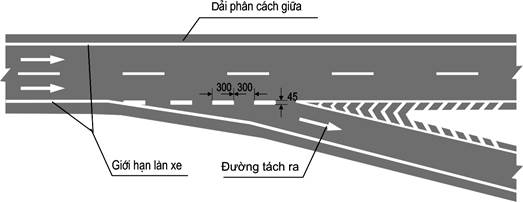
Figure G.14 - Road markings for tapered exit area
- Road markings for parallel exit area:
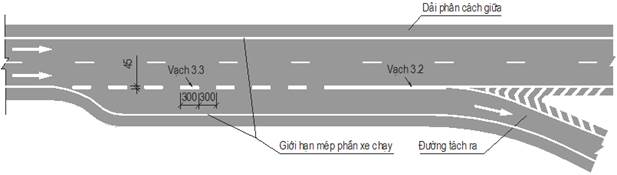
Figure G.15 - Road markings for parallel exit area
- Road markings for tapered merging area:
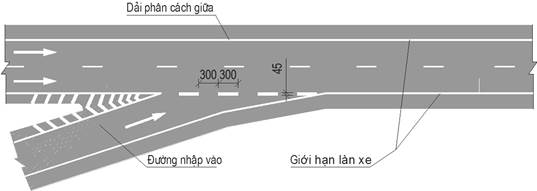
Figure G.16 - Road markings for tapered merging area
- Road markings for parallel merging area:
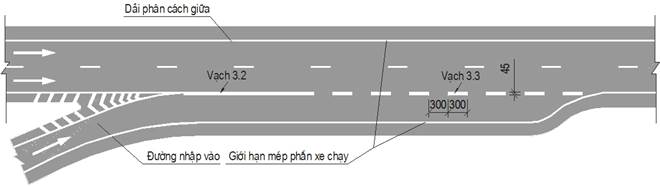
Unit: cm
Figure G.17 - Road markings for parallel merging area
d. Road markings on lanes with lay-bys for parking
Marking 2.2 or marking 3.3 shall be implemented to separate primary lanes and lay-bys. Marking 5.1 can be implemented to create channelizing markings depending on road surface width. See Figure G.18 and Figure G.19 for details.
Unit: cm
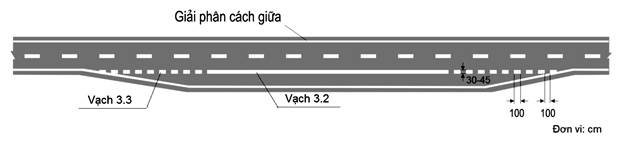
Figure G.18 - Road markings at lay-bys without channelizing markings
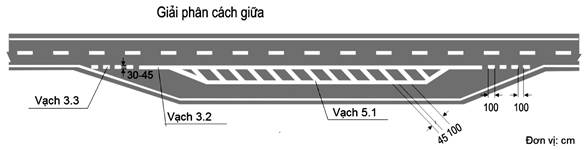
Figure G.19 - Road markings at lay-bys with marking 5.1
e. Road markings for lane reduction
Where width of roadway changes or number of lanes changes, road markings (and signs if necessary) shall be implemented to warn road users about the changes.
Illustrations of road markings for lane reduction are provided below:
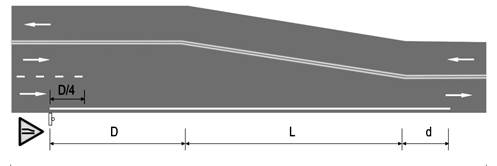
Figure G.20 - Road markings for transition between three lanes and two lanes
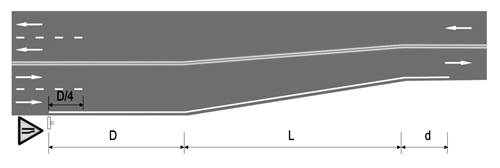
Figure G.21 - Road markings for transition between four lanes and two lanes
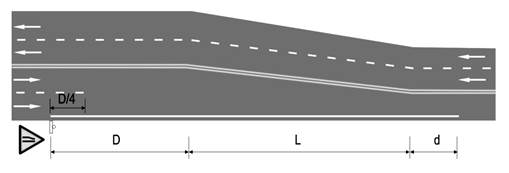
Figure G.22 - Road markings for transition between four lanes and three lanes
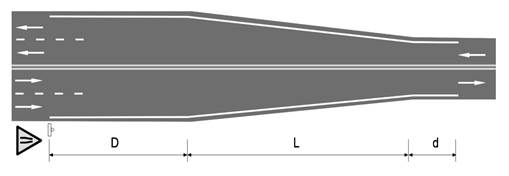
Figure G.23 - Road markings for transition between four lanes and two lanes
Note:
- Regulations on road markings under this section only apply to roadway section that is changed. Combined length of D, L, and d sections according to Figure G.20, Figure G.21, Figure G.22, and Figure G.23 shall be deemed the length of the road in which width of roadway changes.
- Within the area in which width of roadway changes, marking 1.3 shall be implemented to divide directions of travel. Within the direction of travel on which width of roadway changes, road markings limiting roadway (marking 3.1) shall be implemented in combination with sign No. W.203 (b,c).
-
The length
of road sections over which road surface width L(m) changes shall be determined
as follows:
155
V2W
L =
(where V £ 60 km/h) (1)
or L = 0.625V.W (where V > 60 km/h) (2)
In which, V: Maximum speed limit or V85, km/h; W: Reduction in width, m; D: Safety stopping distance, m.
- The extension of marking at the end of sections reduced in width (d) shall be: 40 m on roads with maximum speed limit or V85 > 60 km/h or 20 m on other roads.
INTERPRETATION - USE OF ROAD MARKINGS
g. Placement of road markings warning about obstacles ahead
Where obstacles are present on the road, road markings (in combination with signs when necessary) shall be implemented to warn road users.
- In case of two-lane roads accommodating two directions of travel, where obstacles are located in the middle of the road, road markings as depicted under Figure G.24 can be implemented.
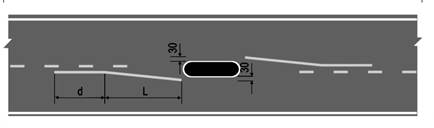
Figure G.24 - Road markings for two-lane road with two directions of travel and obstacles in the middle of the road
Note: d and L shall be determined in accordance with G1.3e: road markings in roadway sections that are changed.
Central markings can be marking 1.1 or marking 1.2.
Width and color of solid line on Figure G.20 shall be similar to those of central markings.
- Where obstacles are located in the middle of roads with at least 4 lanes, road markings compliant with Figure G.25 can be implemented.
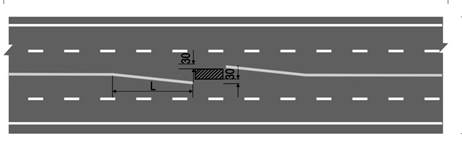
Figure G.25 - Road markings on road with at least 4 lanes and obstacles in the middle of the road
Note: d and L shall be determined in accordance with Point e section G.1.3.
Within the area limited by sections d and L, double solid lines of design and color similar those of marking 1.3 shall be implemented. Beyond this area, central road markings applicable to roads with at least 4 lanes shall be implemented.
- Where obstacles are located in the middle of two lanes traveling in the same direction, markings compliant with Figure G.26 can be implemented.
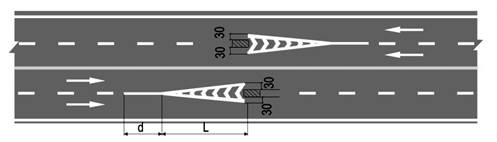
Figure G.26 - Road markings on road with obstacles in the middle of two lanes traveling in the same direction
Note: d and L shall be determined in accordance with G1.3e: road markings in roadway sections that are changed.
Within the area of section d, single white solid lines of a width equal to marking 2.1 shall be implemented. Within the area of section L, chevron marking (marking 4.2) shall be implemented. Road markings defining chevron marking area shall be single solid white lines of which width equals road markings dividing directions of travel (marking 2.1).
G1.4. Channelizing markings
a. Marking 4.1: Diagonal channelizing markings
Interpretation: Diagonal channelizing markings define area of road surface on which vehicles are not allowed and channelize traffic on the road. Where marking 4.1 is implemented, vehicles shall adhere to the stipulated route and shall not cross onto the markings except for emergencies in accordance with the Law on Road Traffic.
Marking design:
Marking 4.1 consists of solid white lines parallel to each other, 45 cm wide each, 100 cm away from each other, creating a 135o angle with the direction of travel. Road markings limiting area of diagonal channelizing markings shall be single solid white lines. These markings shall have b = 20 cm. Figure G.27 illustrates arrangement of diagonal channelizing markings.
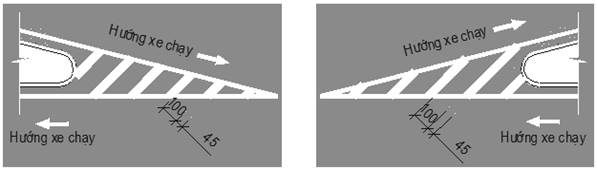
Unit: cm
Figure G.27 - Marking 4.1
b. Marking 4.2: Chevron channelizing markings
Interpretation: Chevron channelizing markings define area of road surface on which vehicles are not allowed and channelize traffic on the road. Where marking 4.2 is implemented, vehicles shall adhere to the stipulated route and shall not cross onto the markings except for emergencies in accordance with the Law on Road Traffic.
Marking design:
Marking 4.2 consists of solid white lines parallel to each other, 45 cm wide each, 100 cm away from each other, creating a 135o angle with the direction of travel. Road markings limiting area of chevron channelizing markings shall be single solid white lines. These markings shall have b = 20 cm. Figure G.28 illustrates arrangement of chevron channelizing markings.
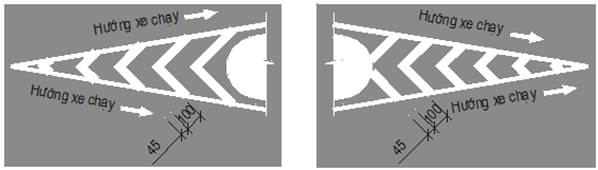
Unit: cm
Figure G.28 - Illustration of arrangement of chevron channelizing markings
c. Use of marking 4.1 and 4.2 for channelizing
- Marking 4.1 and 4.2 shall be implemented to provide directions at toll plaza:
Marking 4.1 or marking 4.2 can be used in combination with single solid white lines of 20 cm in width to guide vehicles to entrance of toll plaza. See Figure G.29 for detail arrangement.
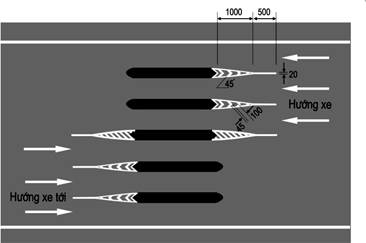
Unit: cm
Figure G.29 - Guiding markings at toll plaza
- Marking 4.1 and 4.2 shall be implemented to channelize traffic flows at at-grade junctions:
Examples regarding the use of marking 4.1 and 4.2 to channelize traffic flows at at-grade junctions are provided below.
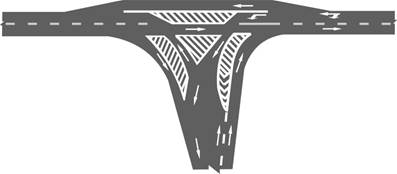
Figure G.30 - Arrangement of channelizing markings at complicated T-junction - Example 1
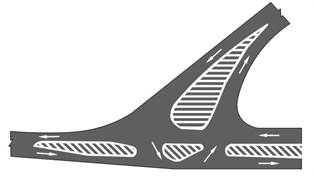
Figure G.31 - Arrangement of channelizing markings at complicated T-junction - Example 2
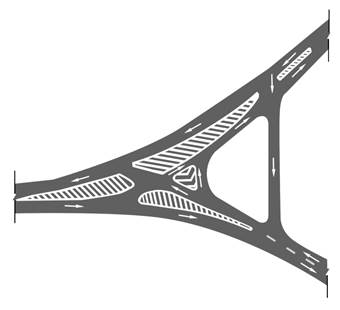
Figure G.32 - Arrangement of channelizing markings at complicated T-junction - Example 3
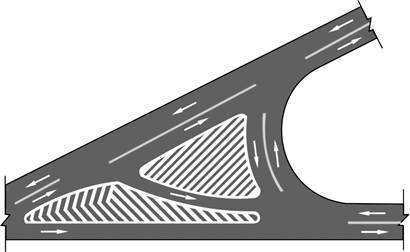
Figure G.33 - Arrangement of channelizing markings at complicated T-junction - Example 4
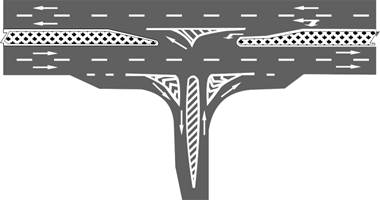
Figure G.34 - Arrangement of channelizing markings at complicated T-junction - Example 5
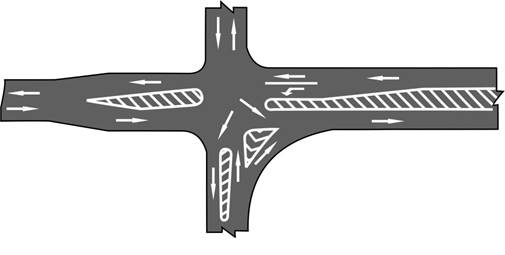
Figure G.35 - Arrangement of channelizing markings at complicated four-way junction
d. Marking 4.3: Roundabout channelizing markings
Interpretation: Roundabout channelizing markings are implemented at the center of at-grade four-way junctions to require vehicles to move around the markings in counterclockwise direction.
Where marking 4.3 is implemented, vehicles shall not cross onto the markings except for emergencies in accordance with the Law on Road Traffic.
Illustration:
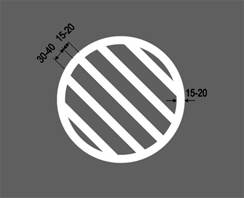
Figure G.36 - Roundabout markings - Example 1
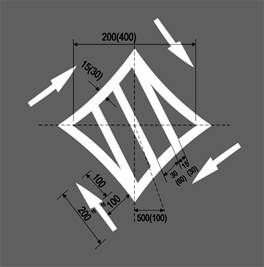
Figure G.37 - Roundabout markings - Example 2
Marking design:
Diameter and shape of roundabout markings shall be determined by dimensions of the junctions. Roundabout markings shall be white in color and of shape and dimensions illustrated on Figure G.36 and G.37 in details.
e. Marking 4.4: Box markings
Interpretation: Box markings inform road users that they are not allowed to stop on road sections where the box markings are located.
- Box markings can be implemented at appropriate locations depending on necessity. Box markings define no-stopping areas at at-grade junctions, entrances and exits of junctions, and sections of the road where stopping is not allowed. Marking 4.4 shall be arranged in accordance with illustrations below depending on dimensions of the junctions.
Illustration:
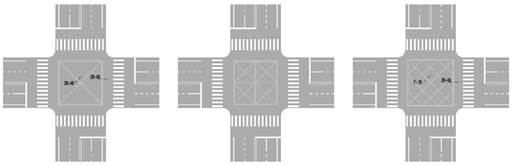
Figure G.38 - Illustrations of box markings at four-way junctions

Figure G.39 - Illustrations of box markings at three-way junctions
Marking design:
- Simplified box markings: consist of a yellow cross in a rectangle, has line width of 20 cm - 40 cm (see illustrations on Figure G.38 and G.39).
- Conventional box markings: consist of yellow lines contained by outer lines of 20 cm in width. Box markings shall create a 45o angle relative to the outer lines, have 10 cm in width, and 1 m - 5 m in length.
G1.5. Lanes marking extension through junctions
a. Marking 5.1: Left-turning lanes marking extension through junctions
Interpretation: guides vehicles turning left in a manner compliant with lane arrangement in the junctions. The marking improves guiding capability and allows vehicles to cross onto the marking when necessary. Marking 5.1 is an extension of central markings or markings dividing lanes traveling in the same direction. It is permissible to implement any of the two line extension methods above to guide vehicles turning left.
Marking 5.1 shall only be implemented if it conforms to traffic arrangement and does not confuse vehicles clearing the junctions.
Illustration:
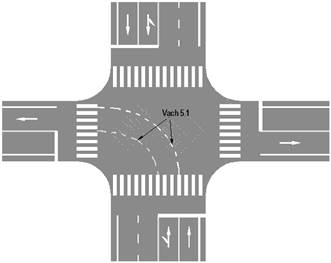
Figure G.40 - Illustration of arrangement of marking 5.1
Design: Marking 5.1 is single broken line of a color consistent with the markings that are extended (markings dividing directions of travel or markings dividing lanes travelling in the same direction). The marking shall has b = 15 cm, L1 = (0,5 m - 2 m), and L2 = (0,5 m - 2 m) where ratio of L1/L2 = 1:1.
b. Marking 5.2: Lanes marking extension through junctions
Interpretation: acts as offset lanes marking extensions at junctions to guide vehicles going straight. The marking improves guiding capability and allows vehicles to cross onto the marking when necessary.
Illustration:
Note:
direction of travel
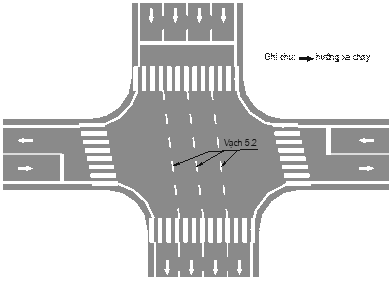
Figure G.41 - Illustration of arrangement of marking 5.2
Design: marking 5.2 is single white line with b = 15 cm, L1 = (0,5 m - 2 m); L2 = (0,5 m - 2 m), and ratio of L1/L2 = 1:1.
c. Marking 5.3: left-turning vehicles waiting areas
Interpretation: the marking creates a waiting area for vehicles that intend to make a left turn at a signalized junction and have cleared the stop line but have not cleared the junction within the time limit for left turning. Where a vehicle has clear the stop line but has not cleared the left-turning vehicles waiting area at a junction before the time limit for turning left expires, the vehicle must stop in the left-turning vehicles waiting area.
Illustration:
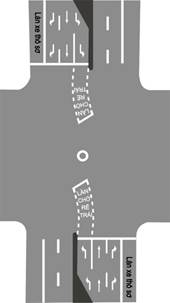
Figure G.42 - Illustration of arrangement of marking 5.3
Marking design:
Marking 5.3 consists of two single white broken lines that are parallel to one another, slightly curved to the left, and ended by stop line (marking 7.1). Each broken line shall has b = 15 cm, L1 = (0,5 m - 1 m), and L2 = (0,5 m - 1 m) where ratio of L1/L2 = 1:1.
d. Illustration of lanes marking at at-grade junctions
Figure G.43 illustrates a common arrangement of lane markings at at-grade junction.
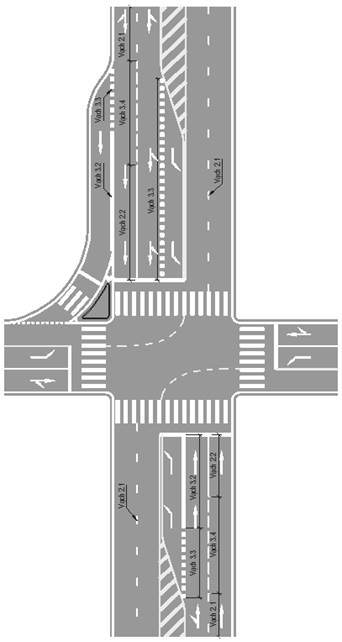
Figure G.43 - Illustration of lane delineation at at-grade junction
G1.6. No-parking markings
a. Marking 6.1: No-parking marking
Interpretation: prohibits roadside parking. Marking 6.1 shall be used as stand-alone signal or in combination with the word “Cấm đỗ xe” (No parking) on road surface and no-parking sign. Supplementary signs indicating time, area, and types of vehicle subject to parking restriction.
Illustration:
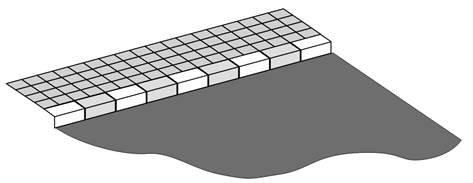
Figure G.44: No-parking marking
Marking design:
Marking 6.1 is a broken yellow line painted on the kerb where parking is restricted or on the road where parking is restricted in which case the marking is 30 cm away from the edge of the road if kerb is not available.
Where marking 6.1 is implemented on kerb, width of section to which yellow paint is applied shall equal the width of kerb or at least 15 cm. Yellow paint shall also be applied to vertical surface of the kerb that meets road surface. Where marking 6.1 is implemented on road surface, width of the marking shall be 15 cm. The length of each painted section (L1) is 100 cm or equals that of each kerb (if marking 6.1 is implemented on kerb), the length of unpainted section (L2) equals L1.
b. Marking 6.2: No-parking, no-stopping marking
Interpretation: prohibits roadside parking and stopping. Marking 6.2 shall be used as stand-alone signal or in combination with the word “Cấm dừng, đỗ xe” (No stopping, parking) on road surface and no-parking, no-stopping sign. Supplementary signs indicating time, area, and types of vehicle subject to parking and stopping restriction.
Illustration:
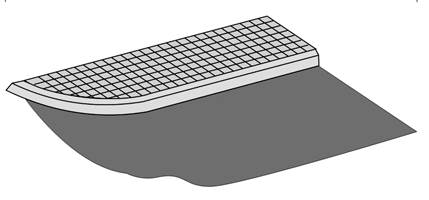
Figure G.45 - No-stopping or no-parking marking
Marking design:
Marking 6.2 is a broken yellow line painted on the kerb where parking or stopping is restricted or on the road where parking or stopping is restricted in which case the marking is 30 cm away from the edge of the road if kerb is not available.
Where marking 6.2 is implemented on kerb, width of section to which yellow paint is applied shall equal the width of kerb or at least 15 cm. Yellow paint shall also be applied to vertical surface of the kerb that meets road surface. Where marking 6.1 is implemented on road surface, width of the marking shall be 15 cm.
G.2. Transverse markings
G2.1. Stop line
Marking 7.1: Stop line
Interpretation: defines waiting area at signalized junctions. The marking defines an area at which vehicle operators shall stop at red light or where sign No. R.122 is installed. stop lines shall also be implemented to define areas at which vehicle operators must stop such as on roads leading to level crossing, on left-turning lanes waiting areas at junctions, and before pedestrian crossing markings.
Illustration:
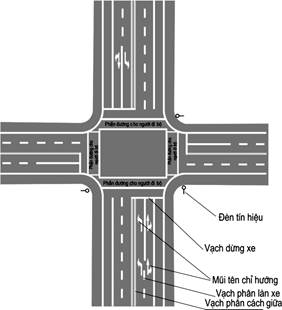
Figure G.46 - Arrangement of stop line at signalized junction
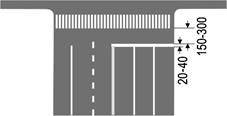
Unit: cm
Figure G.47 - Arrangement of stop line at pedestrian crossing markings
Marking design:
Marking 7.1 is a solid white line. Width of the line shall be 20 cm, 30 cm, or 40 cm depending on road grade, traffic density, and speed (as traffic density and speed of the road increases, width of the line also increases). These lines shall cover the entire width of the road.
Location of stop line shall allow vehicle operators to see with ease. Stop line at at-grade junctions shall overlap the extension of kerb of the intersecting road if pedestrian crossing markings are not present or be 1,5 m - 3 m away from pedestrian crossing markings if pedestrian crossing markings are present (see Figure G.47).
Stop line may be used in combination with the word “STOP”. The top of the word “STOP” shall be 2 m - 3 m away from stop line. Additional “STOP” can be implemented 25 m before the stop line. Details are depicted on Figure G.48.
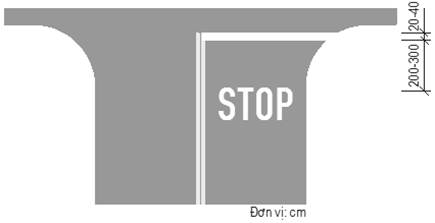
Figure G.48 - Stop line at non-signalized junction
G2.2. Yield line
Marking 7.2: Yield line
Interpretation: requires vehicles to slow down or stop when necessary to yield to vehicles or pedestrians from the other directions of travel. Marking 7.2 shall be used in combination with sign W.208.
Illustration:
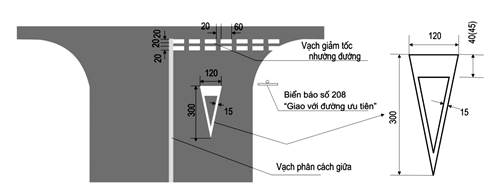
Unit: cm
Figure G.49 - Slow down and yield line - Sample 1
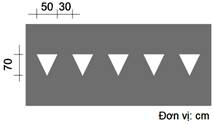
Figure G.50 - Slow down and yield line - Sample 2
Marking design:
Any of the two yield line samples below is available for use:
- Sample 1: Yield line consists of a double broken white line preceded by a white triangle. Yield line shall cover the entire width of roadway. See Figure G.49 for yield line dimensions.
- Sample 2: Yield line consists of isosceles triangles whose base points towards priority road, is 50 cm in width and which has perpendicular of 70 cm. Two adjacent triangles shall be 30 cm away from one another. See Figure G.50 for details.
Location of yield line shall allow vehicle operators to see with ease. Yield line at at-grade junctions shall overlap the extension of kerb of the intersecting road if pedestrian crossing markings are not present or be 1,5 m - 3 m away from pedestrian crossing markings if pedestrian crossing markings are present.
G2. 3. Pedestrian crossing markings
Marking 7.3: Pedestrian crossing markings
Interpretation: Pedestrian crossing markings define section of the road on which pedestrians can cross the road.
Pedestrian crossing markings shall be located where pedestrians may cross the road. Each set of pedestrian crossing markings on a road shall be more than 150 m away from each other. Minimum length of zebra crossing shall be 3 m and increased by incremental of 1 m depending on pedestrian volume.
Pedestrian
crossing markings shall not be implemented on irregular roads (road with
limited visibility, large vertical slope, large bend, small radius horizontal
curve, road with unexpected dangers, or road with tapered roadway). 
Illustration:
a. Perpendicular arrangement
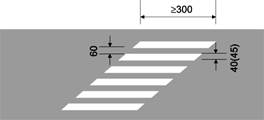
b. Diagonal arrangement
Unit: cm
Figure G.51 - Pedestrian crossing markings - Sample 1
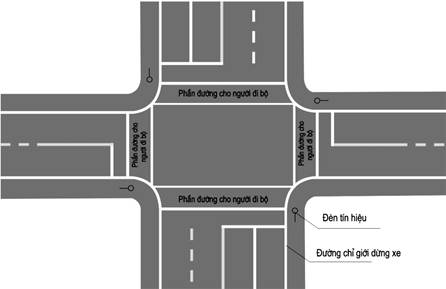
Figure G.52 - Pedestrian crossing markings - Sample 2
Marking design:
- Sample 1: Pedestrian crossing markings are parallel solid white lines (and are also referred to as zebra markings). See Figure G.51 for marking dimensions.
- Sample 2: Pedestrian crossing markings are two transverse parallel solid white lines with b = 40 cm (see Figure 52). Sample 2 shall only be implemented where traffic lights indicating time limit for pedestrian crossing are installed.
Stop line shall be implemented before pedestrian crossing markings. Vehicles shall stop at stop line during red lights or stop and observe before clearing stop line if sign No. R.122 is installed. Where traffic lights are not installed and sign No. R.122 is not present, vehicle operators shall yield to pedestrian crossing the road.
G2.4. Bicycle intersection crossing markings
Marking 7.4: Bicycle intersection crossing markings
Interpretation: Intersection crossing markings define section of the road on which pedestrians can cross the road. In respect of junctions without traffic enforcers and traffic signals, cyclists shall yield to motorized vehicles that cross bicycle lanes.
Illustration:
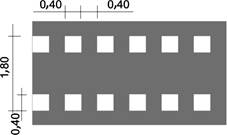
Unit: m
Figure G.53 - Bicycle intersection crossing markings
Marking design:
Two parallel broken lines each of which is 40 cm in width, 40 cm in line segment, and 40 cm in broken line segment. Outermost edges of the markings shall be 1,8 m from one another. The markings define area on which bicycles can clear junctions. In respect of non-signalized junctions, bicycles shall yield to other motorized vehicles on the road.
G2.5. Markings restricting non-motorized vehicles at junctions
Marking 7.5: Markings restricting non-motorized vehicles at junctions
Interpretation: Marking 7,5 informs operators of non-motorized vehicles about restricted areas at signalized junctions.
Illustration:

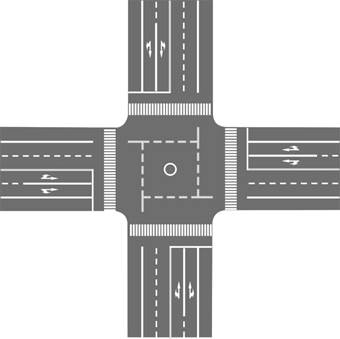
Unit: cm
Figure G.54 - Markings restricting non-motorized vehicles at junctions
Marking design:
Marking 7,5 consists of single broken yellow lines of 20 cm in width. Lanes on which non-motorized vehicles are restricted shall be delineators of non-motorized vehicle lanes. Extension of the line onto non-motorized vehicle lanes shall be depicted by solid yellow lines of the same width as the broken line segment which is 20 cm.
G2.6. Pedestrian crossing ahead markings
Marking 7.6: Pedestrian crossing ahead markings
Interpretation: Marking 7.6 informs road users about pedestrian crossings ahead; especially pedestrian crossing markings in the middle of roads connecting two junctions in order to request vehicle operators to yield to pedestrians crossing the road.
Illustration:
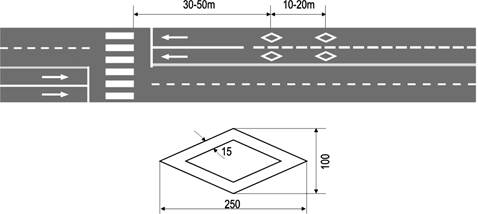
Unit: cm
Figure G.55: Pedestrian crossing ahead markings
Marking design:
The markings shall be in form of white parallelograms. See Figure G.56 for marking dimensions.
G2.7. Railroad crossing ahead markings
Marking 7.7: Railroad crossing ahead markings
Interpretation: Marking 7.7 informs road users about railroad crossing ahead. This markings shall be implemented at railway crossings not stationed by railway crossing guards.
Illustration:
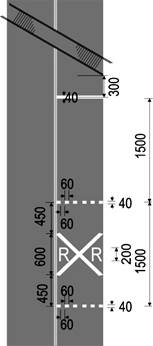
Unit: cm
Figure G.56 - Railroad crossing ahead marking
Marking design:
- The letter “R” is painted with white reflective paint on the left and the right of the “X”.
- The “X” is 450 cm away from broken lines in front and behind it, 40 cm in line width, and covers the entire width of roadway and 600 cm in road length.
- Transverse broken lines are applied using white reflective paint, 40 cm in line width, 60 cm in length in respect of line segment, and 60 cm away from the “X”.
- The marking shall be installed in combination with yield line and stop line. Distance from the nearest rail to stop line shall be 300 cm. See Figure G.56 for details.
G2.8. Safe stopping distance marking
Section 7.8: Safe stopping distance marking.
Interpretation: Marking 7.8 defines distance on the road which vehicle operators must keep to maintain safety distance from vehicles ahead. The marking is usually implemented on expressways where accidents causing by overtaking or rear-end collision usually occur or where special requirements are imposed. This type of markings shall be accompanied by sign indicating distance between the markings.
Illustration:
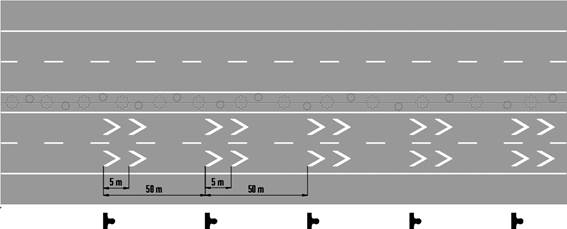
Unit: m
Figure G.57 - Arrangement of safe stopping distance marking
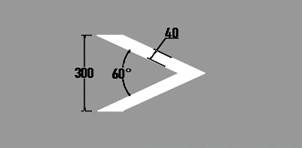
Unit: cm
Figure G.58 - Details of safe stopping distance marking
Marking design:
The marking consists of solid white arrows pointing at a direction parallel to centerline of the road. See Figure G.58 for marking dimensions.
Safe stopping distance markings should be used in combination with signs, shall be installed in groups every 50 m in length (2 markings/lane, each marking 5 m away from one another) and throughout 200 m in length of the road (5 groups of markings/lane)
G2.9. Speed hump markings
General provisions on speed hump markings
Speed hump markings inform vehicle operators to slow down and are designed to force vehicle operators to slow down.
Speed hump markings shall be located before and on roads where vehicle operators must slow down to maintain safety such as at the entrance to toll plaza; roads leading to at-grade junctions, roads leading to horizontal curves with small radius; and where vehicle operators must slow down.
Speed hump markings shall be yellow in color, implemented in form of groups (consisting of multiple single lines) before and on roads where vehicle operators must slow down or in form of single lines throughout the length of roads on which vehicle operators must slow down.
G3. Vertical markings
a. Marking 8.1: Vertical markings on permanent fixtures
Interpretation: marking 8.1 informs road users about obstacles protruding from road surface to prevent collision. Marking 8.1 shall be implemented on vertical surface of obstacles that may damage vehicles such as: piers of overpass, front sides of walls of overpass or underpass or tunnel entrance, dividers, traffic islands on pedestrian crossing, etc.
Illustration:
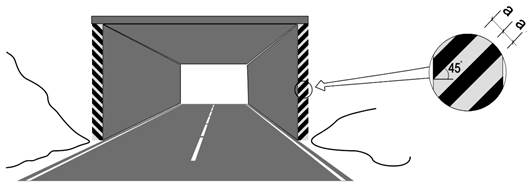
Figure G.63 - Illustration of vertical markings on permanent fixtures
Marking design:
Marking 8.1 consists of alternating yellow, black or red, white lines which create a 45o angle with horizontal plane, point downwards towards roadway, are 15 cm in width, and are 15 cm from each other.
Yellow and black lines are commonly used on roads outside of cities; red and white lines are commonly used on roads in cities. The marking can be chevron lines (see example in Figure G.63 below) when necessary. Details of marking 8.1 are depicted on Figure 62.


Legend:
- H < 2m; b ≤ 30cm then a = 10cm
- H < 2m; b > 30cm then a = 15cm
- H ≥ 2m; b > 30cm then a = 20cm
Figure G.62 - Vertical markings on permanent fixtures
Marking 8.1 at channelizing islands at toll plazas:
- Marking 8.1 shall be implemented on the surface of channelizing islands at entrance to toll plazas to improve guidance.
- The marking consists of alternating yellow and black lines, each of which is 15 cm in width, creates a 45o angle with horizontal plane and is implemented evenly towards both sides of the dividers starting from the end of dividers that faces oncoming traffic. Marking design is depicted under Figure G.63 and Figure G.64.


Figure G.63 - Marking 8.1 at channelizing island at toll plaza - Sample 1


Figure G.64 - Marking 8.1 at channelizing island at toll plaza - Sample 2
b. Marking 8.2: lowest point of overpass or other overhead structures
Interpretation: Marking 8.2 warns road users about the lowest point of overpasses or other similar structures.
Illustration:
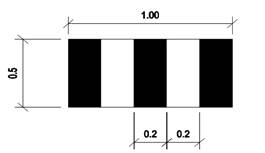
Unit: m
Figure G.65 - Details of marking 8.2
Marking design:
Marking 8.2 consists of vertical alternating red - white lines each of which is 20 cm in width, 50 cm in height and covers a total width of 1 m.
c. Marking 8.3: Markings on poles located on traffic islands, dividers, and similar structures
Horizontal parallel alternating white - red lines each of which has equal width which equals width (B) of structures and are implemented on poles located on traffic islands, dividers, or similar locations:
- Where B £ 30cm then a = 10cm.
- Where B > 30cm then a = 15cm.
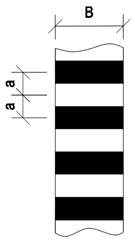
Figure G.66 - Details of marking 8.3
d. Marking 8.4: markings on traffic light posts, barrier posts, marker posts
Diagonal red lines, each of which is 15 cm in width, create a 30o angle with horizontal plane. The middle point of the highest line shall be 15 cm away from the top of the post. The lines shall point downwards towards the road. The lines shall be implemented on traffic light posts, barrier posts, marker posts.
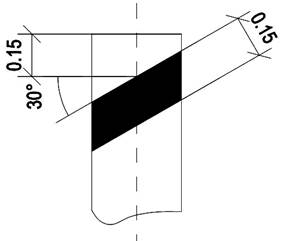
Unit: m
Figure G.67 - Details of marking 8.4
e. Marking 8.5: markings on the topmost bars of barriers on curves with small radius, roads that are higher than surrounding area, descent, and other dangerous areas.
Alternating red - white lines cover the entire width of structures. Each red line is 1 m in length, each white line is 2 m in length.
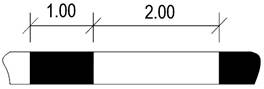
Unit: m
Figure G.68 - Details of marking 8.5
f. Marking 8.6: Markings on the topmost bar of barriers in dangerous location
Continuous red line of 10 cm in width in the middle of the topmost bar.
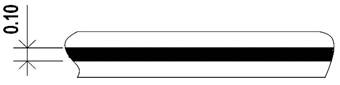
Unit: m
Figure G.69 - Details of marking 8.6
g. Marking 8.7: Markings on kerbs of dangerous locations or kerbs of traffic islands
Alternating red - white lines on vertical and horizontal surfaces with L1 being the length of the red line and L2 being the length of the white line. In normal situations: L1 = 1 m - 2 m; L2 = 2 m - 4 m with L1:L2 ratio = 1:2 (see Figure G.70); in respect of kerbs curved wit ha small radius, L1 = 0,5 m - 2 m; L2 = 0,5 m - 2 m, and L1:L2 ratio = 1:1.
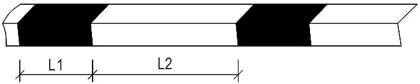
Figure G.70 - Details of marking 8.7
G4. Other road markings
a. Marking 9.1: no u-turn markings
Interpretation: marking 9.1 is implemented at junctions or opening on central dividers where u-turn is prohibited.
Illustration:
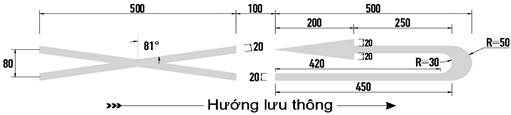
Unit: cm
Figure G.71 - No u-turn marking
Marking design:
Yellow lines of shape and dimensions compliant with Figure G.71.
b. Marking 9.2: Markings defining roadside parking areas for public transport
Interpretation: Marking 9.2 defines parking areas for public transport such as buses, taxis, etc. Other vehicles and pedestrians are not allowed to stop or park in the area defined by the markings and within 15 m radius before and after the markings in direction of travel.
Illustration:
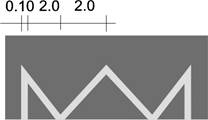
Unit: m
Figure G.72 - Details of marking 9.2
Marking design:
Marking 9.2 is a solid yellow line with b = 10 cm. The marking consists of a series of M-shaped lines. The height of the letter M is 2 m; projection of each diagonal line equals 2 m.
c. Marking 9.3: Directional arrow markings
Interpretation: Arrow markings provide directions. Arrow markings are primarily used at junctions with lane merging and exit and on multi-lane roads. Arrow markings may also be implemented on one-way roadway.
Marking design:
- Arrow markings shall be white in color.
- Dimensions of arrow markings shall be increased proportionally to traffic speed. Dimensions of arrow markings on Figure G.73 apply to roads with low traffic speed. Dimensions of arrow markings outside of brackets on Figure G.74 apply to roads with high traffic speed. Dimensions of arrow markings in brackets on Figure G.74 apply to expressways and roads with design speed ≥ 100 km/h.
Unit: cm
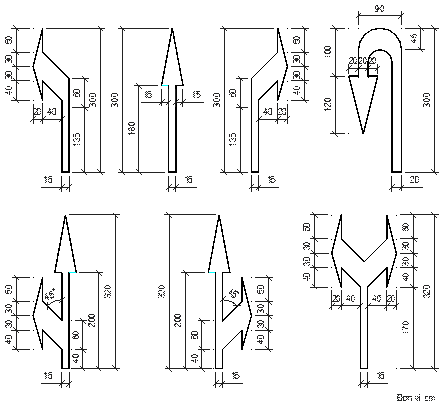
Figure G.73 - Dimensions of arrow markings on roads with low traffic speed
Unit: cm
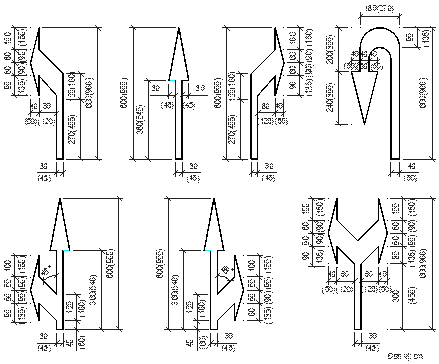
Figure G.74 - Dimensions of arrow markings on roads with high traffic speed
d. Marking 9.4: Lane reduction ahead marking
Interpretation: informs vehicle operators about lane reduction and that vehicle operators must change lane in the direction provided by the arrow markings.
Illustration:
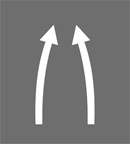
Figure G.75 - Lane-reduction ahead marking
Design: White arrow markings. Dimensions of marking in normal situations are compliant with Figure G.75. In case of roads with low traffic speed, marking dimensions can be reduced by 0,5 times the dimensions specified on Figure G.76; in case of roads with high traffic speed, marking dimensions can be increased by 1,5 times the dimensions specified on Figure G.76.
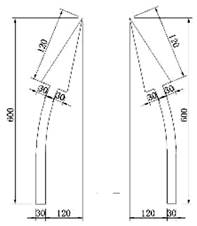
Unit: cm
Figure G.76 - Dimensions of lane-reduction ahead marking
e. Marking 9.5: Text, numeral, or color markings
Interpretation: used in combination with other signals to improve clarity.
General provisions: In respect of text or numeral markings, the texts and numerals shall be white in color, lettering height shall be 3 m for expressway, 2,5 m for other road types, 1,6 m for low-speed roads in cities; spacing between letters and numerals shall be 1 m - 1,5 m; lettering width shall be 12 cm - 18 cm.
Examples of text and numeral markings:
- Marking 9.5a: “STOP” marking

Figure G.77 - “STOP” marking
- Marking 9.5b: “Ô TÔ” (MOTOR VEHICLE) only lane marking

Figure G.78 - “Ô TÔ” (MOTOR VEHICLE) marking
- Marking 9.5 c: “XE MÁY” (MOTORBIKE) only lane marking

Figure G.79 - “XE MÁY” (MOTORBIKE) marking
- Marking 9.5d: “XE BUÝT” (BUS) only lane marking

Figure G.80 - “XE BUÝT” (BUS) marking
- Marking 9.5e: “XE ĐẠP” (BICYCLE) only lane marking

Figure G.81 - “XE ĐẠP” (BICYCLE) marking
f. Marking 9.6: Bicycle marking
Interpretation: defines bicycle-only lanes.
Illustration:
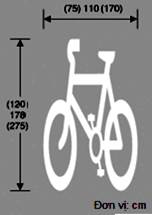
Figure G.82 - Bicycle-only lane marking
Design: The marking consists of a white illustration of bicycle according to Figure G.82. Illustration dimension shall be determined on the basis of width of bicycle-only lane. Possible dimensions of the illustration: 75 cm x 120 cm; 110 cm x 170 cm, và 170 cm x 275 cm.
g. Lane color: In some cases, lane color can be implemented.
MILESTONE KILOMETER MARKERS - H MARKERS - RIGHT-OF-WAY MARKERS
I.1 Regulations on shape, dimensions, and color of short milestone kilometer markers and post-mounted milestone kilometer markers
a) Short milestone kilometer markers
- Short milestone kilometer markers are rectangular in shape where the top section is curved to form a semicircle of 40 cm in diameter.
- Middle section of the markers (excluding the base and the top) shall be 53 cm in height, 40 cm in width, and 20 cm in depth. See Figure I.1
- Top section of the markers is red for national highways, blue for provincial roads, brown for district roads, and yellow for specialized roads. Middle section of the markers shall be white in color.
b) Post-mounted milestone kilometer markers
- Post-mounted milestone kilometer markers are rectangular in shape where the top section is curved to form a semicircle of 52 cm in diameter.
- Dimensions: compliant with Figure I.2.
- Top section of the markers is red for national highways, blue for provincial roads, brown for district roads, and yellow for specialized roads. Middle section of the markers shall be white in color.
I.2 Texts on short milestone kilometer markers and post-mounted milestone kilometer markers
Texts on both sides shall be perpendicular to the direction of travel and black in color. Contents and dimensions of texts:
- The semicircle head of the marker contains number or name of the road and kilometric point of the milestone kilometer marker. Height of number or name of the road is 4 cm. Height of the letter “K” is 8 cm, “m” is 5 cm, kilometric point value is 8 cm; texts and numerals are white in color.
- White surface of the marker contains name of administrative division in accordance with I.3. Height of texts is 12 cm, numerals and “K” is 10 cm, “m” is 6,25 cm.
- Surface parallel to the centerline of the road contains number or name of the road in black where height of texts and numerals is 10 cm.
I.3 Regulations on name of administrative division on short milestone kilometer markers and post-mounted milestone kilometer markers
a) Administrative divisions listed on the markers shall be the administrative divisions that the road leads to directly and not administrative divisions that side roads lead to.
b) Administrative divisions listed on the markers shall be those specified under 44.4 of Article 44 hereof.
c) Where a road goes through multiple provinces, markers on sections of the road that travel through each province shall contain name of administrative divisions of that province and provide direction to administrative centers of adjacent provinces or starting and end points of road section that leads to adjacent province.
d) Special cases:
- As national highway No. 1 is an important road that runs across Vietnam, milestone kilometer markers on national highway may additionally contain name of any 3 major cities on this route which are Hanoi, Hue, Ho Chi Minh City.
- Where new roads bypass administrative centers of provinces as a result of route improvement, milestone kilometer markers on the new roads shall also contain direction to the administrative centers of provinces.
e) Accurate correlation between distance, kilometric point, and name of administrative divisions on both sides of milestone kilometer markers relative to both directions of travel shall be respected:
- For example: the side of a milestone kilometer marker that faces starting point of QL1 contains kilometric point of Km131, name of Bac Ninh Province, and distance value of 10 km. On the other side of the milestone kilometer marker that faces the end point of QL1 contains kilometric point of Km131, name of Bac Ninh Province, and distance value of 10 km.
This milestone kilometer marker means Bac Ninh is at kilometric point Km141 (131 + 10 = 141), Bac Giang is at kilometric point Km121 (131 - 10 = 121). Bac Ninh is 20 km away from Bac Giang (141 - 121 = 20 or 10 + 10 = 20). Consequently, other milestone kilometer markers on QL1 that provide direction to Bac Ninh and/or Bac Giang shall be depicted in a way that kilometric point of Bac Ninh and Bac Giang respectively is Km141 and Km121.
g) Where name of an administrative division is too long, the first letters can be written as acronym. For example: “Phan Rang” can be written as “P.Rang”, “Buon Ma Thuot” can be written as “B.M.Thuot”.
I.4 Regulations on shape, dimensions, and color of rectangular kilometer signs
- Shape: rectangle signs mounted on posts.
- Dimension: rectangle sign is 350 mm in width, 700 mm or 1000 mm or 1300 mm in height depending on whether 1 or 2 or 3 kilometric points are depicted vertically. See figure I.3 for details.
- The sign has green background and white outline in case of expressway.
- The sign has blue background and white outline in case of other highways.
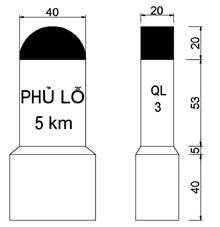
Note: All dimensions are in cm
Figure I.1 - Short milestone kilometer marker
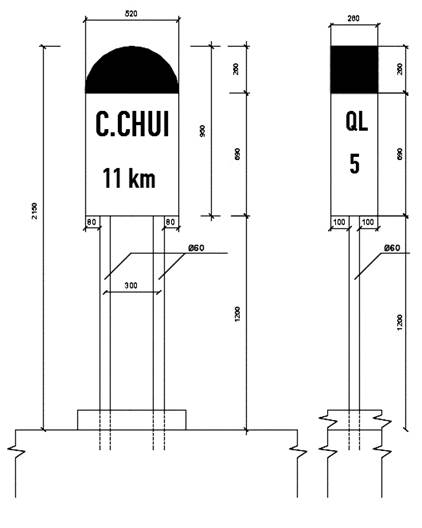
Note: All dimensions are in mm
Figure I.2 - Post-mounted milestone kilometer marker


|
a) One kilometric point |
b) Two kilometric points |
c) Three kilometric points |
Note: Green background applies to expressway and blue background applies to other highways
Figure I.3 - Rectangular kilometer sign
Schedule on dimensions on Figure I.3
Unit: mm
|
Symbol |
A |
B |
C |
D |
E |
F |
G |
H |
J |
|
Dimensions (mm) |
300 |
600 |
12 |
90 |
100 |
70 |
250 |
90 |
40 |
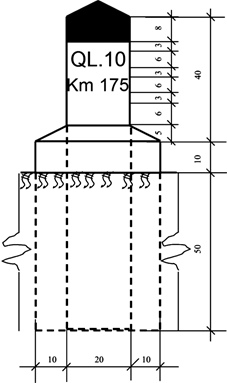
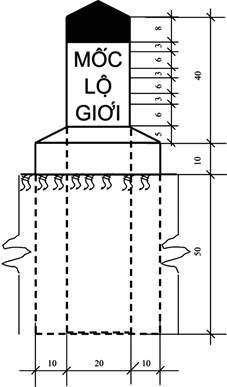
Note: All dimensions are in cm
a) Main surface (directed towards the road) b) Side surface (directed towards direction of travel)
Figure I.4 - Right-of-way marker
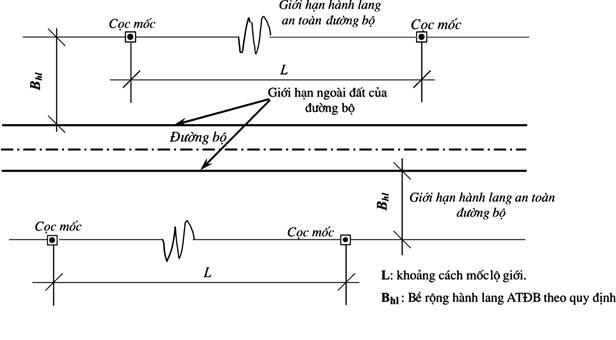
Figure I.5 - Layout of right-of-way marker installation
QCVN 41 : 2019/BGTVT
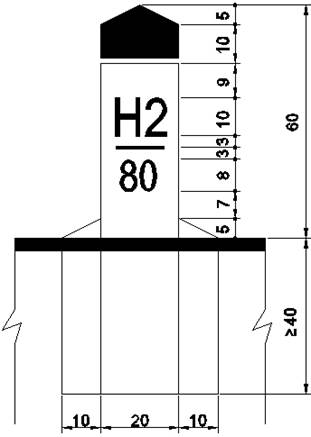
Note: All dimensions are in cm
Figure I.6 - Details of H marker
QCVN 41 : 2019/BGTVT
DIMENSIONS OF TEXTS AND NUMERALS ON SIGNS
K.1 Normal font (gt2)
Technical specifications of normal font (gt2)
Unit: mm - Lettering height 100 mm
|
All capitals |
|
Small capitals |
||||||
|
|
Left margin |
Middle |
Right margin |
|
|
Left margin |
Middle |
Right margin |
|
A |
0,27 |
85,86 |
1,44 |
|
a |
4,80 |
56,01 |
6,73 |
|
Ă |
0,27 |
85,86 |
1,44 |
|
ă |
4,80 |
56,01 |
6,73 |
|
 |
0,27 |
85,86 |
1,44 |
|
â |
4,80 |
56,01 |
6,73 |
|
B |
10,02 |
70,49 |
5,22 |
|
b |
8,79 |
57,24 |
6,86 |
|
C |
6,73 |
71,38 |
0,00 |
|
c |
3,36 |
58,27 |
0,75 |
|
D |
10,02 |
71,31 |
7,21 |
|
d |
8,79 |
57,24 |
6,86 |
|
Đ |
2,06 |
79,20 |
7,28 |
|
đ |
8,79 |
63,97 |
0,14 |
|
E |
10,02 |
64,52 |
3,57 |
|
e |
5,01 |
58,96 |
5,97 |
|
Ê |
10,02 |
64,52 |
3,57 |
|
ê |
5,01 |
58,96 |
5,97 |
|
F |
10,02 |
64,52 |
0,89 |
|
f |
2,47 |
37,95 |
0,00 |
|
G |
6,73 |
71,79 |
7,21 |
|
g |
6,31 |
57,17 |
9,40 |
|
H |
10,02 |
70,49 |
10.57 |
|
h |
8,79 |
57,24 |
9,40 |
|
I |
9,81 |
16,54 |
9,88 |
|
i |
8,99 |
15,58 |
9,13 |
|
J |
0,34 |
58,68 |
8,58 |
|
j |
0,00 |
27,32 |
8,92 |
|
K |
10,09 |
78,45 |
0,00 |
|
k |
8,85 |
62,87 |
1,17 |
|
L |
10,02 |
64,52 |
3,57 |
|
l |
8,65 |
25,60 |
1,99 |
|
M |
10,09 |
85,66 |
10,78 |
|
m |
9,88 |
98,83 |
10,98 |
|
N |
10,02 |
75,50 |
10,57 |
|
n |
8,79 |
57,24 |
9,40 |
|
O |
6,73 |
71,79 |
7,21 |
|
o |
5,35 |
58,96 |
5,97 |
|
Ô |
6,73 |
71,79 |
7,21 |
|
ô |
5,35 |
58,96 |
5,97 |
|
Ơ |
6,73 |
78,45 |
0,55 |
|
ơ |
5,35 |
68,15 |
0,00 |
|
P |
10,02 |
70,08 |
3,23 |
|
p |
8,79 |
57,24 |
6,86 |
|
Q |
3,98 |
81,33 |
0,41 |
|
q |
6,31 |
57,17 |
9,40 |
|
R |
10,02 |
73,78 |
1,92 |
|
r |
6,11 |
48,52 |
0,00 |
|
S |
1,37 |
73,78 |
5,49 |
|
s |
0,69 |
61,43 |
5,35 |
|
T |
0,00 |
70,42 |
0,00 |
|
t |
2,40 |
32,81 |
3,84 |
|
U |
8,24 |
71,59 |
8,72 |
|
u |
8,79 |
57,24 |
9,40 |
|
Ư |
4,80 |
87,92 |
0,00 |
|
ư |
6,04 |
74,33 |
0,00 |
|
V |
0,00 |
78,31 |
0,00 |
|
v |
0,00 |
64,31 |
0,00 |
|
W |
1,17 |
113,86 |
1,85 |
|
w |
0,14 |
100,27 |
1,03 |
|
X |
0,00 |
78,72 |
0,00 |
|
x |
0,89 |
65,13 |
1,44 |
|
Y |
0,00 |
75,09 |
0,00 |
|
y |
0,00 |
64,58 |
0,00 |
|
Z |
3,98 |
64,58 |
4,32 |
|
z |
4,19 |
53,53 |
4,67 |
Note: Sample texts and numerals are for reference for the purpose of designing information signs (grid size = 10 x 10 mm)
QCVN 41:2019/BGTVT


Figure K.1 - Detail dimensions of texts
QCVN 41:2019/BGTVT
K.1.1 All capitals and small capitals (gt2)

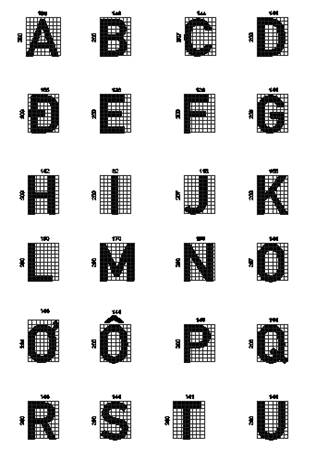
Note: unit of mm.
Figure K.2 - Details of texts and numerals in all capitals and small capitals (gt2)
QCVN 41:2019/BGTVT
K.1.2 Small capitals, normal font (gt2)
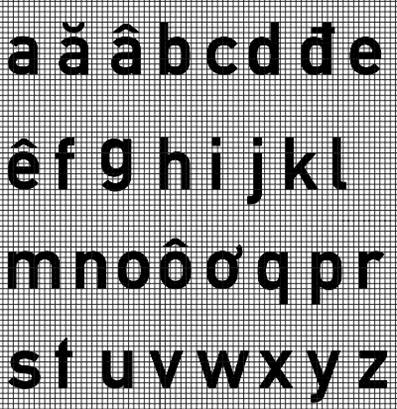
Figure K.3 - Details of texts and numerals in small capitals and normal font (gt2)
QCVN 41 : 2019/BGTVT
K.2 Compressed font (gt1)
Detail technical specifications of compressed font (gt1)
Unit: mm - Lettering height 100 mm
|
All capitals |
|
Small capitals |
||||||
|
|
Left margin |
Middle |
Right margin |
|
|
Left margin |
Middle |
Right margin |
|
A |
0,15 |
57,10 |
0,29 |
|
a |
5,05 |
42,90 |
6,15 |
|
Ă |
0,15 |
57,10 |
0,29 |
|
ă |
5,05 |
42,90 |
6,15 |
|
 |
0,15 |
57,10 |
0,29 |
|
â |
5,05 |
42,90 |
6,15 |
|
B |
7,76 |
46,19 |
6,44 |
|
b |
6,44 |
42,90 |
5,64 |
|
C |
6,88 |
46,19 |
4,61 |
|
c |
5,20 |
42,75 |
3,44 |
|
D |
7,76 |
46,19 |
6,73 |
|
d |
5,78 |
42,90 |
6,15 |
|
Đ |
0,59 |
54,90 |
5,20 |
|
đ |
5,78 |
49,05 |
0,00 |
|
E |
7,76 |
42,75 |
5,34 |
|
e |
5,05 |
42,90 |
4,90 |
|
Ê |
7,76 |
42,75 |
5,34 |
|
ê |
5,05 |
42,90 |
4,90 |
|
F |
7,76 |
42,61 |
4,76 |
|
f |
2,34 |
31,92 |
0,95 |
|
G |
6,73 |
47,95 |
6,44 |
|
g |
5,05 |
43,05 |
6,30 |
|
H |
7,76 |
46,49 |
7,76 |
|
h |
6,30 |
42,90 |
6,37 |
|
I |
7,76 |
14,13 |
7,91 |
|
i |
6,30 |
14,42 |
6,22 |
|
J |
0,73 |
43,05 |
5,20 |
|
j |
0,15 |
22,77 |
4,17 |
|
K |
8,05 |
53,22 |
2,12 |
|
k |
6,30 |
50,07 |
0,59 |
|
L |
7,91 |
42,61 |
3,00 |
|
l |
6,30 |
21,45 |
2,49 |
|
M |
7,76 |
64,20 |
7,76 |
|
m |
6,30 |
71,52 |
6,22 |
|
N |
7,76 |
49,93 |
7,76 |
|
n |
6,08 |
42,90 |
6,44 |
|
O |
6,73 |
48,10 |
6,73 |
|
o |
5,20 |
42,90 |
5,12 |
|
Ô |
6,73 |
48,10 |
6,73 |
|
ô |
5,20 |
42,90 |
5,12 |
|
Ơ |
6,00 |
55,42 |
0,15 |
|
ơ |
3,73 |
51,39 |
0,29 |
|
P |
7,76 |
46,34 |
2,42 |
|
p |
6,44 |
42,90 |
5,05 |
|
Q |
4,90 |
56,22 |
0,00 |
|
q |
5,64 |
42,90 |
6,30 |
|
R |
7,61 |
51,90 |
2,20 |
|
r |
6,30 |
33,02 |
2,64 |
|
S |
3,88 |
49,19 |
4,90 |
|
s |
3,29 |
42,90 |
3,22 |
|
T |
2,34 |
48,83 |
2,27 |
|
t |
0,73 |
30,31 |
4,32 |
|
U |
7,76 |
46,49 |
7,61 |
|
u |
6,44 |
42,90 |
6,22 |
|
Ư |
4,83 |
59,52 |
0,37 |
|
ư |
4,25 |
56,00 |
0,00 |
|
V |
0,88 |
53,51 |
0,88 |
|
v |
0,00 |
49,93 |
0,00 |
|
W |
0,88 |
78,55 |
0,88 |
|
w |
0,59 |
74,96 |
0,29 |
|
X |
1,32 |
55,34 |
0,88 |
|
x |
0,00 |
49,78 |
0,00 |
|
Y |
0,00 |
53,37 |
0,00 |
|
y |
0,00 |
49,93 |
0,00 |
|
Z |
4,76 |
42,90 |
4,03 |
|
z |
3,29 |
38,95 |
3,44 |
Note: Sample texts and numerals are for reference for the purpose of designing information signs (grid size = 10 x 10 mm)
QCVN 41:2019/BGTVT
K.2.1 All capitals, compressed font (gt1)

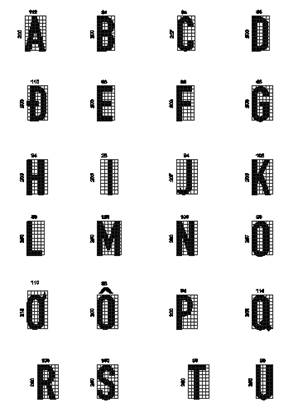
Note: unit of mm.
Figure K.4 - Details of texts and numerals in all capitals, compressed font (gt1)
QCVN 41:2019/BGTVT
K.2.2 Small capitals, compressed font (gt1)
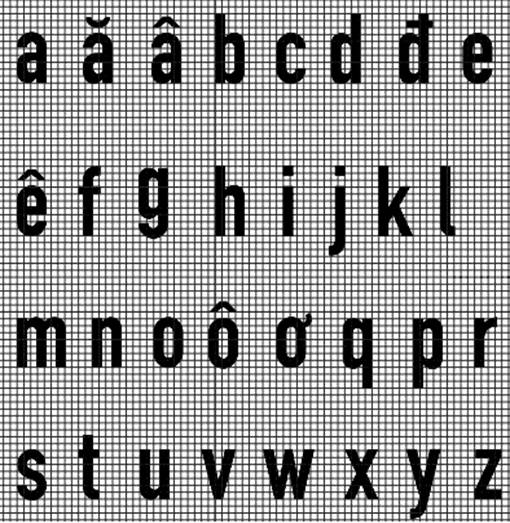
Figure K.5 - Details of small capitals, compressed font (gt1)